The du'as of the Prophets in the Quran, and when to make each one
Every Prophet's du'a the Quran keeps, from Adam to Muhammad ﷺ, in Arabic, transliteration and English, with the moment it was said, the answer Allah gave, and when to make it in your own life.
The Quran does not only tell us that the Prophets prayed. It keeps their words. Adam's first repentance, Musa's plea from the shade in Madyan, Yunus calling out from the dark, Zakariya asking for a child when his hair had turned white: each was preserved exactly as it was said, in a Book we recite in our own prayers. That is an invitation to make them our own. This guide gathers the du'as of the Prophets in the Quran, peace be upon them all, each in Arabic, in transliteration and in English, with the moment it was said, what Allah answered, and when it fits your own life.
In short
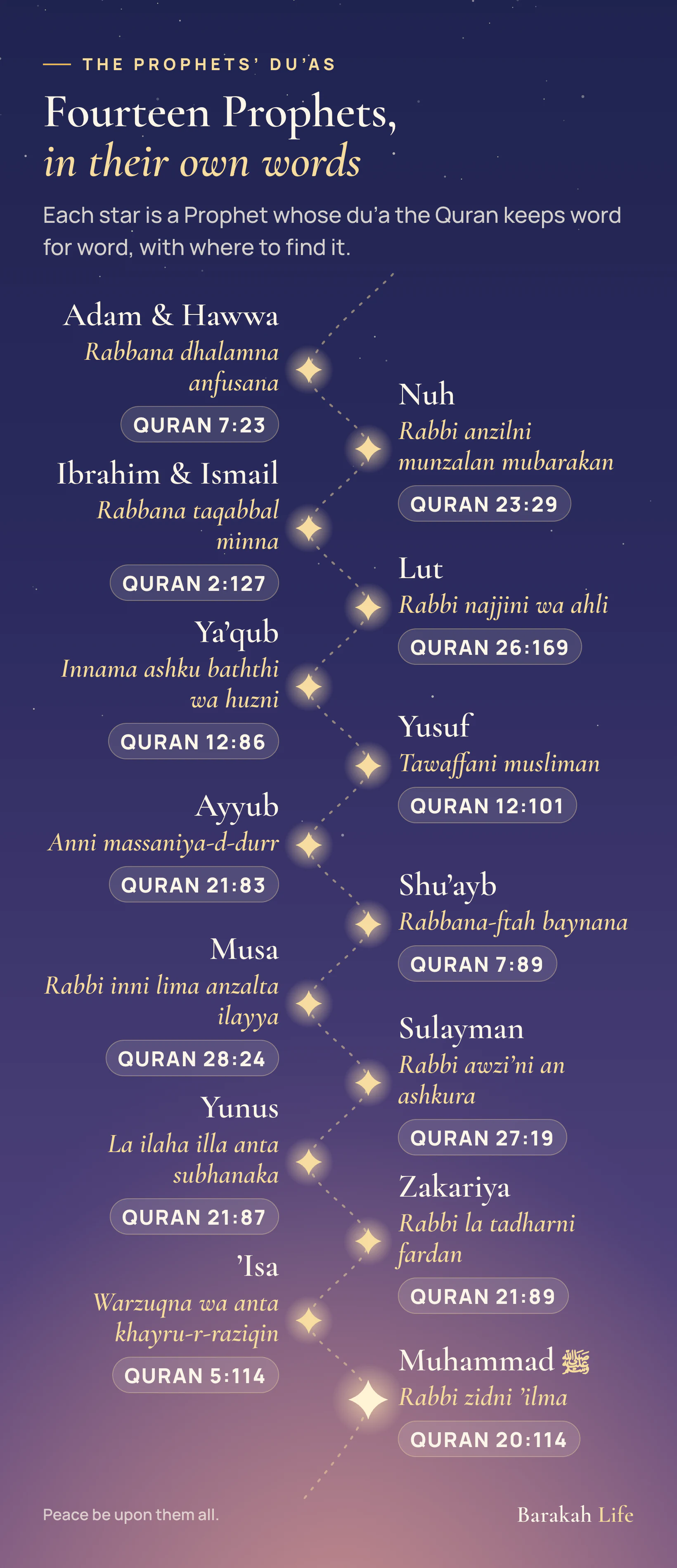
The Quran keeps the du'as of at least fourteen Prophets in their own words. The best known are Adam's du'a of repentance (7:23), Ibrahim's Rabbana taqabbal minna (2:127), Ayyub's du'a in illness (21:83), Yunus's du'a of distress La ilaha illa anta subhanaka inni kuntu mina-dh-dhalimin (21:87), Zakariya's du'a for a child (21:89), Musa's du'a for provision Rabbi inni lima anzalta ilayya min khayrin faqir (28:24), and Rabbi zidni 'ilma (20:114), taught to the Prophet Muhammad ﷺ. In many of these passages the very next verse is Allah's answer. Apart from a few the Sunnah ties to a moment, none has a fixed time or count: make each one when its need is yours, in Arabic or in your own words.
The Prophets knew Allah best, and their du'as show how a servant speaks to his Lord when he has done wrong, when he is afraid, ill or grateful. Allah's command to all of us is simple:
وَقَالَ رَبُّكُمُ ٱدْعُونِىٓ أَسْتَجِبْ لَكُمْ
Wa qala rabbukumu-d'uni astajib lakum.
And your Lord said: Call on Me, and I will answer you.
Quran 40:60 (part)
The Prophet ﷺ recited this verse after saying that du'a is itself worship (Sunan Abi Dawud 1479, Jami' al-Tirmidhi 2969, both graded sahih). So when you say the words of Musa or Ayyub, you are doing two things at once: asking for your need, and worshipping in the way the Prophets worshipped.
Read the verses around these du'as and a pattern appears. Again and again the next verse is Allah's reply: fa-stajabna lahu, “so We answered him”. Ayyub is healed, Yunus is saved, Zakariya is given Yahya, Musa is told “you have been granted your request”. This guide gives that answer with each du'a, because it is half of the lesson.
Fourteen Prophets whose own words of du'a the Quran preserves, in the order this guide follows.
Adam and Hawwa: the first repentance
After Adam and Hawwa ate from the tree they had been told to leave, they did not argue or blame. They said, together:
Rabbana dhalamna anfusana wa in lam taghfir lana wa tarhamna lanakunanna mina-l-khasirin.
Our Lord, we have wronged ourselves. If You do not forgive us and have mercy on us, we will surely be among the losers.
Quran 7:23
Set it beside Iblis a few verses earlier. Asked why he refused to bow, he said “I am better than him” and then blamed Allah for leading him astray (7:12 to 16). One answered a mistake with pride and an excuse; the other with “we have wronged ourselves”. In Surat al-Baqarah Allah says that Adam “received words from his Lord, and He turned to him in mercy” (2:37). Many early commentators, among them Mujahid, Sa'id ibn Jubayr, al-Hasan and Qatadah, said those words are this du'a, as Ibn Kathir records. It is the first human du'a the Quran records, and it was answered.
Make it when you have done something you regret and want to come back without excuses. Read it on its own page, Rabbana dhalamna anfusana, with word-by-word meaning and audio.
Nuh: when you are worn out
Nuh called his people for nine hundred and fifty years (29:14). When they mocked and threatened him, his du'a was three words in Arabic:
أَنِّى مَغْلُوبٌۭ فَٱنتَصِرْ
Anni maghlubun fa-ntasir.
I am overpowered, so help me.
Quran 54:10 (part)
The next verse is the answer: “So We opened the gates of the sky with pouring water” (54:11). There is no shame in telling Allah you are beaten. When the ark was ready, Allah taught Nuh what to say as he boarded and as he looked for land:
Rabbi anzilni munzalan mubarakan wa anta khayru-l-munzilin.
My Lord, bring me down to a blessed landing place, for You are the best of those who bring to land.
Quran 23:29
Many people say Rabbi anzilni munzalan mubarakan when moving into a new home, arriving in a new city or starting a new job: any place where you are about to set down. And at the end of Surat Nuh, his last recorded du'a reaches out to everyone who believes:
Rabbi-ghfir li wa li-walidayya wa liman dakhala baytiya mu'minan wa lil-mu'minina wal-mu'minat.
My Lord, forgive me and my parents, and whoever enters my house as a believer, and the believing men and the believing women.
Quran 71:28 (part)
Ibrahim and Ismail: building, and asking for acceptance
Ibrahim's du'as fill more of the Quran than almost any other Prophet's, and many of them are for people who did not yet exist. The most famous was said with his son, while they laid the stones of the Ka'bah. Ismail carried the stones, Ibrahim built, and both kept repeating it (Sahih al-Bukhari 3364):
Our Lord, accept this from us. You are the All-Hearing, the All-Knowing.
Quran 2:127 (part)
Two Prophets building the House of Allah, still asking for it to be accepted: that is the lesson of Rabbana taqabbal minna: say it after a good deed, after a fast, after giving charity, after finishing a project done for Allah. They went straight on to ask for faith that would outlive them:
Rabbana wa-j'alna muslimayni laka wa min dhurriyyatina ummatan muslimatan lak, wa arina manasikana wa tub 'alayna, innaka anta-t-Tawwabu-r-Rahim.
Our Lord, make us both submit to You, and from our descendants a nation that submits to You. Show us our rites of worship and turn to us in mercy. You are the One who accepts repentance, the Most Merciful.
Quran 2:128
In old age Ibrahim prayed for his prayer, his children and his parents, in two verses many Muslims say in the final sitting of salah:
Rabbi-j'alni muqima-s-salati wa min dhurriyyati, rabbana wa taqabbal du'a'. Rabbana-ghfir li wa li-walidayya wa lil-mu'minina yawma yaqumu-l-hisab.
My Lord, make me one who keeps up the prayer, and some of my descendants too. Our Lord, accept my du'a. Our Lord, forgive me and my parents and the believers on the Day the reckoning takes place.
My Lord, grant me a child from among the righteous.
Quran 37:100
“So We gave him the good news of a gentle boy” (37:101). He asked for a righteous child, not simply a child, and Rabbi hab li mina-s-salihin is still the du'a of couples waiting for one. One more phrase belongs to Ibrahim through the Sunnah. Ibn 'Abbas said that Hasbuna-llahu wa ni'ma-l-wakil was said by Ibrahim when he was thrown into the fire, and by Muhammad ﷺ when he was told an army had gathered against him (Sahih al-Bukhari 4563):
حَسْبُنَا ٱللَّهُ وَنِعْمَ ٱلْوَكِيلُ
Hasbuna-llahu wa ni'ma-l-wakil.
Allah is enough for us, and He is the best One to trust.
Quran 3:173 (part)
Say Hasbunallah when people or circumstances seem to be lined up against you.
Lut and Shu'ayb: standing alone among your people
Two Prophets sent to communities that mocked them asked Allah for rescue and for a fair judgment, not for revenge. Lut prayed for his household, and then for help against those spreading corruption:
رَبِّ نَجِّنِى وَأَهْلِى مِمَّا يَعْمَلُونَ
Rabbi najjini wa ahli mimma ya'malun.
My Lord, save me and my family from what they do.
Quran 26:169
“So We saved him and his family, all of them” (26:170). His second du'a, رَبِّ ٱنصُرْنِى عَلَى ٱلْقَوْمِ ٱلْمُفْسِدِينَ (Rabbi-nsurni 'ala-l-qawmi-l-mufsidin, “My Lord, help me against the people who spread corruption”, 29:30), is a short du'a for anyone trying to stay upright where wrong is normal. Shu'ayb, threatened with expulsion unless his followers returned to the old religion, left the matter with Allah:
Rabbana-ftah baynana wa bayna qawmina bil-haqqi wa anta khayru-l-fatihin.
Our Lord, judge between us and our people with the truth, for You are the best of judges.
Quran 7:89 (part)
Ya'qub and Yusuf: grief, temptation and a good ending
Ya'qub lost Yusuf, then Binyamin. His sons told him he would wear himself out with grief. His reply is one of the most comforting lines in the Quran for anyone who is mourning:
Innama ashku baththi wa huzni ila-llahi wa a'lamu mina-llahi ma la ta'lamun.
I only complain of my anguish and my sorrow to Allah, and I know from Allah what you do not know.
Quran 12:86 (part)
Grief is not a lack of faith. Ya'qub's eyes turned white with sorrow (12:84), and he still called it “beautiful patience” (12:18, 12:83). What he refused was complaining to people about Allah. Innama ashku baththi wa huzni ila-llah is for the nights when you cannot explain the weight to anyone else; our guide to du'as for anxiety builds a routine around it.
His son Yusuf faced a different test. Pressed by the women of the city, he chose prison over sin, and asked Allah to protect him from his own weakness: “My Lord, prison is dearer to me than what they invite me to. Unless You turn their scheming away from me, I may incline towards them” (رَبِّ ٱلسِّجْنُ أَحَبُّ إِلَىَّ مِمَّا يَدْعُونَنِىٓ إِلَيْهِ, Rabbi-s-sijnu ahabbu ilayya mimma yad'unani ilayh, 12:33). “So his Lord answered him” (12:34). Years later, reunited with his parents and with power in his hands, his du'a was not for more:
Creator of the heavens and the earth, You are my protector in this world and the next. Take my soul as one who submits to You, and join me with the righteous.
Quran 12:101 (part)
At the top of his life, Yusuf asked for a good death. It is a du'a for when things are going well.
Ayyub: illness and a long trial
Ayyub lost his health and his family, and by most accounts his wealth, and Allah says “We found him patient” (38:44). When he finally called out, he did not demand anything. He described his state and named Allah's mercy:
Harm has touched me, and You are the most merciful of the merciful.
Quran 21:83 (part)
“So We answered him, removed the harm that was on him, and gave him back his family and as many again with them, as a mercy from Us and a reminder for all who worship” (21:84). Allah calls the story a reminder for worshippers: it is meant to be used. Anni massaniya-d-durr is the du'a for chronic illness, for a long wait for a diagnosis, for pain that has outlasted everyone's sympathy. In Surat Sad he says it another way (38:41), and is told to strike the ground with his foot, where a spring appears to wash and drink from (38:42): du'a, then the means.
Musa: a du'a for every stage of a hard road
No Prophet's du'as follow a single journey as closely as Musa's. Read in order, they are a map of a hard year. After he struck a man who died from the blow, he turned straight to Allah:
رَبِّ إِنِّى ظَلَمْتُ نَفْسِى فَٱغْفِرْ لِى
Rabbi inni dhalamtu nafsi faghfir li.
My Lord, I have wronged myself, so forgive me.
Quran 28:16 (part)
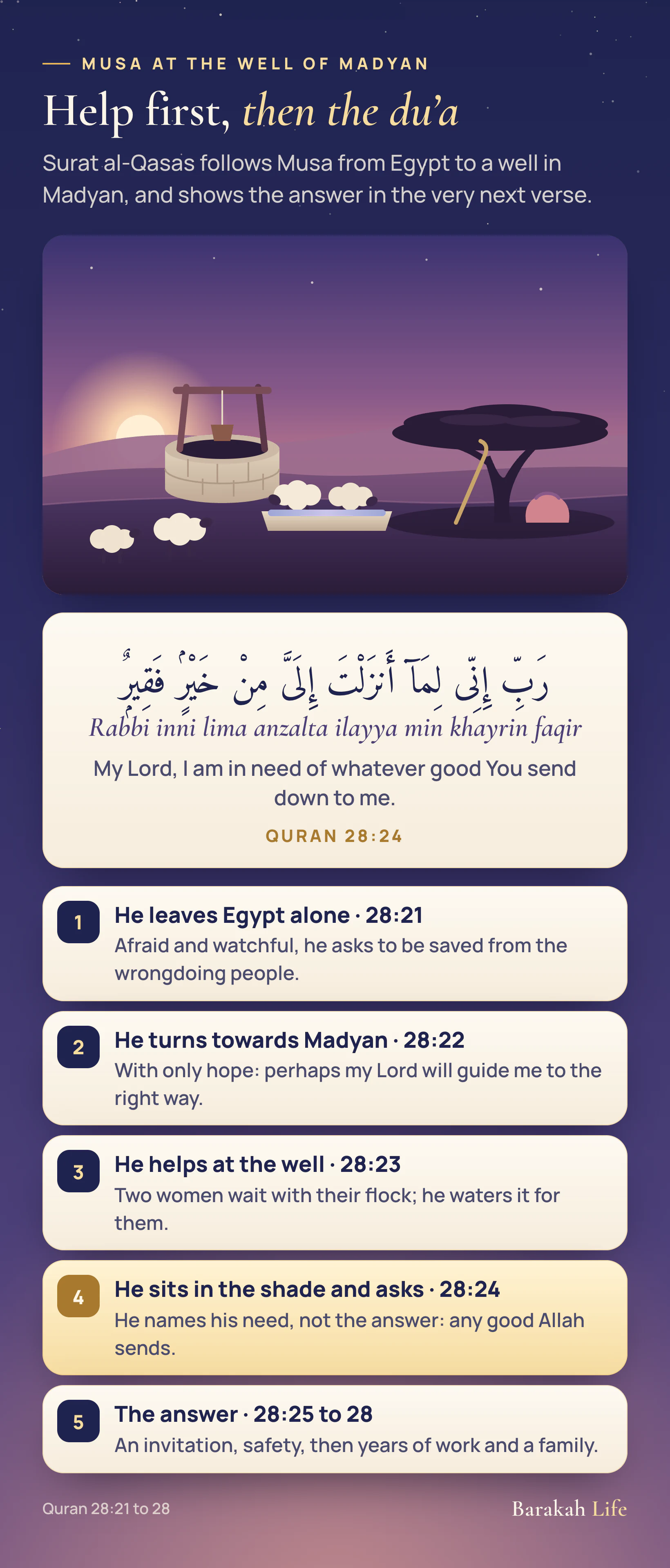
The same verse records the answer: “so He forgave him”. Warned that the chiefs were plotting to kill him, he fled Egypt alone, afraid and watchful, saying Rabbi najjini mina-l-qawmi-dh-dhalimin (رَبِّ نَجِّنِى مِنَ ٱلْقَوْمِ ٱلظَّٰلِمِينَ, “My Lord, save me from the wrongdoing people”, 28:21). He walked towards Madyan with nothing but hope: “Perhaps my Lord will guide me to the right way” (28:22).
At the well of Madyan: the du'a for provision
At Madyan he found shepherds crowding a well and two women holding their flock back, waiting. He watered their animals for them, then went back to the shade and said:
My Lord, I am in need of whatever good You send down to me.
Quran 28:24 (part)The du'a for provision came after the help, not instead of it. The answer arrived in the very next verse.
Look at what he did not say. He did not ask for food, a job, a home or a wife, though he had none of them. He said he was faqir, in need, of whatever khayr, good, Allah would send. In the next verse one of the women returns, walking shyly, with an invitation from her father; by the end of the passage Musa has safety, a reward, eight to ten years of work and a marriage (28:25 to 28). Rabbi inni lima anzalta ilayya min khayrin faqir is the du'a for job hunting, for debt, for a move abroad, for any season of need. Do what Musa did: the useful thing first, then the du'a.
Before a task too big for you
Years later, called at the burning bush and told to go to Pharaoh, Musa asked for four things:
Rabbi-shrah li sadri, wa yassir li amri, wa-hlul 'uqdatan min lisani, yafqahu qawli.
My Lord, open my chest for me, make my task easy for me, and untie the knot from my tongue, so that they understand my words.
Quran 20:25 to 28
He also asked for his brother Harun as a helper (20:29 to 35), and was told, “You have been granted your request, O Musa” (20:36). Rabbi-shrah li sadri is the du'a before an exam, an interview, a presentation, a hard conversation. And when he came back to find his people worshipping the calf, and had been harsh with Harun in his anger, he asked forgiveness for both of them: رَبِّ ٱغْفِرْ لِى وَلِأَخِى وَأَدْخِلْنَا فِى رَحْمَتِكَ ۖ وَأَنتَ أَرْحَمُ ٱلرَّٰحِمِينَ (Rabbi-ghfir li wa li-akhi wa adkhilna fi rahmatika wa anta arhamu-r-rahimin, “My Lord, forgive me and my brother, and admit us into Your mercy, for You are the most merciful of the merciful”, 7:151). It is a du'a for after an argument with someone you love.
Sulayman: gratitude at the height of blessing
Sulayman was given a kingdom no one else has had. Marching with his army, he heard an ant warn the others to get out of the way, and he smiled. His response to that small moment was a du'a:
Rabbi awzi'ni an ashkura ni'mataka-llati an'amta 'alayya wa 'ala walidayya wa an a'mala salihan tardahu wa adkhilni bi-rahmatika fi 'ibadika-s-salihin.
My Lord, inspire me to be grateful for the favour You have given me and my parents, and to do good that pleases You, and by Your mercy admit me among Your righteous servants.
Quran 27:19 (part)
He asks Allah for the ability to be grateful, because even gratitude is a gift. The same opening, Rabbi awzi'ni an ashkura, returns in Surat al-Ahqaf (46:15), where it is the du'a of a believer who reaches forty and adds a prayer for his children; that version is the one on our Rabbi awzi'ni page. Either way, it is the du'a for a promotion, a birth, a recovery, or an ordinary good day.
Sulayman's other du'a is bolder: “My Lord, forgive me, and grant me a kingdom that will not belong to anyone after me. You are the Giver” (رَبِّ ٱغْفِرْ لِى وَهَبْ لِى مُلْكًۭا لَّا يَنۢبَغِى لِأَحَدٍۢ مِّنۢ بَعْدِىٓ, Rabbi-ghfir li wa hab li mulkan la yanbaghi li-ahadin min ba'di, 38:35). Allah gave it, with the wind and the jinn under his command (38:36 to 38). It asked for something unique to him: the Prophet ﷺ once overpowered a jinn that tried to disturb his prayer and let it go rather than tie it to a pillar, because he remembered “the du'a of my brother Sulayman” (Sahih al-Bukhari 461). What we take from it is the order: forgiveness first, then a request as big as your trust in the Giver.
Yunus in the whale: the du'a of distress
Yunus left his people in anger (21:87) and fled to a laden ship (37:140). Swallowed by the great fish, he called out “in the darknesses”, which the early commentators explained as the night, the sea and the belly of the whale:
La ilaha illa anta, subhanaka, inni kuntu mina-dh-dhalimin.
There is no god but You. Glory be to You. I have been one of the wrongdoers.
Quran 21:87 (part)
The answer follows, and then a promise that reaches us: “So We answered him and saved him from the distress. And that is how We save the believers” (21:88). The Prophet ﷺ made the promise explicit:
Da'watu Dhi-n-Nuni idh da'a wa huwa fi batni-l-hut: la ilaha illa anta subhanaka inni kuntu mina-dh-dhalimin. Fa-innahu lam yad'u biha rajulun muslimun fi shay'in qattu illa-stajaba-llahu lah.
The du'a of Dhu-n-Nun (Yunus) when he called out in the belly of the whale was: There is no god but You, glory be to You, I have been one of the wrongdoers. No Muslim ever makes du'a with it for anything without Allah answering him.
Jami' al-Tirmidhi 3505, from Sa'd ibn Abi Waqqas. Graded sahih by al-Albani
The du'a never mentions the whale. It declares Allah's oneness, clears Him of any wrong, and puts the fault where it belongs. Elsewhere Allah says that had Yunus not been one of those who glorified Him, he would have stayed in its belly until the Day of Resurrection (37:143 to 144). Say La ilaha illa anta subhanaka whenever you feel trapped, especially when the trap is partly of your own making. No fixed number is reported; repeat it as your heart needs.
Zakariya: asking for a child, late
Zakariya was old and his wife had never had children. He was the guardian of Maryam, and every time he visited her prayer niche he found provision there. “Where does this come from?” he asked. “From Allah,” she said. “Allah provides for whom He wills without measure” (3:37). The next verse begins hunalika, “right there”:
Rabbi hab li min ladunka dhurriyyatan tayyibah, innaka sami'u-d-du'a'.
My Lord, grant me from Yourself good offspring. You hear every du'a.
Quran 3:38 (part)
Seeing Allah's generosity to someone else made him hopeful for himself, the right response to another person's blessing. In Surat Maryam he prays quietly, admitting his bones are weak and his head is white with age, and then says something every person waiting on a du'a should memorise: وَلَمْ أَكُنۢ بِدُعَآئِكَ رَبِّ شَقِيًّۭا (wa lam akun bi-du'a'ika rabbi shaqiyya, “and never, my Lord, have I been disappointed in calling on You”, 19:4). In Surat al-Anbiya his du'a is this:
Rabbi la tadharni fardan wa anta khayru-l-warithin.
My Lord, do not leave me alone without an heir, though You are the best of inheritors.
Quran 21:89 (part)
The answer came while he was standing in prayer (3:39): “So We answered him, gave him Yahya, and made his wife able to bear a child. They used to hasten to good deeds, and call on Us in hope and in fear, and they were humble before Us” (21:90). Couples waiting for a child often keep both Rabbi hab li min ladunka dhurriyyatan tayyibah and Rabbi la tadharni fardan; see also our du'as for waiting for a child. The second also suits anyone afraid of being left alone in old age. Its ending is gentle: even if no heir comes, Allah remains, the best of those who inherit.
'Isa: provision as a sign
When the disciples asked whether his Lord could send down a table spread with food from heaven, 'Isa first warned them to fear Allah. When they insisted that it would settle their hearts, he asked:
Allahumma rabbana anzil 'alayna ma'idatan mina-s-sama'i takunu lana 'idan li-awwalina wa akhirina wa ayatan mink, warzuqna wa anta khayru-r-raziqin.
O Allah, our Lord, send down to us a table from heaven, to be a celebration for the first of us and the last of us, and a sign from You. Provide for us, for You are the best of providers.
Quran 5:114 (part)
Allah answered, “I will send it down to you”, with a warning to anyone who would disbelieve after it (5:115). Its last line, warzuqna wa anta khayru-r-raziqin, is a complete du'a for provision on its own.
The Prophet Muhammad ﷺ: knowledge, a sound entrance and exit, forgiveness
Several du'as in the Quran open with qul, “say”: Allah teaching His Messenger ﷺ the words to use. The most searched for is two words long in Arabic. The Prophet ﷺ used to hurry to repeat the Quran while Jibril was still reciting it; he was told to wait, and to ask for more:
رَّبِّ زِدْنِى عِلْمًۭا
Rabbi zidni 'ilma.
My Lord, increase me in knowledge.
Quran 20:114 (part)
It is the only place in the Quran where he is told to ask for more of something. The Quranic du'a ends at 'ilma. The longer “full” version people search for usually means a du'a from the Sunnah built around the same words:
Allahumma-nfa'ni bima 'allamtani wa 'allimni ma yanfa'uni wa zidni 'ilma, wal-hamdu lillahi 'ala kulli hal.
O Allah, benefit me through what You have taught me, teach me what will benefit me, and increase me in knowledge. All praise is Allah's in every situation.
Sunan Ibn Majah 251 and Jami' al-Tirmidhi 3599, from Abu Hurayrah. Graded sahih by al-Albani; some other scholars graded its chain weak
The popular addition warzuqni fahma, “and give me understanding”, is not part of the verse. If you say it, say it as your own words after the Quranic du'a, not as if it were the Quran. The Rabbi zidni 'ilma page has audio and word-by-word meaning, and du'as for exams and study gathers the rest. Another du'a he was taught is for every beginning and ending:
Rabbi adkhilni mudkhala sidqin wa akhrijni mukhraja sidqin wa-j'al li min ladunka sultanan nasira.
My Lord, let me enter with an entry of truth and leave with an exit of truth, and give me from Yourself a supporting authority.
Quran 17:80
Commentators often link it to the Hijra (the report naming that occasion, Jami' al-Tirmidhi 3139, has a weak chain); its wording fits any move or new chapter. The last verse of Surat al-Mu'minun gives the shortest du'a of forgiveness in the Quran: رَّبِّ ٱغْفِرْ وَٱرْحَمْ وَأَنتَ خَيْرُ ٱلرَّٰحِمِينَ (Rabbi-ghfir warham wa anta khayru-r-rahimin, “My Lord, forgive and have mercy, for You are the best of those who show mercy”, 23:118). A few verses earlier he is taught to seek refuge from the whispers of the devils (23:97 to 98; our page on it).
Two more Quranic du'as belong to his daily life through the Sunnah. Anas said the du'a he made most often was Rabbana atina (Sahih al-Bukhari 6389), which the Quran gives as the du'a of pilgrims at Hajj:
Rabbana atina fi-d-dunya hasanatan wa fi-l-akhirati hasanatan wa qina 'adhaba-n-nar.
Our Lord, give us good in this world and good in the Hereafter, and protect us from the punishment of the Fire.
Quran 2:201 (part)
He was also heard saying it during tawaf, between the Yemeni corner and the Black Stone (Sunan Abi Dawud 1892, graded hasan). And Surat al-Baqarah closes with Rabbana la tu'akhidhna (2:286), the du'a of the Messenger and the believers: Allah's reply after each of its requests was “I have done so” (Sahih Muslim 126), and whoever recites the last two verses of al-Baqarah at night, they are enough for him (Sahih al-Bukhari 5009).
Du'as often listed as the Prophets', that belong to others
Many lists of “Prophets' du'as” include Quranic du'as said by other believers. They are just as much ours to use, but it is worth knowing whose words they were:
The servants of the Most Merciful pray Rabbana hab lana min azwajina for spouses and children who are a comfort to the eyes (25:74).
Those firm in knowledge pray Rabbana la tuzigh qulubana, that their hearts not swerve after guidance (3:8).
Talut's small army, facing Jalut, prayed Rabbana afrigh 'alayna sabra for patience and firm feet (2:250). Dawud was in that army, but the Quran gives the du'a to all of them.
Asiya, the wife of Pharaoh, asked for a house near Allah in Paradise (66:11).
Rabbana atina min ladunka rahmatan wa hayyi' lana min amrina rashada.
Our Lord, grant us mercy from Yourself, and set our affair on the right course for us.
Quran 18:10 (part)
What the Prophets' du'as teach about asking
Read together, these du'as share habits worth copying, even in your own words.
They call Him by the name that fits the need. Ayyub, in pain, says “the most merciful of the merciful”. Zakariya, asking for an heir, says “the best of inheritors”. 'Isa, asking for food, says “the best of providers”.
They own their part. Adam, Musa and Yunus all say “I have wronged myself” or “I was one of the wrongdoers” before or instead of asking for anything.
They describe their state and leave the solution to Allah. Ayyub says “harm has touched me”; Musa says “I am in need of whatever good You send”. Neither dictates the answer.
They act, then ask. Musa watered the flock before he sat in the shade. Ibrahim was laying stones while he prayed.
They ask for the long term. Ibrahim prays for descendants he would never meet. Yusuf, at the height of success, asks for a good death.
They do not give up. Zakariya asked into old age and said he had never been disappointed in calling on his Lord. The Prophet ﷺ said a du'a is answered as long as the person does not grow impatient and say, “I made du'a and it was not answered” (Sahih al-Bukhari 6340, Sahih Muslim 2735).
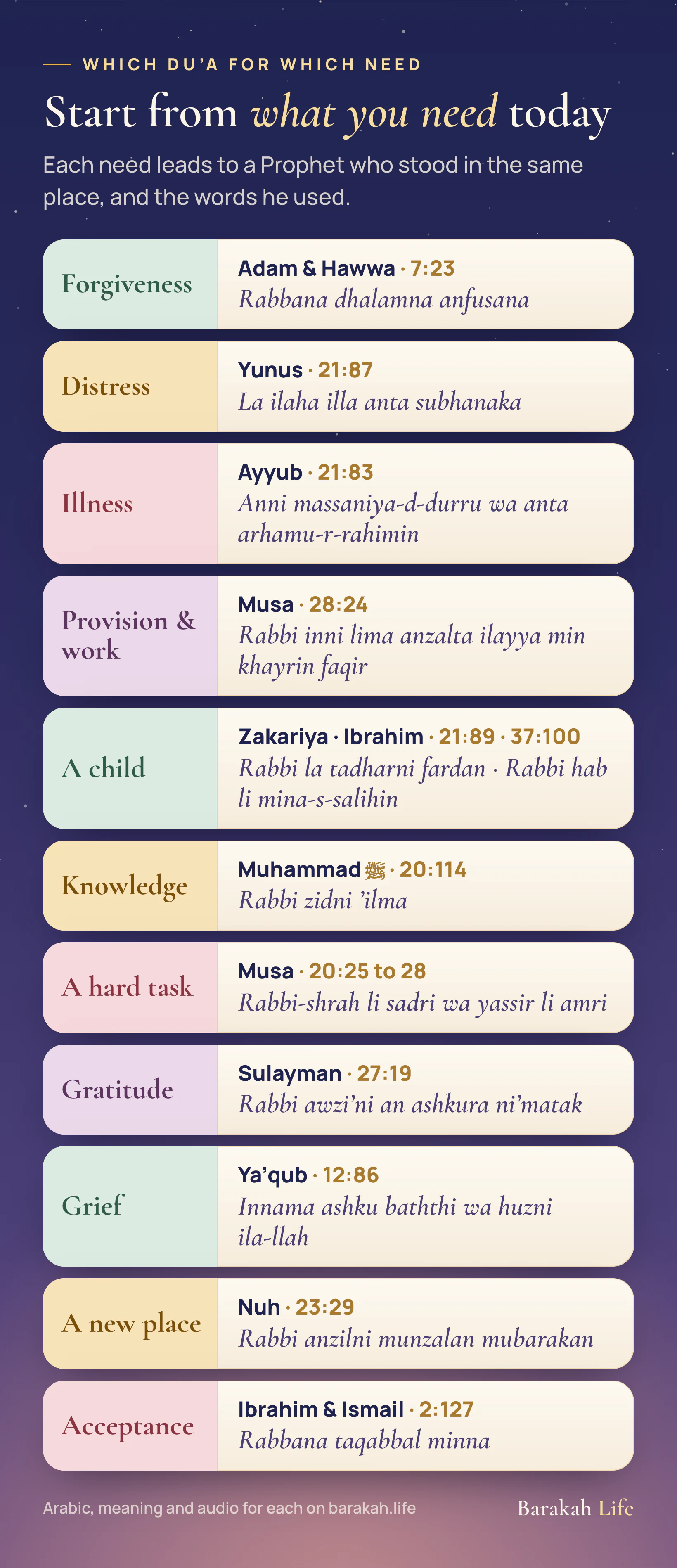
Which du'a for which need
Start from what you need today. Each line leads to a Prophet who was in the same place.
Beyond the few the Sunnah ties to a moment, such as Rabbana atina in tawaf, these du'as have no prescribed time or count. The Sunnah does name moments when du'a is especially hoped to be answered:
The last third of the night, when Allah asks, “Who is calling on Me, that I may answer him?” (Sahih al-Bukhari 1145).
Between the adhan and the iqamah, a du'a that is not turned back (Sunan Abi Dawud 521, Jami' al-Tirmidhi 212, graded sahih).
In prostration, “the nearest a servant comes to his Lord” (Sahih Muslim 482).
In the final sitting of the prayer, after the tashahhud and the salawat, before the salam (our step-by-step salah guide shows where that falls).
Quranic du'as in sujud
The Prophet ﷺ said he had been forbidden to recite the Quran while bowing or prostrating, and that in prostration we should strive in du'a (Sahih Muslim 479). Scholars of the schools reconcile the two in the same way: a Quranic verse that is itself a du'a may be said in sujud when you mean it as du'a, not as recitation. Hanafi texts state this (al-Tahtawi in his notes on Maraqi al-Falah), and Shafi'i scholars such as al-Qalyubi make the dislike of reciting outside the standing depend on intending recitation. So Rabbi zidni 'ilma in sujud, said as your own request, is fine. If you would rather avoid the question, make these du'as in the final sitting or after the prayer.
On your period, or before ghusl
The schools differ here, so it is worth setting them side by side. Our guide to fasting and prayer on your period covers the wider rulings.
Hanafi, Shafi'i and Hanbali: a woman on her period, or anyone in a state of major impurity, does not recite the Quran as recitation, but may say Quranic words as du'a or dhikr, intending du'a. So Rabbana atina or the du'a of Yunus, said as a du'a, is permitted.
Maliki: a woman on her period may recite the Quran from memory, so these du'as are permitted for her in any case.
In every school, du'a in your own words is open to everyone at all times. Outside the prayer that includes any language; inside it, the schools differ over du'a in a language other than Arabic, which is one more reason to learn these short Arabic phrases.
Keep them close in Barakah Life. Every du'a linked above has its own page with Arabic, transliteration, translation, word-by-word meaning and recitation audio. Open any ayah in the Quran reader to read the verses around it and the tafsir. In the Barakah Life app you can save the ones you love to your own list, and with Premium the Du'a finder takes what you are going through, in your own words, and suggests authentic du'as for it with their sources.
Questions people ask
What are the du'as of the Prophets in the Quran?
The supplications the Quran records in the Prophets' own words: Adam (7:23), Nuh (23:29), Ibrahim (2:127, 14:40), Lut (26:169), Ya'qub (12:86), Yusuf (12:101), Ayyub (21:83), Shu'ayb (7:89), Musa (28:24, 20:25), Sulayman (27:19), Yunus (21:87), Zakariya (21:89), 'Isa (5:114), and those taught to the Prophet Muhammad ﷺ (20:114, 17:80, 23:118).
What does “Rabbi inni lima anzalta ilayya min khayrin faqir” mean?
“My Lord, I am in need of whatever good You send down to me.” Musa said it in Madyan after helping two women water their flock (Quran 28:24). It is widely used as a du'a for provision and work, because it asks for any good without limiting it.
Which Prophet's du'a is for distress?
The du'a of Yunus: La ilaha illa anta subhanaka inni kuntu mina-dh-dhalimin (21:87). The Prophet ﷺ said no Muslim makes du'a with it for anything without Allah answering him (Jami' al-Tirmidhi 3505, graded sahih).
What is the full du'a of “Rabbi zidni 'ilma”?
In the Quran the du'a is just Rabbi zidni 'ilma, “My Lord, increase me in knowledge” (20:114). The longer du'a often meant is from the Sunnah: Allahumma-nfa'ni bima 'allamtani wa 'allimni ma yanfa'uni wa zidni 'ilma (Ibn Majah 251). Warzuqni fahma is a popular addition, not part of the verse.
Which du'a did Zakariya make for a child?
Rabbi la tadharni fardan wa anta khayru-l-warithin (21:89) and Rabbi hab li min ladunka dhurriyyatan tayyibah, innaka sami'u-d-du'a' (3:38). Allah answered by giving him Yahya.
Can I make these du'as for my own needs?
Yes. They are in the Quran so that we can use them. Just keep in mind the few that were specific to their speaker, such as Sulayman's request for a kingdom no one after him would have (38:35).
Is there a set number of times to recite them?
No number is fixed in the Quran or the authentic Sunnah for these du'as. Repeat them sincerely as often as your need calls for, and be wary of counts presented as Sunnah without a source.
A closing word
The Prophets were not people for whom everything went smoothly. They were swallowed by the sea, run out of their cities, made ill, made childless, left to grieve. What they had was a way of speaking to Allah, and the Quran handed it down to us word for word. Pick the one that matches the season you are in. Say it tonight. And remember the line Zakariya said before he had seen any answer at all:
وَلَمْ أَكُنۢ بِدُعَآئِكَ رَبِّ شَقِيًّۭا
Wa lam akun bi-du'a'ika rabbi shaqiyya.
And never, my Lord, have I been disappointed in calling on You.
Quran 19:4 (part)
Sources
Quran 2:37, 2:127 to 128, 2:201, 2:250, 2:286, 3:8, 3:37 to 39, 3:173, 5:114 to 115, 7:12 to 16, 7:23, 7:89, 7:151, 12:33 to 34, 12:84 to 86, 12:101, 14:40 to 41, 17:80, 18:10, 19:4, 20:25 to 36, 20:114, 21:83 to 90, 23:29, 23:97 to 98, 23:118, 25:74, 26:169 to 170, 27:19, 28:16 to 28, 29:14, 29:30, 37:100 to 101, 37:143 to 144, 38:35 to 42, 40:60, 46:15, 54:10 to 11, 66:11, 71:28. Arabic from the Uthmani text in the Barakah Life Quran reader; English renderings are our own.
Sunan Abi Dawud 521, 1479, 1892; Jami' al-Tirmidhi 212, 2969, 3139, 3505, 3599; Sunan Ibn Majah 251. Gradings as recorded by al-Albani and others on sunnah.com.
Ibn Kathir, Tafsir al-Quran al-'Adhim, on 2:37 (quran.com).
On Quranic du'as in sujud: al-Tahtawi, Hashiyah 'ala Maraqi al-Falah, as summarised by SeekersGuidance; al-Qalyubi, Hashiyah 'ala Sharh al-Mahalli.
On reciting while on a period: Ibn 'Abidin, Radd al-Muhtar (Hanafi); al-Nawawi, al-Majmu' (Shafi'i); Ibn Qudamah, al-Mughni (Hanbali); al-Mudawwanah and Khalil's Mukhtasar (Maliki).
This guide gathers the du'as as the Quran records them and summarises the positions of the schools where they differ. It is a study aid, not a fatwa. Where a ruling matters to your situation, confirm it with a scholar whose knowledge you trust.
Tagsduaquranprophetsquranic duassupplication
Pass it on
Know someone who needs this today? Send it to them.
“Whoever guides someone to good has a reward like the one who does it.” Sahih Muslim 1893