The du'as the Prophet ﷺ taught for anxiety, worry, fear and grief, from the Quran and authentic Sunnah, each with Arabic, transliteration and meaning, and an honest word on treatment alongside them.
Anxiety came to the best of people. The Prophet ﷺ sought refuge from worry and grief by name, morning and evening. Abu Bakr was afraid in the cave of Thawr, and the Prophet ﷺ comforted him. The Quran itself says plainly that the human being was created anxious. So if your chest is tight tonight, you are not failing at faith; you are human, and you are in good company. What the Prophet ﷺ gave his Companions for these moments was not a lecture but exact words. This guide gathers the authentic du'as for anxiety, worry, grief, fear and distress from the Quran and the Sunnah, each in Arabic with transliteration and translation, explains why they fit a troubled heart, and is honest about the place of treatment alongside them.
If you are in crisis right now, or thinking about harming yourself, please contact your local emergency number or a crisis line before anything else. In the US you can call or text 988; in the UK and Ireland, Samaritans answer on 116 123. Reaching for help is not a lack of trust in Allah. It is one of the means He placed in front of you.
In short
The most authentic du'a for worry is the refuge the Prophet ﷺ sought from it: Allāhumma innī aʿūdhu bika mina-l-hammi wa-l-ḥazan, “O Allah, I seek refuge in You from worry and grief” (Bukhari 6369). For a heavy heart he taught the du'a that begins Allāhumma innī ʿabduk (Musnad Ahmad 3712), with the promise that Allah replaces worry with relief. In distress, say the words of Yunus: Lā ilāha illā anta, subḥānaka, innī kuntu mina-dh-dhālimīn, “There is no god but You. Glory be to You. I have been among the wrongdoers” (21:87). Anxiety is not a sign of weak faith: the Quran says the human being was created anxious (70:19). Treatment, medication included, belongs alongside du'a, not instead of it.
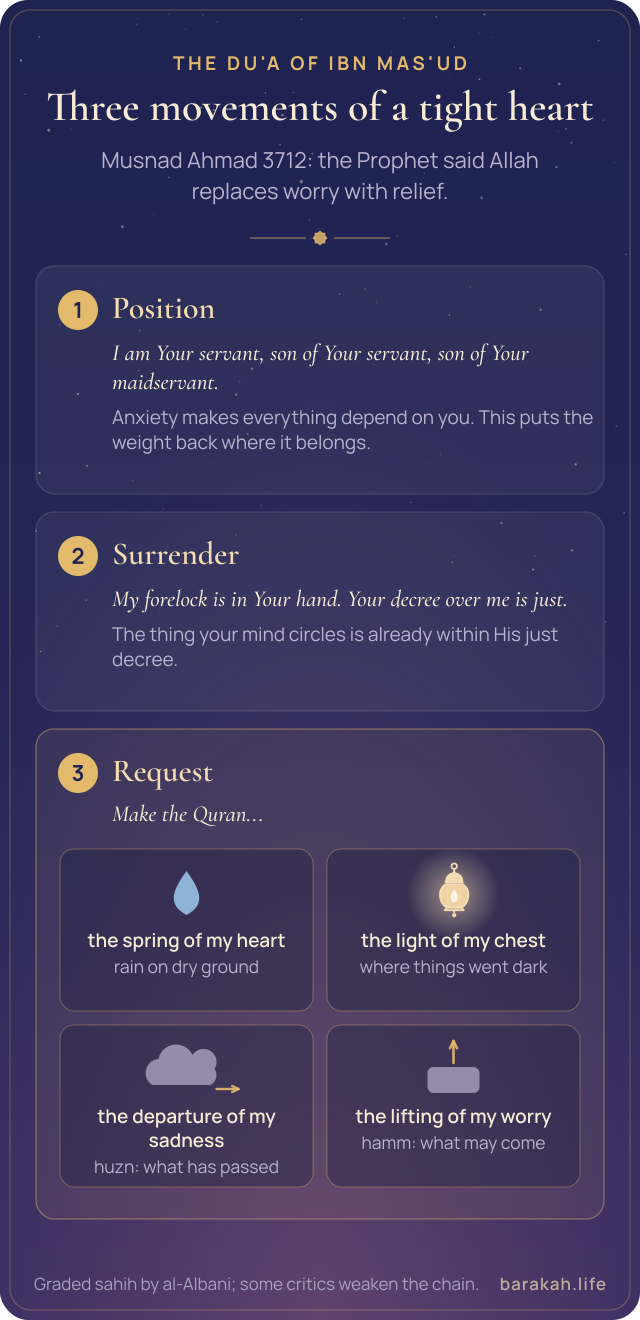
‘Abdullah ibn Mas'ud narrated that the Prophet ﷺ said: no one is ever struck by worry or grief and says the following, except that Allah removes his worry and grief and replaces it with relief.
Allāhumma innī ʿabduk, ibnu ʿabdik, ibnu amatik, nāṣiyatī bi-yadik, māḍin fiyya ḥukmuk, ʿadlun fiyya qaḍā'uk. As'aluka bi-kulli-smin huwa lak, sammayta bihī nafsak, aw ʿallamtahū aḥadan min khalqik, aw anzaltahū fī kitābik, awi-sta'tharta bihī fī ʿilmi-l-ghaybi ʿindak, an tajʿala-l-Qur'āna rabīʿa qalbī, wa nūra ṣadrī, wa jalā'a ḥuznī, wa dhahāba hammī.
O Allah, I am Your servant, the son of Your servant, the son of Your maidservant. My forelock is in Your hand. Your command over me is carried out, and Your decree concerning me is just. I ask You by every name that is Yours, with which You have named Yourself, or taught to any of Your creation, or revealed in Your Book, or kept to Yourself in the knowledge of the unseen with You, that You make the Quran the spring of my heart, the light of my chest, the lifting of my sadness and the departure of my worry.
Musnad Aḥmad 3712; Ibn Ḥibbān 972; graded ṣaḥīḥ by al-Albānī (al-Silsila al-Ṣaḥīḥa 199)
When the Companions heard this, they asked whether they should learn it, and he said that whoever hears it should learn it. A note on its strength: al-Albani and Ahmad Shakir graded it authentic, while some critics, including Shu'ayb al-Arna'ut, considered its chain weak because one narrator is unknown. Most teachers of du'a continue to teach it, and its words are pure tawhid and request, so there is no harm in saying it with the hope of its promise.
Why these words fit a tight heart
Three movements: who you are, Whose decree it is, and four precise requests.
First, position. Before asking for anything, you say who you are: a servant, from servants. Anxiety tends to swell the self until everything depends on you. These opening words set the weight down where it belongs.
Then, surrender.My forelock is in Your hand; Your decree concerning me is just. The thing your mind keeps circling is already inside Allah's decree, and that decree is just. Saying it aloud, in your own voice, interrupts the loop.
Then, a precise request. Not “take the feeling away”, but four exact things: the Quran as the spring of the heart, the season of rain on dry ground; the light of the chest, where things have gone dark; the lifting of huzn, sadness about what has already happened; and the departure of hamm, worry about what may come. The Prophet ﷺ named the two separately because they are different weights. One looks back and the other looks forward, and anxious hearts usually carry both.
Du'a for worry, grief and feeling overwhelmed
Anas ibn Malik, who served the Prophet ﷺ for ten years, said he often heard him say:
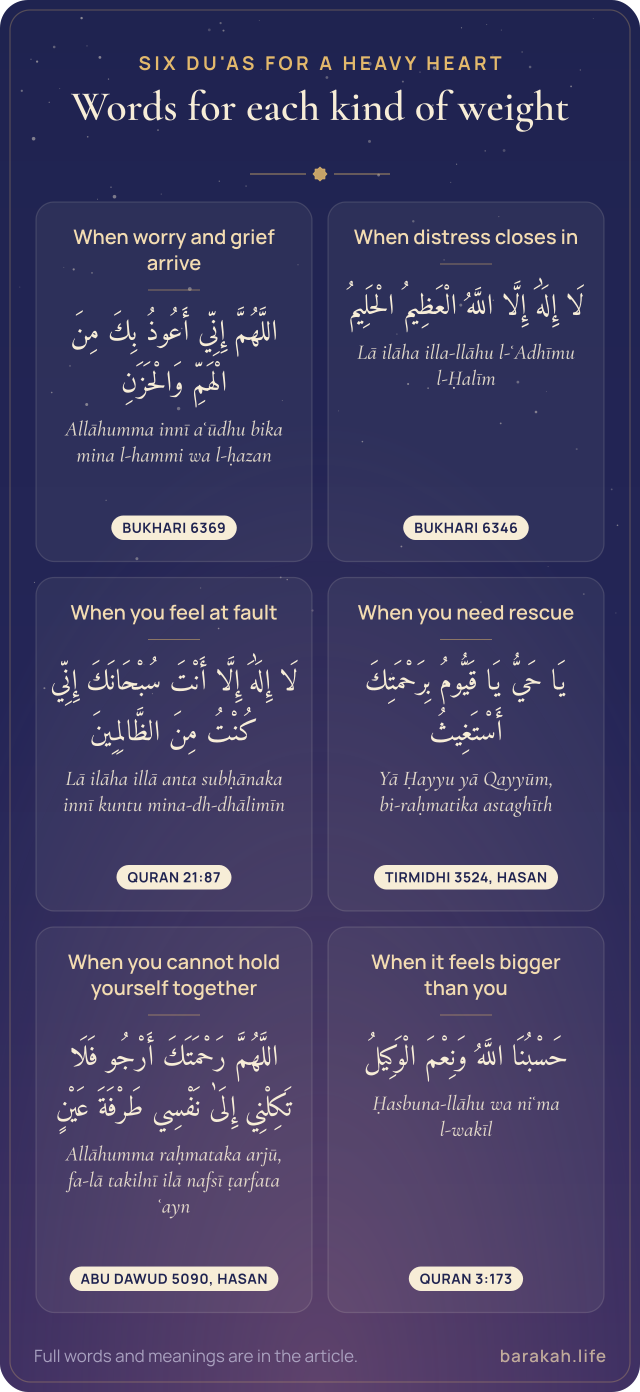
Allāhumma innī aʿūdhu bika mina-l-hammi wa-l-ḥazan, wa-l-ʿajzi wa-l-kasal, wa-l-jubni wa-l-bukhl, wa ḍalaʿi-d-dayn, wa ghalabati-r-rijāl.
O Allah, I seek refuge in You from worry and grief, from helplessness and laziness, from cowardice and miserliness, from the burden of debt and from being overpowered by people.
Ṣaḥīḥ al-Bukhārī 6369
Read it as a list of the things that feed anxiety: worry about tomorrow, grief about yesterday, the feeling that you cannot cope, the inertia that makes it worse, fear, a closed hand, debt, and other people's power over you. The Prophet ﷺ named each one and handed it to Allah. It is a good du'a to make part of your morning.
Du'a for distress, when it closes in
Ibn ‘Abbas narrated that at times of distress the Prophet ﷺ would say:
Lā ilāha illa-llāhu-l-ʿAdhīmu-l-Ḥalīm. Lā ilāha illa-llāhu rabbu-l-ʿarshi-l-ʿadhīm. Lā ilāha illa-llāhu rabbu-s-samāwāti wa rabbu-l-arḍi wa rabbu-l-ʿarshi-l-karīm.
There is no god but Allah, the Magnificent, the Forbearing. There is no god but Allah, Lord of the magnificent Throne. There is no god but Allah, Lord of the heavens, Lord of the earth, and Lord of the noble Throne.
Ṣaḥīḥ al-Bukhārī 6346; Ṣaḥīḥ Muslim 2730
There is no request in it at all, only praise. In a panic the mind shrinks the world to the size of the problem. These words do the opposite: they widen the frame until the problem sits inside the heavens, the earth and the Throne, under a Lord who is both magnificent and forbearing.
Du'a when you feel you have failed
When Yunus, peace be upon him, was in the darkness of the sea, the night and the whale, he called out with these words. The Prophet ﷺ said that no Muslim calls on his Lord with them for anything except that Allah answers him (Tirmidhi 3505, graded sahih by al-Albani).
There is no god but You. Glory be to You. I have been among the wrongdoers.
Qur'ān 21:87
Much anxiety is tangled with guilt: the mistake, the message you should not have sent, the years you feel you wasted. This du'a admits the fault without despair. It ends in an admission and begins in tawhid, and in the very next verse Allah tells us that He answered Yunus and rescued him from his distress, and that this is how He rescues the believers (21:88).
Du'a for fear and panic
Asma' bint ‘Umays said the Prophet ﷺ taught her words to say in distress (Abu Dawud 1525, graded sahih by al-Albani). They are short enough to say on a single breath, which is exactly what a panicking body needs:
اللَّهُ اللَّهُ رَبِّي، لَا أُشْرِكُ بِهِ شَيْئًا
Allāhu, Allāhu rabbī, lā ushriku bihī shay'ā.
Allah, Allah is my Lord. I do not associate anything with Him.
Sunan Abī Dāwūd 1525
And for the moment when a situation, or a person, feels bigger than you. Ibn ‘Abbas said these words were said by Ibrahim when he was thrown into the fire, and by the Prophet ﷺ and his Companions when they were told that an army had gathered against them (Bukhari 4563):
حَسْبُنَا ٱللَّهُ وَنِعْمَ ٱلْوَكِيلُ
Ḥasbuna-llāhu wa niʿma-l-wakīl.
Allah is enough for us, and He is the best One to rely on.
Qur'ān 3:173
Du'a when you cannot hold yourself together
Abu Bakrah narrated that the Prophet ﷺ called these “the du'as of the one in distress” (Abu Dawud 5090, graded hasan by al-Albani):
O Allah, it is Your mercy that I hope for, so do not leave me to myself even for the blink of an eye, and set right all of my affairs. There is no god but You.
Sunan Abī Dāwūd 5090
“Do not leave me to myself” may be the most honest sentence an anxious person can say. And Anas narrated that when something distressed the Prophet ﷺ, he would say (Tirmidhi 3524, graded hasan by al-Albani):
يَا حَيُّ يَا قَيُّومُ، بِرَحْمَتِكَ أَسْتَغِيثُ
Yā Ḥayyu yā Qayyūm, bi-raḥmatika astaghīth.
O Ever-Living, O Sustainer of all, by Your mercy I call for help.
Jāmiʿ al-Tirmidhī 3524Six du'as, matched to six kinds of weight. Save it to your phone and keep it close.
Du'a for peace of mind, from the Quran
The Quran names the source of calm directly:
أَلَا بِذِكْرِ ٱللَّهِ تَطْمَئِنُّ ٱلْقُلُوبُ
Alā bi-dhikri-llāhi taṭma'innu-l-qulūb.
Truly, it is in the remembrance of Allah that hearts find rest.
Qur'ān 13:28
When Musa, peace be upon him, was sent to face Pharaoh, a task that would frighten anyone, he asked first for an open chest and an easy path. It is a du'a for any day you dread:
So surely with hardship comes ease. Surely with hardship comes ease.
Qur'ān 94:5 to 6
Is anxiety a sign of weak iman?
No. The Quran says the human being was created anxious (70:19). The Prophet ﷺ wept when his son Ibrahim died and said: “The eyes shed tears and the heart grieves, and we say only what pleases our Lord” (Bukhari 1303). In the cave during the Hijrah, with the enemy at the entrance, Abu Bakr was afraid, and the Prophet ﷺ comforted him with words the Quran preserved:
لَا تَحْزَنْ إِنَّ ٱللَّهَ مَعَنَا
Lā taḥzan, inna-llāha maʿanā.
Do not grieve; Allah is with us.
Qur'ān 9:40
Feeling fear and grief is not the problem. What matters is where you take them.
The Sunnah even turns the weight itself into something that counts for you. The Prophet ﷺ said that no fatigue, illness, worry, grief, harm or distress befalls a Muslim, not even a thorn that pricks him, except that Allah removes some of his sins by it (Bukhari 5641, 5642). And: “How wonderful is the affair of the believer: all of it is good for him. If something good happens he is grateful, and that is good for him; if something harmful befalls him he is patient, and that is good for him” (Muslim 2999).
Overthinking and the trap of “if only”
Anxious minds replay the past and rehearse the future. The Prophet ﷺ addressed both in one hadith: “Strive for what benefits you, seek help from Allah, and do not give up. If something befalls you, do not say ‘if only I had done this, it would have been like that’; say rather ‘Allah decreed, and He does what He wills’, for ‘if only’ opens the door to the work of Shaytan” (Muslim 2664). There is a whole method in that sentence: act on what you can, ask Allah for help with the rest, and when the mind starts its “if only” loop, close the door with qaddara-llāhu wa mā shā'a fa'al, Allah decreed, and He did what He willed.
Du'a and treatment together
Islam never asked anyone to choose between du'a and medicine. The Prophet ﷺ said: “Allah has not sent down any disease except that He also sent down its cure” (Bukhari 5678), and told the Bedouins who asked whether they should seek treatment: “Yes, seek treatment, O servants of Allah, for Allah has not made a disease without making a cure for it, except one: old age” (Abu Dawud 3855, graded sahih by al-Albani).
Anxiety that lasts for weeks, wakes you at night, brings panic attacks, or stops you working, studying or caring for your family is a health condition, not a verdict on your faith. Talking therapies such as cognitive behavioural therapy have strong evidence behind them, and medication, where a doctor recommends it, is a permissible means of treatment. Start with your doctor. Many countries also have Muslim counsellors and therapists who understand faith, if that would help you speak more freely. Keep the du'as with you on the way to every appointment; they are not a replacement for care, and care is not a replacement for them.
Means and trust go together. Seeking help is part of tawakkul, not its opposite. Make the du'a, take the medicine if it is prescribed, keep the appointment, and tell one trusted person how you really are.
A daily routine for an anxious heart
Morning and evening remembrance. Say the du'a from Bukhari 6369 in your morning and evening adhkar. A little every day steadies more than a lot once a month.
The five prayers, on time. The Quran tells the believers to seek help through patience and prayer (2:153). Prayer gives the day five fixed points of stillness.
A few verses of Quran. The Ibn Mas'ud du'a asks for the Quran to be the spring of your heart; open it, even for five minutes.
Look after the body. Sleep, food, a daily walk, and less late-night scrolling. The body is an amanah, and an exhausted body makes a frightened mind.
Use the last third of the night. If you wake at night, that is a time when Allah asks, “Who is calling on Me, that I may answer him?” (Bukhari 1145).
Talk to someone. A friend, an imam, a counsellor, a doctor. You are not meant to carry it alone.
The du'a the Prophet ﷺ taught for worry and grief, “Allahumma inni ‘abduka, ibnu ‘abdika...” (Musnad Ahmad 3712), comes with a promise that Allah will replace worry with relief. The du'a of refuge from worry and grief in Bukhari 6369 is the most authentic, and the du'a of Yunus (21:87) is promised an answer.
Is anxiety haram, or a sign of weak faith?
No. The Quran says the human being was created anxious (70:19), the Prophet ﷺ felt grief, and Abu Bakr felt fear. Anxiety is a human state. What Islam asks is that you bring it to Allah and take the means of help available to you.
What should I read when I feel scared?
“Allahu Allahu rabbi, la ushriku bihi shay'a” (Abu Dawud 1525) and “Hasbunallahu wa ni'mal wakil” (3:173) are short enough to say on a single breath. Ayat al-Kursi and the last two surahs of the Quran are also recited for protection.
Which surah is good for anxiety?
There is no single surah prescribed for anxiety in authentic hadith. Al-Sharh (94), with its double promise that ease comes with hardship, and the verses of remembrance in al-Ra'd (13:28) are close companions for an anxious heart, and the Ibn Mas'ud du'a asks for the whole Quran to be the spring of your heart.
Can I take medication for anxiety as a Muslim?
Yes. Seeking treatment is encouraged in the Sunnah (Bukhari 5678, Abu Dawud 3855), and medication prescribed by a doctor is a permissible means. Taking it does not weaken your trust in Allah.
Is there a du'a for anxiety before an exam?
The du'a of Musa, “Rabbi-shrah li sadri, wa yassir li amri” (20:25 to 26), asks for an open chest and an easy task. More are in our du'as for exams and knowledge.
What is the du'a for peace of mind?
The Quran says hearts find rest in the remembrance of Allah (13:28). Any of the du'as above, said with presence, is that remembrance. Many people find the du'a of distress, “La ilaha illallahul-‘Adhimul-Halim...” (Bukhari 6346), especially calming.
You are not alone with this weight. The first generations carried heavier ones, and these are the exact words they were given to carry them. Say one tonight, slowly, and let it do its work.
Sources
Qur'ān 2:153, 3:173, 9:40, 13:28, 20:25 to 26, 21:87 to 88, 70:19, 94:5 to 6 (quran.com).
Musnad Aḥmad 3712; Ṣaḥīḥ Ibn Ḥibbān 972; al-Albānī, al-Silsila al-Ṣaḥīḥa 199. Gradings as recorded by al-Albānī and others.
This article is about du'a and the Islamic view of anxiety. It is not medical advice. If anxiety is affecting your daily life, please speak to a doctor or a qualified therapist.
Tagsduaanxietymental healthhadith
Pass it on
Know someone who needs this today? Send it to them.
“Whoever guides someone to good has a reward like the one who does it.” Sahih Muslim 1893