Zakat on gold and jewellery: worn, stored, and how to work it out
Is zakat due on the gold you wear? The nisab in grams, tola and your currency, karats turned into pure gold, the Hanafi and majority views with their evidence, and three worked examples from jewellery box to zakat figure.
Open almost any Muslim family's jewellery box and you will find the same mix: the wedding set that comes out twice a year, the bangles worn every day, a ring with a stone, a few coins given at a birth, and a tangle of broken chains nobody has looked at in years. Is zakat due on the gold you wear, the gold you keep for your daughter, the 22 karat bangles at their full weight? This guide answers each question, shows the arithmetic in full, and sets the schools side by side where they differ, so you can reach your own figure with confidence.
In short. Gold and silver kept as savings, coins, bars or investment are zakatable on every view: pay 2.5% of the value of the pure metal once your zakatable wealth reaches the nisab (85 g of pure gold, or the silver equivalent for cash) and a lunar year has passed. Jewellery that is worn is where the schools differ. The Hanafi school says zakat is due on it. The Maliki, Shafiʿi and Hanbali schools say permissible jewellery worn within normal custom is exempt. Gemstones are never counted, only the gold or silver. To find the gold in a piece, multiply its weight by the karat over 24.
Zakat falls on wealth that can grow, and gold and silver were the money of the world into which the Qur'ān was revealed. That is why the strongest warning about withheld zakat names them directly:
Wa-lladhīna yaknizūna dh-dhahaba wa l-fiḍḍata wa lā yunfiqūnahā fī sabīli llāhi fa-bashshirhum bi-ʿadhābin alīm. Yawma yuḥmā ʿalayhā fī nāri jahannama fa-tukwā bihā jibāhuhum wa junūbuhum wa dhuhūruhum, hādhā mā kanaztum li-anfusikum fa-dhūqū mā kuntum taknizūn.
And those who hoard gold and silver and do not spend it in the way of Allah, give them tidings of a painful punishment, on the Day it will be heated in the fire of Hell and their foreheads, their sides and their backs branded with it: “This is what you hoarded for yourselves, so taste what you used to hoard.”
Qur'ān 9:34 (part) to 35
The Prophet ﷺ explained the verse in the same terms: no owner of gold or silver who does not pay its due except that on the Day of Resurrection it is beaten into plates of fire and he is branded with them (Ṣaḥīḥ Muslim 987). And when Umm Salama asked whether the gold ornaments she wore counted as the hoarding the verse condemns, he answered that whatever reaches the zakat threshold and has its zakat paid is not hoarded treasure (Sunan Abī Dāwūd 1564, graded ḥasan by al-Albānī, weak by Zubair ʿAlī Zaʾī). Paid zakat is what turns a store of gold from a liability into lawful, purified wealth.
The nisab of gold, in grams, tola and money
Zakat is owed only once you hold a minimum amount, the nisab. For gold it was set at twenty dinars, with half a dinar due on them:
Wa laysa ʿalayka shay'un, yaʿnī fi dh-dhahab, ḥattā yakūna laka ʿishrūna dīnārā. Fa-idhā kāna laka ʿishrūna dīnāran wa ḥāla ʿalayhā l-ḥawlu fa-fīhā niṣfu dīnār.
Nothing is owed by you, meaning on gold, until you have twenty dinars. When you have twenty dinars and a year has passed over them, half a dinar is due on them.
Sunan Abī Dāwūd 1573, from ʿAlī. Graded ṣaḥīḥ by al-Albānī
Half a dinar out of twenty is one fortieth, which is 2.5%. Some scholars of hadith criticise this chain, but the twenty-dinar threshold itself is agreed by the four schools and stated by Mālik in the Muwaṭṭaʾ as the settled practice. The silver nisab, two hundred dirhams, is in Ṣaḥīḥ al-Bukhārī 1447 as five awāq.
A dinar is a weight of gold (a mithqal), and converting it to modern grams gives two common figures:
85 g of pure gold, from a mithqal of 4.25 g weighed from surviving early dinars. This is the figure of Yūsuf al-Qaraḍāwī, AAOIFI and the Kuwaiti Fiqh Encyclopedia, and of most zakat bodies worldwide.
87.48 g, or 7.5 tola, used in many South Asian Hanafi fatwas, including Darul Uloom Deoband. The silver equivalent there is 612.36 g, or 52.5 tola.
Nobody disagrees about the Sunnah amount. The two figures convert an old weight differently, and the gap is under 3%. Use the one your local scholars use.
The nisab in your currency
The table uses world prices on 5 October 2026: gold at about $133.73 a gram and silver at about $1.99 a gram. Local retail prices in India and Pakistan run higher than the world price because of import duties, so use your local jeweller's rate if you are there.
Currency
Gold nisab (85 g)
Silver nisab (595 g)
US dollar
$11,367
$1,183
British pound
£8,590
£894
Euro
€10,104
€1,052
UAE dirham
AED 41,745
AED 4,345
Saudi riyal
SAR 42,626
SAR 4,436
Malaysian ringgit
RM 46,429
RM 4,832
Indian rupee
₹10.96 lakh
₹1.14 lakh
Pakistani rupee
Rs 31.54 lakh
Rs 3.28 lakh
On the 7.5 tola figure the gold nisab is about $11,699, and on 52.5 tola of silver about $1,218. The Barakah Life zakat calculator shows today's figures in your own currency.
Gold alone, or gold with cash? If all you own is gold, the gold nisab decides. Once you also hold cash or trade goods, they are added together and measured against one nisab, and many scholars then use the far lower silver figure for the combined total. That question has its own section below, because it is where most people's answer changes.
Turning karats into pure gold
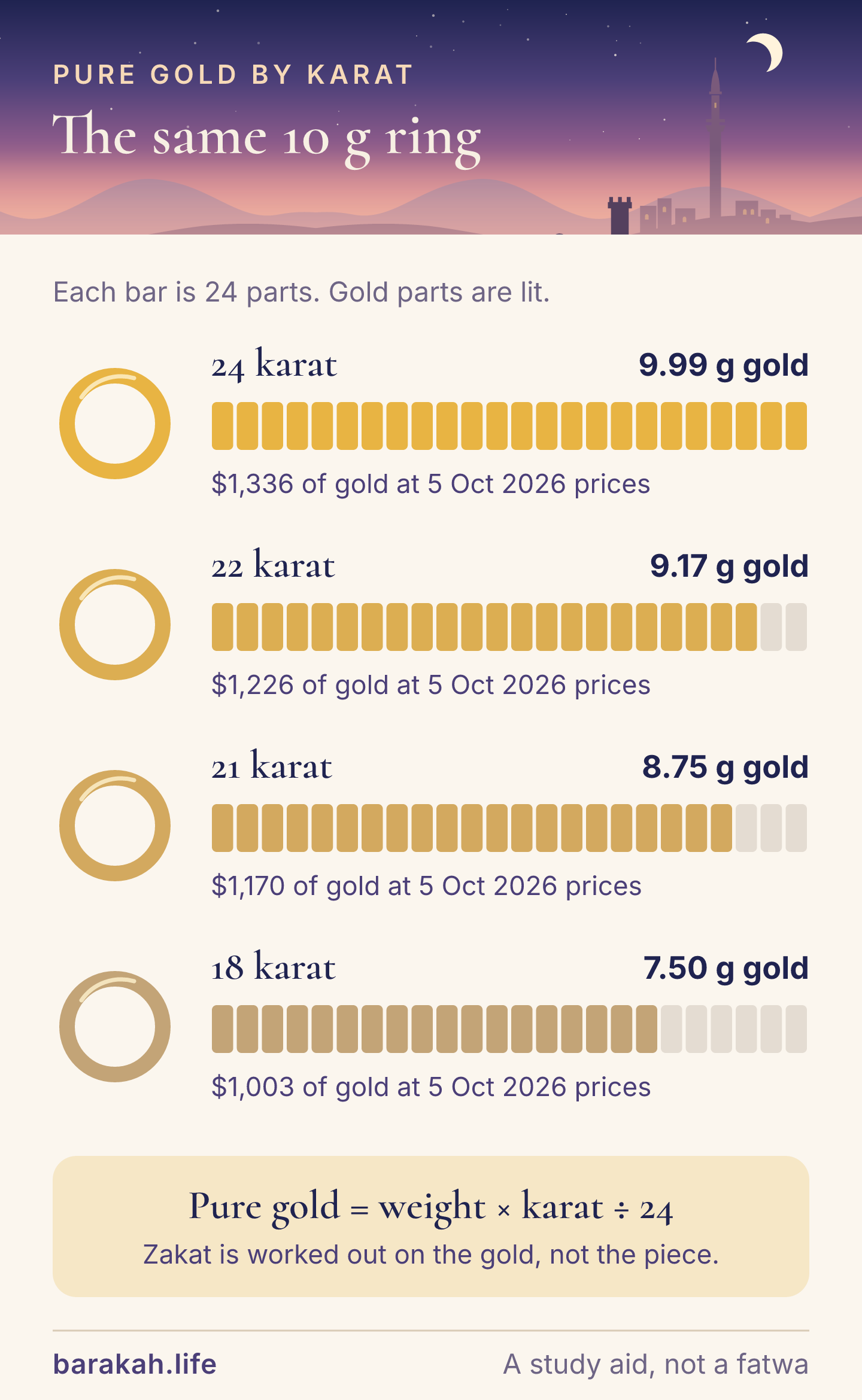
The nisab and the zakat are measured in pure gold, but jewellery is almost never pure. A karat is one twenty-fourth part, so 22 karat means 22 parts gold and 2 parts other metals. To find the gold in any piece:
Pure gold = weight × karat ÷ 24.
A 10 g ring in 22 karat holds 10 × 22 ÷ 24 = 9.17 g of gold. The rest is copper, silver or zinc, which carry no zakat.
Same weight, different gold. Zakat is worked out on the gold, not on the weight of the piece.
Karat
Hallmark
Gold content
Common in
24k
999
99.9%
Bars, coins, investment gold
22k
916
91.7%
South Asian and Gulf jewellery, sovereigns
21k
875
87.5%
Gulf, Egyptian and Turkish jewellery
18k
750
75%
European jewellery, white gold, diamond settings
14k
585
58.5%
American jewellery
9k
375
37.5%
British budget jewellery
Where the schools differ on alloys
The Shafiʿi and Hanbali schools count only the pure gold, for both the nisab and the zakat. The Hanafi school treats an item that is more than half gold as wholly gold, so 22k, 21k, 18k and 14k pieces count at their full weight when testing the nisab. The Maliki school counts debased coins at full weight when they circulate like pure ones, and otherwise the pure content.
The money you pay comes out almost the same either way, because a 22k piece is valued at the 22k price. The difference shows only at the threshold: 90 g of 22k jewellery holds 82.5 g of pure gold, so on its own it reaches the Hanafi nisab of 87.48 g by full weight, but not the 85 g pure-gold nisab of the Shafiʿi and Hanbali schools. For a 10k or 9k item, where gold is the minority metal, the Hanafi rule would treat it as ordinary goods rather than gold; that application to modern karats is a contemporary reading, so a Hanafi follower with a lot of 9k jewellery should ask a scholar.
White gold, plating, platinum and stones
White gold is gold alloyed with white metals. Count its gold by karat like any other piece.
Gold-plated and gold-filled items carry only a trace of gold: ignore them unless you hold them for sale.
Platinum and palladium are not gold or silver. Personal platinum jewellery carries no zakat according to the fatwa bodies we checked; platinum bars held as an investment, or stock held for sale, are counted like trade goods.
Diamonds, pearls and gemstones are not zakatable unless you trade in them. Subtract their weight (one carat of stone is 0.2 g) or use the net gold weight on the receipt or hallmark.
Jewellery that is worn
This is one of the best-known differences in the whole of zakat, and both sides argue from the Sunnah and the Companions. It helps to see the evidence as each side reads it.
The Hanafi school: zakat is due
The Hanafi school holds that gold and silver are zakatable by their very nature, as the money of the world, whatever their shape or use. The general texts above (9:34 and Ṣaḥīḥ Muslim 987) make no exception for jewellery, and two narrations speak to worn jewellery directly:
أَنَّ امْرَأَةً أَتَتْ رَسُولَ اللَّهِ صلى الله عليه وسلم وَمَعَهَا ابْنَةٌ لَهَا، وَفِي يَدِ ابْنَتِهَا مَسَكَتَانِ غَلِيظَتَانِ مِنْ ذَهَبٍ، فَقَالَ لَهَا: «أَتُعْطِينَ زَكَاةَ هَذَا؟» قَالَتْ: لاَ. قَالَ: «أَيَسُرُّكِ أَنْ يُسَوِّرَكِ اللَّهُ بِهِمَا يَوْمَ الْقِيَامَةِ سِوَارَيْنِ مِنْ نَارٍ؟»
Anna mra'atan atat rasūla llāhi ṣallā llāhu ʿalayhi wa sallam wa maʿahā bnatun lahā, wa fī yadi bnatihā masakatāni ghalīdhatāni min dhahab, fa-qāla lahā: “A-tuʿṭīna zakāta hādhā?” Qālat: lā. Qāla: “A-yasurruki an yusawwiraki llāhu bihimā yawma l-qiyāmati siwārayni min nār?”
A woman came to the Messenger of Allah ﷺ with her daughter, who wore two heavy gold bangles. He asked her, “Do you give the zakat on these?” She said no. He said, “Would it please you if Allah put two bangles of fire on you for them on the Day of Resurrection?”
Sunan Abī Dāwūd 1563, from ʿAmr ibn Shuʿayb from his father from his grandfather. Graded ḥasan by al-Albānī
The woman took the bangles off at once and gave them away for Allah and His Messenger. A similar report of two women with gold bracelets is in Jāmiʿ al-Tirmidhī 637, which al-Albānī graded ḥasan. The second narration is from ʿĀʾisha herself:
دَخَلَ عَلَىَّ رَسُولُ اللَّهِ صلى الله عليه وسلم فَرَأَى فِي يَدِي فَتَخَاتٍ مِنْ وَرِقٍ، فَقَالَ: «مَا هَذَا يَا عَائِشَةُ؟» فَقُلْتُ: صَنَعْتُهُنَّ أَتَزَيَّنُ لَكَ يَا رَسُولَ اللَّهِ. قَالَ: «أَتُؤَدِّينَ زَكَاتَهُنَّ؟» قُلْتُ: لاَ، أَوْ مَا شَاءَ اللَّهُ. قَالَ: «هُوَ حَسْبُكِ مِنَ النَّارِ»
The Messenger of Allah ﷺ came in and saw large silver rings on my hand. He said, “What is this, ʿĀʾisha?” I said, “I had them made to adorn myself for you, Messenger of Allah.” He said, “Do you pay their zakat?” I said no, or something like it. He said, “That would be enough to bring you to the Fire.”
Sunan Abī Dāwūd 1565. Graded ṣaḥīḥ by al-Albānī
The same view is reported from ʿUmar, Ibn Masʿūd, ʿAbdullāh ibn ʿAmr and Ibn ʿAbbās. Among recent scholars, Ibn Bāz and Ibn ʿUthaymīn held it too, though neither was Hanafi.
The Maliki, Shafiʿi and Hanbali schools: not due on what is worn
The other three schools (in the Shafiʿi case, its relied-upon position) hold that zakat falls on wealth kept for growth, and jewellery kept for permissible wearing has left that category, like clothes, furniture or a riding animal. Their strongest evidence is what the Companions did. ʿĀʾisha, the narrator of the silver rings, raised her brother's orphaned daughters:
أَنَّ عَائِشَةَ زَوْجَ النَّبِيِّ صلى الله عليه وسلم كَانَتْ تَلِي بَنَاتِ أَخِيهَا يَتَامَى فِي حَجْرِهَا، لَهُنَّ الْحَلْىُ، فَلاَ تُخْرِجُ مِنْ حُلِيِّهِنَّ الزَّكَاةَ
Anna ʿĀ'ishata zawja n-nabiyyi ṣallā llāhu ʿalayhi wa sallam kānat talī banāti akhīhā yatāmā fī ḥajrihā, lahunna l-ḥalyu, fa-lā tukhriju min ḥuliyyihinna z-zakāh.
ʿĀʾisha, the wife of the Prophet ﷺ, had charge of her brother's orphaned daughters, who were in her care. They had jewellery, and she did not pay zakat from their jewellery.
Muwaṭṭaʾ Mālik, Book 17, no. 10, from al-Qāsim ibn Muḥammad, her nephew, who grew up in that household
In the next report Mālik relates from Nāfiʿ that ʿAbdullāh ibn ʿUmar adorned his daughters and slave women with gold and did not pay zakat on their jewellery (Muwaṭṭaʾ, Book 17, no. 11). The Kuwaiti Fiqh Encyclopedia lists the same view from Jābir, Anas and Asmāʾ bint Abī Bakr. The majority add two points about the Hanafi evidence. First, al-Tirmidhī, after recording the bracelets report, said that nothing on this subject is authentic from the Prophet ﷺ, and the chains of these narrations have been debated ever since. Second, when a Companion narrates a hadith and then acts otherwise, they take it that she understood it in a way that did not reach everyday worn jewellery, and she knew best what she had heard.
The Hanafis have answers too. ʿĀʾisha's nieces were minors, and in the Hanafi school a minor's wealth owes no zakat at all, so her practice does not settle the case of an adult woman. A Prophetic wording “there is no zakat on jewellery” also circulates, but al-Bayhaqī judged it to have no sound basis, and the majority do not rely on it.
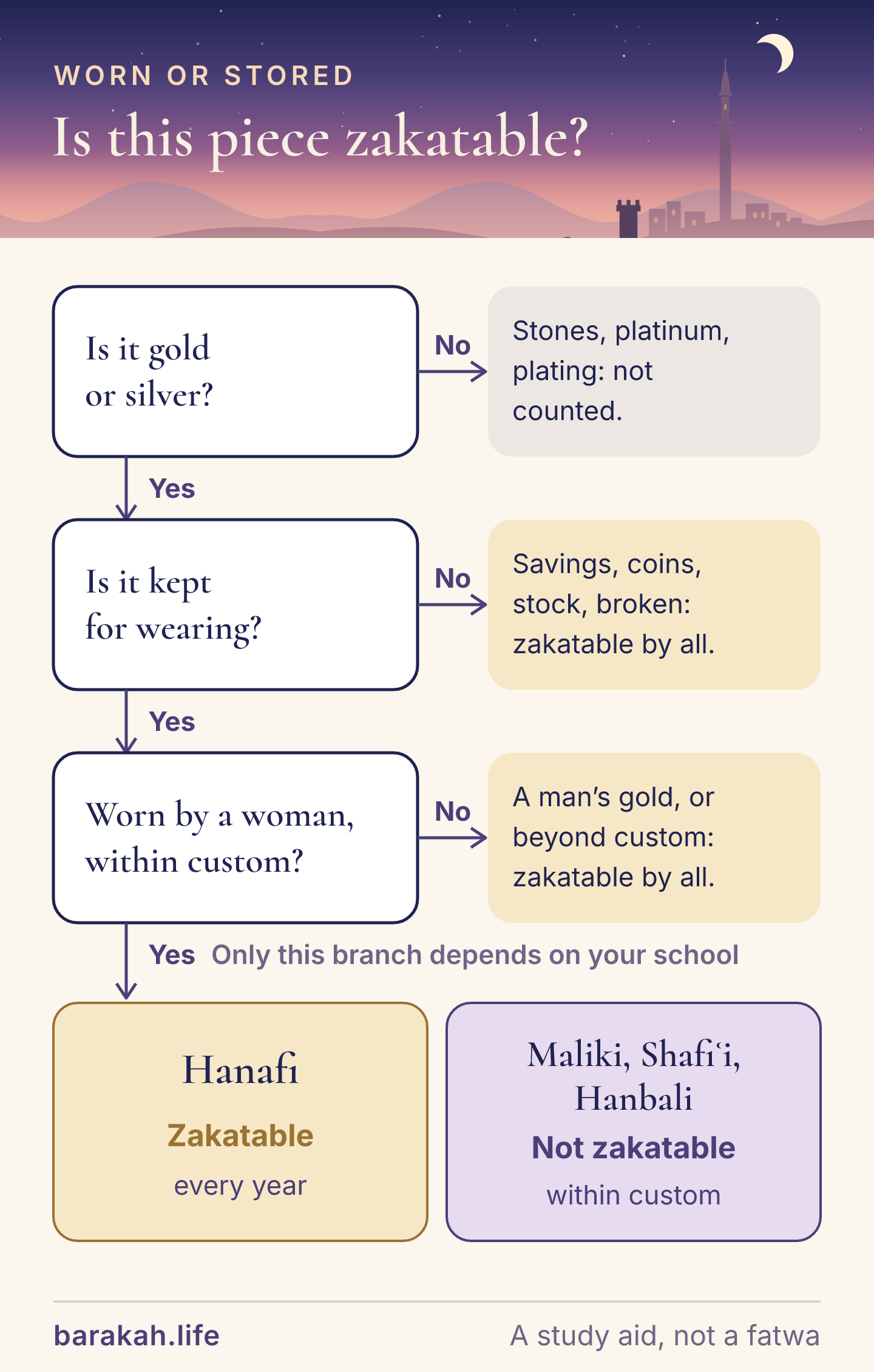
Three questions settle any piece. Only the last branch depends on your school.
So which figure should you use?
If you follow a school, follow it: both positions are held by the imams of this ummah and you are not blameworthy for following either. If you have no school and want one figure that is sound on every view, include your worn jewellery. If zakat was due, you have paid it; if it was not, you have given charity that Allah rewards. Al-Qaraḍāwī, who held that worn jewellery within custom is not zakatable, still wrote that paying on it is better for a woman and gives her more peace about her duty, while no one may force her to. This is also why the Barakah Life calculator shows one figure first, labelled with the school it follows, and puts the other schools' figures one tap away.
How much is “custom”?
The schools that exempt worn jewellery limit the exemption to what women customarily wear. Beyond that, the excess is treated as stored wealth. Some authorities have put a number on custom:
Singapore (MUIS, 2011): 860 g (200 mithqal). Above it, zakat is due on the total weight, not only on the excess.
Selangor, Malaysia (amended fatwa, 2023): 800 g. Zakat is due on the weight above 800 g. Other Malaysian states set their own figures, so check your state zakat board.
Where no figure is set, judge honestly by what women in your community actually wear. Necklaces that never leave the drawer are not adornment, whatever they were bought for.
Jewellery that is stored, gifted or kept as savings
Here the schools agree: jewellery that is not kept for wearing is zakatable, like any other gold. Mālik puts it plainly in the Muwaṭṭaʾ: gold or silver jewellery that is not used for wearing is weighed every year and one fortieth is taken. That covers:
pieces bought as a store of value, or kept “for a rainy day”;
broken jewellery that would need melting down before it could be worn again (one that only needs a small repair you mean to make keeps its worn status in the Maliki and Shafiʿi schools);
old pieces you no longer wear and do not intend to;
jewellery held for sale, which is trade stock and counted at its sale value;
any gold jewellery owned by a man, since wearing gold is forbidden to men (“silk and gold are forbidden to the males of my ummah and permitted to its females”, Jāmiʿ al-Tirmidhī 1720, ṣaḥīḥ). A man's silver ring is permitted and is treated like worn jewellery by the majority; the Hanafi school counts it with his other silver.
Gold kept for a daughter's wedding
Many mothers put gold aside for a daughter. Zakat follows ownership, not intention. Gold you still hold, even if you call it hers or register it in her name, remains yours, and you pay on it. Once you actually give it to her and hand it over, it is hers: an adult daughter pays if she reaches the nisab. For a minor daughter, the Hanafi school owes nothing on a child's wealth, while the other schools make it zakatable, paid by the guardian (subject to their rule on worn jewellery). Gold set aside unworn for years is stored wealth on every view.
Gold bought as an investment
Bars, coins, sovereigns and gold bought to hold are zakatable in every school, at 2.5% of their market value on your zakat date, once your total reaches the nisab. The forms people hold today:
Bars and coins: pure weight × the day's price. A 22k sovereign holds 7.32 g of gold.
Allocated gold in a vault or app, where specific gold is held in your name: it is your gold, counted in full.
Gold ETFs and gold funds: their units represent gold, so count their full market value on your zakat date.
Unallocated gold accounts, where you hold only a claim on the provider: Lembaga Zakat Selangor regards these as non-compliant and asks for zakat on the capital paid in, as savings. Whether the product itself is halal is a separate question worth asking before you buy.
Weigh it, or read the weight from the receipt, the hallmark or a jeweller's scale. Subtract stones.
Find the pure gold: weight × karat ÷ 24.
Multiply by the price of pure gold on your zakat date. Not what you paid, and not the making charges: the Hanafi school measures gold by weight, so workmanship is ignored. Ibn ʿUthaymīn advised using what the piece would fetch as used gold on the day, and a jeweller's buy-back quote is a fair way to find it.
Pay 2.5%. Most people pay in money. The Hanafi school, the well-known Maliki position and a narration preferred by Ibn Qudāma accept payment by value; the Shafiʿi school in principle pays gold's zakat in gold, so a Shafiʿi follower may ask a scholar how that applies to modern money.
A shortcut that works in any currency. 2.5% of the weight is the zakat. For every 10 g of gold you owe the value of 0.25 g of that same gold, and for every tola (11.66 g) the value of 0.29 g. At 5 October 2026 prices, that is about $35.75 for each tola of 22k jewellery.
Gold together with cash
Very few people hold only gold. The schools agree that trade goods are added to gold and silver to complete the nisab, and most scholars give cash the ruling of gold and silver, so cash, gold and trade goods are normally added together and the total tested once. The Hanafi school adds them by value; the Maliki school and one narration from Ahmad add them as fractions of each nisab; the Shafiʿi school does not add gold to silver at all. In Malaysia, Singapore, Indonesia and Brunei, where the Shafiʿi school prevails, follow the method of your zakat authority for combining gold with savings.
Which nisab do you test the total against? For gold alone, the gold nisab. For a mix, Hanafi fatwa bodies such as Deoband use the silver nisab, the measure more beneficial to the poor, while others use gold. Today the silver nisab is about a tenth of the gold one, so this choice decides whether many households owe anything. The savings guide sets out both sides in full; Example 2 below shows the effect.
Three worked examples
All prices are from 5 October 2026: pure gold at about $133.73 a gram and silver at about $1.99 a gram, with £1 = $1.32 and $1 = AED 3.67. Each person has held their wealth above the nisab for a lunar year.
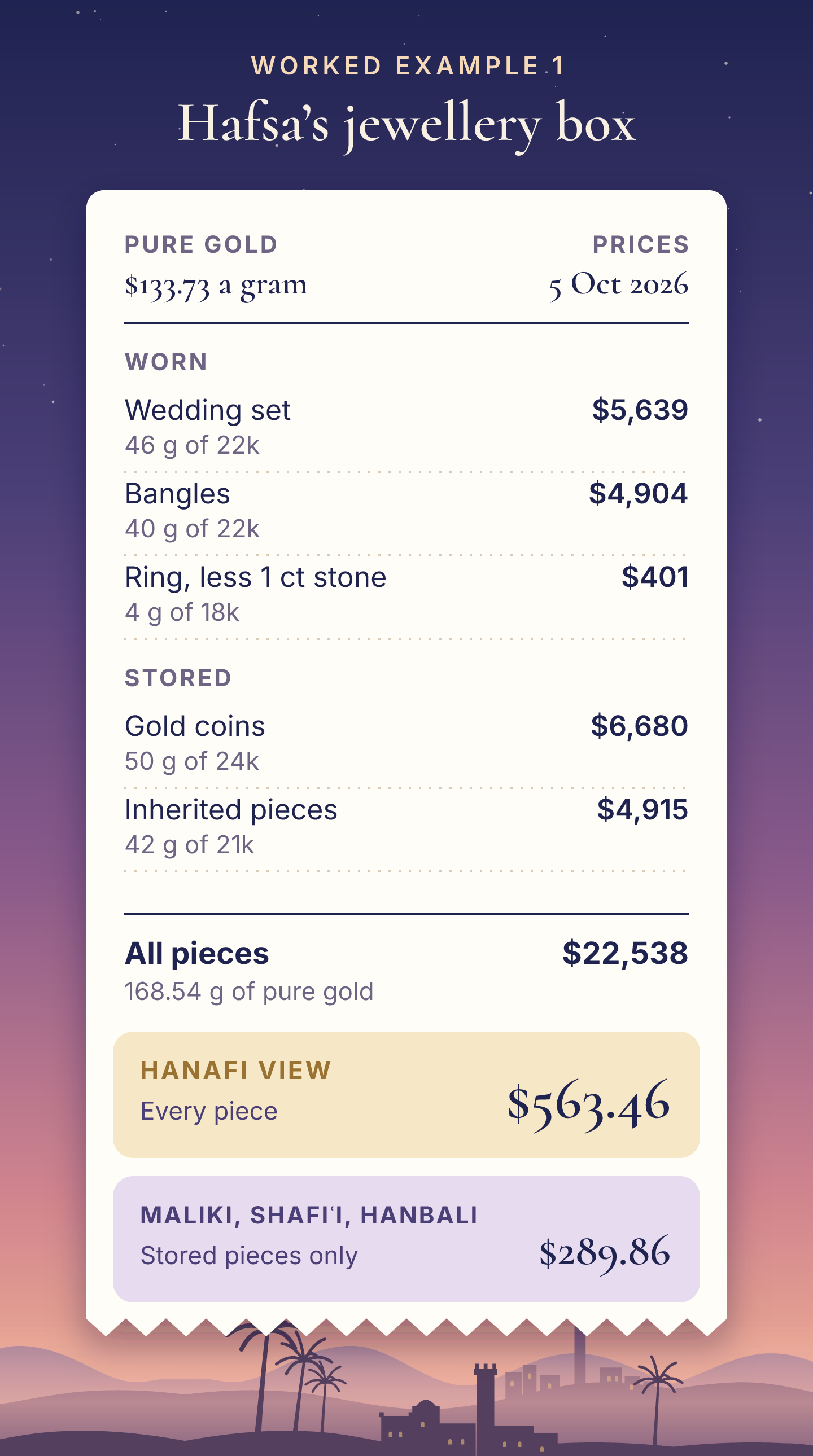
Example 1: Hafsa's jewellery box
Hafsa wears her bangles every day, her wedding set at weddings and Eid, and her ring always. She also keeps 50 g of gold coins and 42 g of 21k pieces she inherited from her grandmother and never wears.
Every piece, its gold and its value on one page, with the one line where the schools part ways.
Piece
Pure gold
Value
Wedding set, 46 g of 22k (worn)
42.17 g
$5,639
Bangles, 40 g of 22k (worn)
36.67 g
$4,904
Ring, 4 g of 18k after a 1 carat diamond (worn)
3.00 g
$401
Coins, 50 g of 24k (stored)
49.95 g
$6,680
Inherited pieces, 42 g of 21k (stored)
36.75 g
$4,915
All pieces
168.54 g
$22,538
Hanafi view: zakat $563.46, on all five pieces. Maliki, Shafiʿi and Hanbali view: zakat $289.86, on the stored pieces only. Their 86.70 g of pure gold is just above the 85 g nisab, so zakat is due on them in every school even with nothing else.
Example 2: Sana, with bangles and some savings
Sana lives in Birmingham. She wears 40 g of 22k bangles and has £2,500 in savings, nothing more.
View
Counted
Zakat
Hanafi, silver nisab for the mix
£3,706 gold + £2,500 cash
£155.14
Maliki, Shafiʿi, Hanbali, silver nisab for cash
£2,500 cash
£62.50
Any school, gold nisab for cash
Under £8,590
None
That day the silver nisab was £894 and the gold nisab £8,590. Her bangles alone (36.67 g of pure gold) are well under the gold nisab, so on their own they would owe nothing in any school. It is the cash beside them, and the silver nisab, that brings her into zakat. This is the most common case, and why a calculator that asks only about gold can mislead.
Example 3: Yusuf, who invests in gold
Yusuf, in Dubai, holds a 100 g bar of 24k gold, 20 g of allocated gold in an app, and a gold ETF worth AED 15,000. All of it is investment gold, so the schools agree on every line.
Holding
Value (AED)
Bar, 100 g × 0.999
49,063
Allocated app gold, 20 g × 0.999
9,813
Gold ETF at market value
15,000
Total
73,876
Zakat at 2.5%
1,846.90
If Yusuf also wore a 6 g 18k gold ring, its 4.5 g of gold (about AED 2,210) would be zakatable on every view, since gold jewellery is not permitted to men; better still to give it to his wife or sell it.
Do it in the Barakah Life calculator
The Barakah Life zakat calculator was built around jewellery boxes like Hafsa's. Add each piece with its weight in grams, tola, vori, mithqal or troy ounces, pick its karat, subtract stones in grams or carats, and say whether it is worn, stored or held for sale, and who wears it. It shows the pure gold and its value at today's price as you type, or takes a jeweller's buy-back quote instead. The result leads with one figure in your school's view, named on the screen, and “how the schools differ” opens the others, with the source behind each line. There are country versions for India, Pakistan, the UK and the UAE.
Ask about your own case. In the Barakah Life app, Barakah Life AI answers questions like “is zakat due on gold I keep for my daughter?” from the same cited rulings, school by school, and the app remembers your pieces and your zakat date from one year to the next. It is a study aid built on cited rulings, not a fatwa.
Questions people ask
Is zakat due on gold jewellery that I wear?
In the Hanafi school, yes, on all gold and silver jewellery. In the Maliki, Shafiʿi and Hanbali schools, no, as long as it is permissible jewellery worn within normal custom. Both views are held by the imams; paying on it is the precaution that is sound on every view.
What is the nisab of gold in grams?
85 g of pure gold in most modern calculations, or 87.48 g (7.5 tola) in many South Asian Hanafi fatwas. On 5 October 2026, 85 g was worth about $11,367.
How do I calculate zakat on 22 karat gold?
Multiply the weight by 22 and divide by 24 to find the pure gold, multiply by the day's price of pure gold, and take 2.5%. For 100 g of 22k: 91.67 g × $133.73 = $12,259, and the zakat is $306.48 (prices of 5 October 2026).
How much zakat is due per tola of gold?
The value of 0.29 g of the same gold for every tola, which is 2.5% of 11.66 g. At 5 October 2026 world prices that was about $38.96 per tola of 24k and $35.75 per tola of 22k; use your local rate per tola where retail prices differ.
Do I pay zakat on gold if I have less than the nisab?
On gold alone, no. But if you also hold cash or trade goods, they are added together, and many scholars test the total against the silver nisab, which is far lower. Small amounts of gold often become zakatable that way.
Is there zakat on diamonds, pearls or platinum?
Not on stones or platinum kept for personal use; only gold and silver carry zakat as metals. If you trade in them, or hold platinum bars as an investment, they are counted as trade goods at their market value.
Who pays zakat on a wife's jewellery?
The owner. Jewellery given to a wife as mahr or as a gift is hers, so the zakat is hers, though her husband may pay it on her behalf with her permission.
A closing word
Gold is the one wealth the Qur'ān promises to the people of Paradise to wear without measure, and without zakat:
Jannātu ʿadnin yadkhulūnahā yuḥallawna fīhā min asāwira min dhahabin wa lu'lu'ā, wa libāsuhum fīhā ḥarīr.
Gardens of perpetual residence, which they will enter. They will be adorned there with bracelets of gold and with pearls, and their garments there will be silk.
Qur'ān 35:33
In this world, gold comes with a right owed to others. The Prophet ﷺ told the women of Madinah to give charity “even from your jewellery” (Ṣaḥīḥ al-Bukhārī 1466), and when he urged them after the Eid prayer, they did not reach for a calculator: they took off their earrings and necklaces and gave them there and then (Ṣaḥīḥ al-Bukhārī 964). Work out your figure carefully, follow the scholarship you trust where it differs, and then give it gladly, knowing that the gold which leaves your box this way is the part of it you keep.
Ṣaḥīḥ al-Bukhārī 964, 1447, 1466; Ṣaḥīḥ Muslim 987; Sunan Abī Dāwūd 1563, 1564, 1565, 1573; Jāmiʿ al-Tirmidhī 637, 1720; Muwaṭṭaʾ Mālik, Book 17, nos. 10 and 11. Gradings as recorded by al-Albānī and others.
al-Mawsūʿa al-Fiqhiyya al-Kuwaytiyya (Kuwaiti Fiqh Encyclopedia), vol. 18, entry “Ḥulī”, pp. 108 to 116, and vol. 23, entry “Zakat”, pp. 262 to 270 and 298 to 300 (shamela.ws).
Yūsuf al-Qaraḍāwī, Fiqh al-Zakah, trans. Monzer Kahf, vol. 1 (PDF), and his answer on zakat on jewellery.
Darul Uloom Deoband, nisab fatwa 1758 (islamqa.org); Darul Iftaa Birmingham on platinum jewellery; Jamia Uloom Islamia Banuri Town on gold kept for children; National Zakat Foundation on gold and silver.
This guide summarises the positions of the schools and of contemporary bodies as recorded in the sources above. It is a study aid, not a fatwa. Where your situation is unusual, or where the views differ and it matters to you, confirm with a scholar whose knowledge you trust.
Tagszakatgoldjewellerynisabfiqh
Pass it on
Know someone who needs this today? Send it to them.
“Whoever guides someone to good has a reward like the one who does it.” Sahih Muslim 1893