How to make up missed prayers (qada): a realistic plan
Whether you missed a week or ten years, here is how to count what you owe, pray each make-up prayer, keep the right order in each of the four schools, and choose a pace you can sustain.
Maybe you drifted from the prayer in your teens and came back at thirty. Maybe a hard year, an illness or a new baby left gaps you stopped counting. Maybe someone told you that you owe “thousands” of prayers, and the number felt like a wall. This guide turns the wall into steps: what the scholars agree on, how to estimate what you owe, how a make-up prayer is prayed, the order and timing in each of the four schools, and the arithmetic of a pace you can keep.
In short
The four schools agree that an obligatory prayer missed through sleep or forgetting is made up, and they extend this to prayers missed for any other reason; a minority of scholars hold that prayers left on purpose are repented from rather than made up. Count from puberty, subtract what you are sure you prayed, and round up where unsure. Pray each make-up prayer exactly as it was due (two rak'ahs for Fajr, four for Dhuhr), with an intention naming it. Then choose a steady pace: one extra prayer after each daily prayer clears one missed year in one year. Keep today's prayers on time while you repay, and repent alongside the make-up.
Man nasiya ṣalātan aw nāma ʿanhā fa-kaffāratuhā an yuṣalliyahā idhā dhakarahā.
Whoever forgets a prayer or sleeps through it, its expiation is to pray it when he remembers it.
Ṣaḥīḥ Muslim 684, from Anas ibn Mālik. A shorter wording is in Ṣaḥīḥ al-Bukhārī 597
In al-Bukhārī's wording he adds, “there is no expiation for it except that,” and then recites wa aqimi ṣ-ṣalāta li-dhikrī, “establish the prayer for My remembrance” (Qur'ān 20:14). No charity, fast or fee replaces a missed prayer. The only way through is to pray it.
He did this himself. On the day of the Trench, the battle kept him from Asr until after sunset; he made wudu, prayed Asr, and then prayed Maghrib after it (Ṣaḥīḥ al-Bukhārī 596). On the way back from Khaybar the whole camp slept through Fajr; he had them move a little way, Bilāl called the iqāma, and he led the missed Fajr in congregation (Ṣaḥīḥ Muslim 680). When it happened again on another journey, he explained where blame lies:
There is no negligence in sleep. Negligence is when someone does not pray a prayer until the time of the next one comes. Whoever does that, let him pray it when he becomes mindful of it.
Ṣaḥīḥ Muslim 681, from Abū Qatāda (excerpt)
Notice the last line: even the negligent person is told to pray it. The scholars of the four schools add a second argument. When a man asked whether he could fast the days his late mother owed, the Prophet ﷺ answered, “the debt of Allah has more right to be paid” (Ṣaḥīḥ al-Bukhārī 1953). If a prayer missed through sleep, which carries no sin, must be made up, a prayer missed through carelessness is owed all the more.
Prayers you left on purpose
This is the one real disagreement, and it is worth knowing both sides.
The four schools (Hanafi, Maliki, Shafiʿi and Hanbali) hold that every obligatory prayer that was owed and not prayed must be made up, however it was missed, together with sincere repentance. This is the position of the great majority of scholars.
A minority, including Ibn Ḥazm, Ibn Taymiyya and, among recent scholars, Ibn ʿUthaymīn, hold that a prayer deliberately left until its time passed cannot be made up, because the Sunnah names only sleep and forgetting. For them the path is sincere repentance and many voluntary prayers from here on.
Many who find the minority view persuasive still make the prayers up as a precaution: if they were owed, they are paid; if not, the record is full of prayer. Both views agree on what matters most today: repent, and do not miss another one.
What you never owe
Anything before you became Muslim. A convert owes no prayers for the years before the shahada.
Qul lilladhīna kafarū in yantahū yughfar lahum mā qad salaf.
Say to those who disbelieve: if they stop, what has passed will be forgiven them.
Qur'ān 8:38 (part)
The Prophet ﷺ told ʿAmr ibn al-ʿĀṣ that Islam wipes out what came before it (Ṣaḥīḥ Muslim 121). If you are a new Muslim, your count starts on the day you said the shahada, and our guide to becoming Muslim covers those first days. Nor do you owe:
Anything before puberty. The obligation begins at maturity, not at seven or ten, the ages at which children are taught.
Prayers during a period or postnatal bleeding. Asked whether a woman makes up the prayers of her period, ʿĀʾisha said the women were told to make up missed fasts but not missed prayers (Ṣaḥīḥ Muslim 335). This is agreed.
Prayers during insanity, by agreement, and in most schools prayers during a long loss of consciousness (details below).
Step one: count, honestly and on the safe side
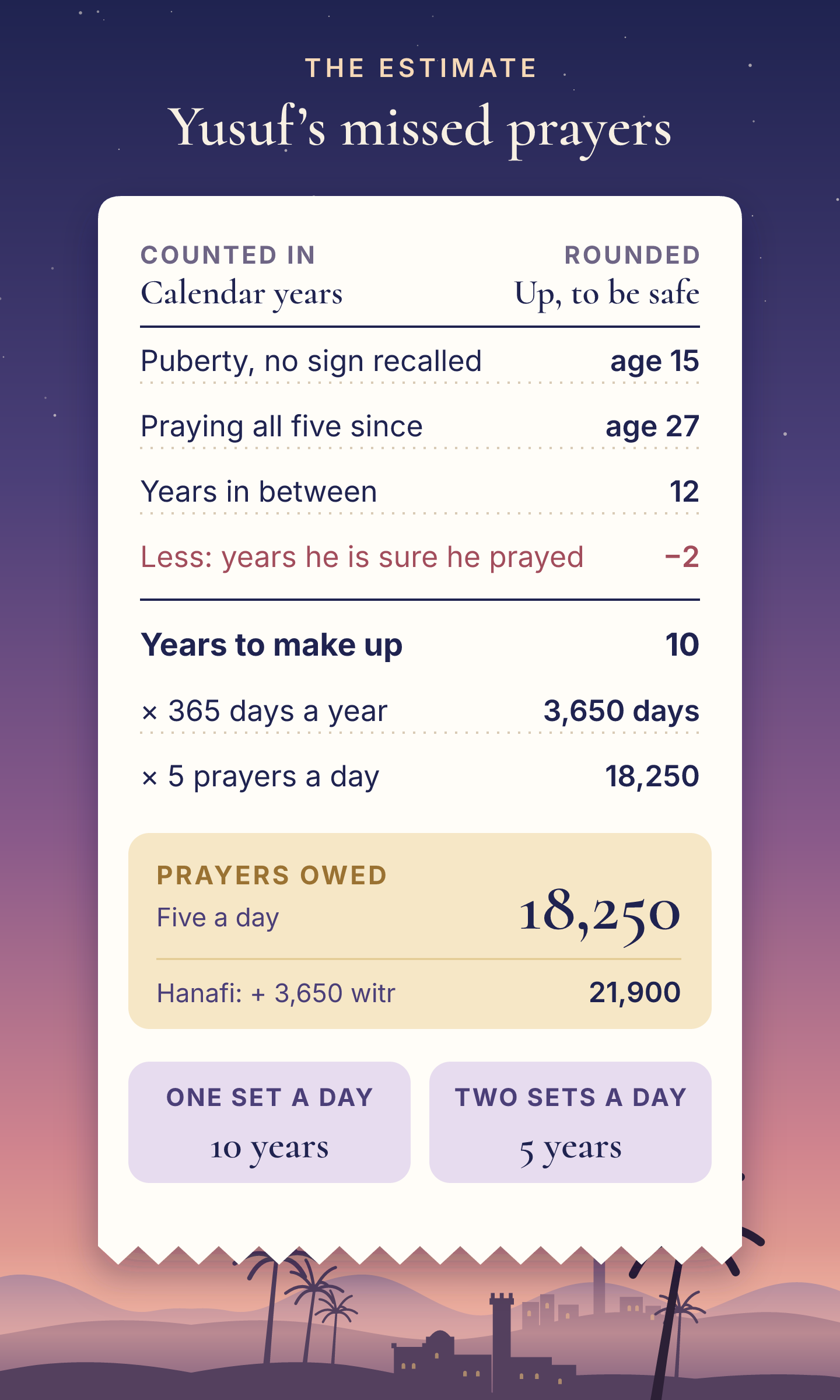
Few people know their exact number. The schools do not ask for one. They ask for a sincere estimate that leaves you confident nothing remains. The Hanafi school works on your strongest estimate; the Maliki, Shafiʿi and Hanbali schools tell you to keep going until you are sure you are clear, which in practice means rounding up. Either way, when you are torn between two numbers, take the higher.
Find your start: puberty. For a boy, the first wet dream or emission; for a girl, the first period. Growth of coarse pubic hair also counts in the Maliki and Hanbali schools. If you cannot remember any sign, the Shafiʿi and Hanbali schools and the relied-upon Hanafi view use fifteen lunar years of age; the well-known Maliki position is eighteen.
Find your end: the point from which you have prayed all five, every day.
Subtract what you are sure you prayed. Ramadans when you prayed every prayer, a year at a strict school, a stretch after Hajj. Be conservative: count only what you are confident of.
Turn years into days. Multiply by 365 if you counted in ordinary calendar years, or by 354 if you counted in Hijri years. Prayers are owed per day lived, so use the calendar you measured in.
Multiply by five. Each day owes a Fajr, a Dhuhr, an Asr, a Maghrib and an Isha. If you follow the Hanafi school, add one witr per day too, because the school holds witr to be wājib (necessary).
Sisters: take out your period days. Multiply your usual period length by the number of months. Seven days a month over ten years is about 840 days you never owed.
The whole estimate is four multiplications. The pace you choose afterwards matters more than the exact number.
If the total frightens you, remember that it is finite, and that the Prophet ﷺ said the most beloved of deeds to Allah are the most constant, even if small (Ṣaḥīḥ al-Bukhārī 6464). A number you are working on is very different from a number you are avoiding.
You can also count each prayer separately. If you always prayed Maghrib with family but missed Fajr for years, owe what you actually missed.
How to pray a qada prayer
A make-up prayer is the same prayer, prayed late. If you know how to pray, you already know how to pray qada. If you are still learning, our step-by-step salah guide and wudu guide cover every position and every word.
Same rak'ahs. Fajr is two, Dhuhr four, Asr four, Maghrib three, Isha four. A Hanafi's witr is three.
Intention in the heart. Intend the specific prayer: “the Dhuhr I owe”. When you owe many, the Hanafi school asks you to make it definite, such as “the first Dhuhr I owe” (or the last), so that each prayer points to one day. The other schools are satisfied with naming the prayer. Nothing needs to be said aloud.
Iqāma. You may say the iqāma before it, as Bilāl did for the missed Fajr at Khaybar (Ṣaḥīḥ Muslim 680).
No special du'a or extra prayer. There is no separate “qada prayer” with its own wording. You pray Dhuhr as Dhuhr.
Quietly and privately. Missed prayers are between you and Allah. Scholars advise against announcing them, and the Prophet ﷺ said his whole community would be pardoned except those who expose what Allah had covered (Ṣaḥīḥ al-Bukhārī 6069). Pray them at home, or in the mosque without explaining.
With others, if you like. Spouses or friends who owe the same prayer may pray it together; the Prophet ﷺ led the missed Fajr in congregation.
When may I pray them?
Any time you are free, with one difference between the schools.
School
The three disliked times (sunrise, the sun at its height, sunset)
After Fajr and after Asr
Hanafi
Not valid: wait until the time passes
Allowed (after Asr, until the sun yellows)
Maliki
Allowed
Allowed
Shafiʿi
Allowed
Allowed
Hanbali
Allowed
Allowed
The difference touches only a few minutes a day, so a fixed slot after Fajr or after Isha works in every school.
Which order? A few prayers versus many
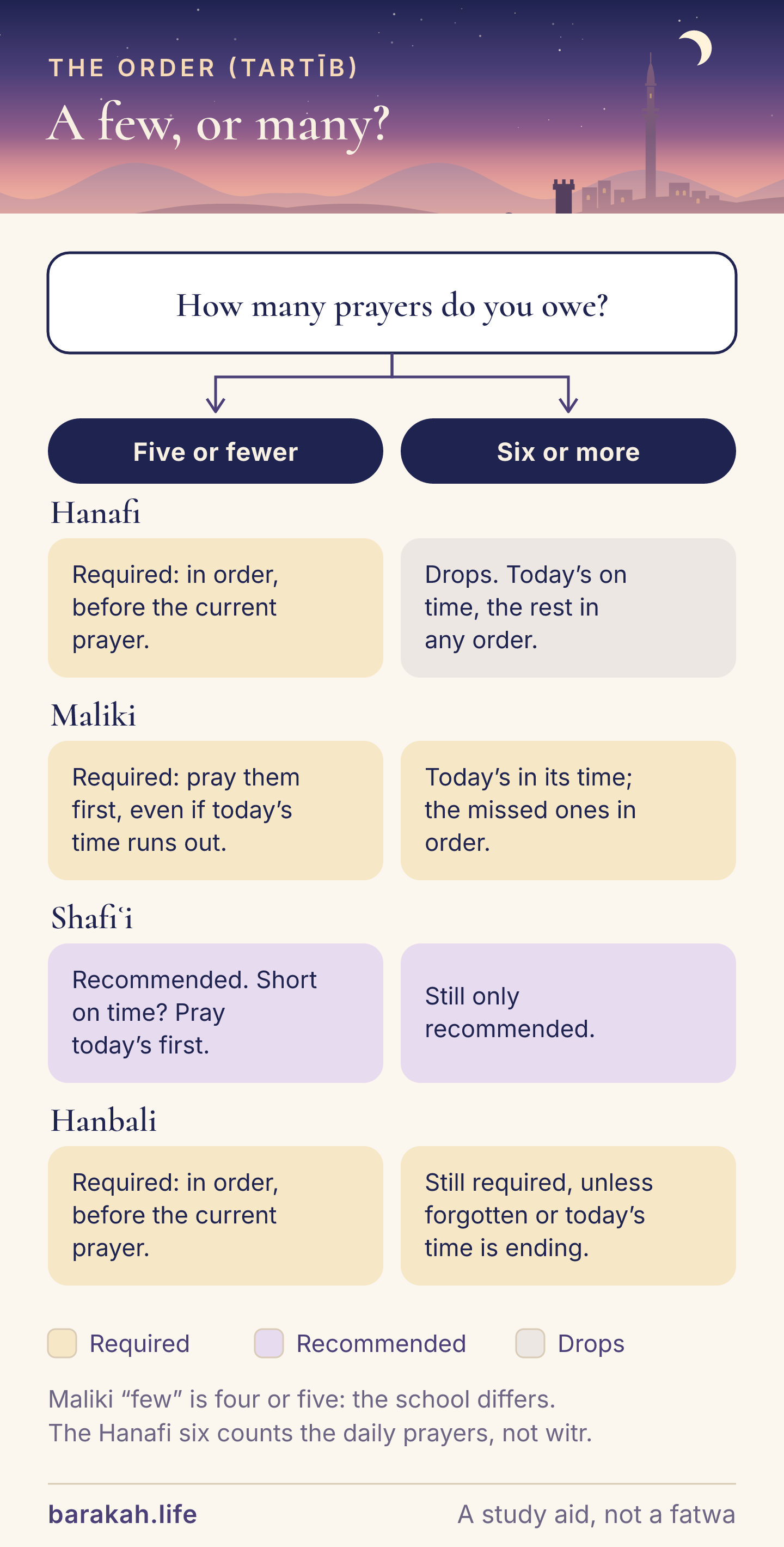
Order (tartīb) means praying missed prayers in the sequence they were missed, and praying them before the current prayer. The Prophet ﷺ prayed the missed Asr before Maghrib at the Trench, and the schools build on that. Where they differ is how far the rule reaches.
The schools agree on a few missed prayers far more than on many. Hanafi “six” counts the five daily prayers, not witr.
School
A few missed (about a day's worth)
Many missed (six or more)
Hanafi
Order is required, between them and before the current prayer, unless you forgot or the current prayer's time is about to end.
The requirement drops once six prayers are owed. Pray the current prayer in its time and make up the rest in any order.
Maliki
A small number (four or five; the school's scholars differ) is prayed before the current prayer, even if its time runs out.
Pray the current prayer in its time. The missed prayers are made up in order among themselves.
Shafiʿi
Order is recommended, not required. If the current prayer's time is short, pray it first.
The same: recommended, never a condition.
Hanbali
Order is required.
Still required, few or many, unless you forgot or the current prayer's time is about to end.
For years of missed prayers, every school gives the same practical answer: pray each day's prayers in their times, and make up the backlog in sequence around them, Fajr then Dhuhr then Asr then Maghrib then Isha, one day's set after another. Praying the oldest day first keeps you inside the Hanbali and Maliki requirement and costs a Hanafi or Shafiʿi nothing.
For one or two prayers missed this week, act on the morning you notice. Overslept Fajr? Pray it as soon as you wake. Remember a missed Dhuhr when Asr comes in? Pray Dhuhr first, then Asr, as long as Asr's time is not running out.
How fast? The schools on timing
None of the schools treats a backlog as something to park for later.
Maliki and Hanbali: making up is due straight away, as far as you can without harming your health or the work your family depends on.
Shafiʿi: a prayer missed with an excuse, such as sleep or forgetting, may be made up later, though promptly is better. A prayer left without excuse must be made up immediately.
Hanafi: the school allows the qada to be spread over time for the needs of life, but delaying it without reason is blameworthy, so keep a steady rhythm and do not drift.
So the schools agree: start now, and give it a real, regular share of your free time. What about voluntary prayers? The Maliki, Shafiʿi and Hanbali schools tell someone with a large backlog to put it ahead of open-ended voluntary prayer, while keeping the confirmed sunnahs such as the two rak'ahs before Fajr and witr; the Shafiʿi school is strictest here for prayers left without excuse. The Hanafi school keeps the confirmed sunnahs of every prayer and advises spending your other voluntary time on qada. Nobody is told to abandon the sunnahs of Fajr or witr.
Choosing a pace: the arithmetic
Most plans fail for lack of arithmetic, not sincerity. A heroic week of twenty extra prayers a day usually ends by week three; a pace you can keep on a tired Tuesday wins.
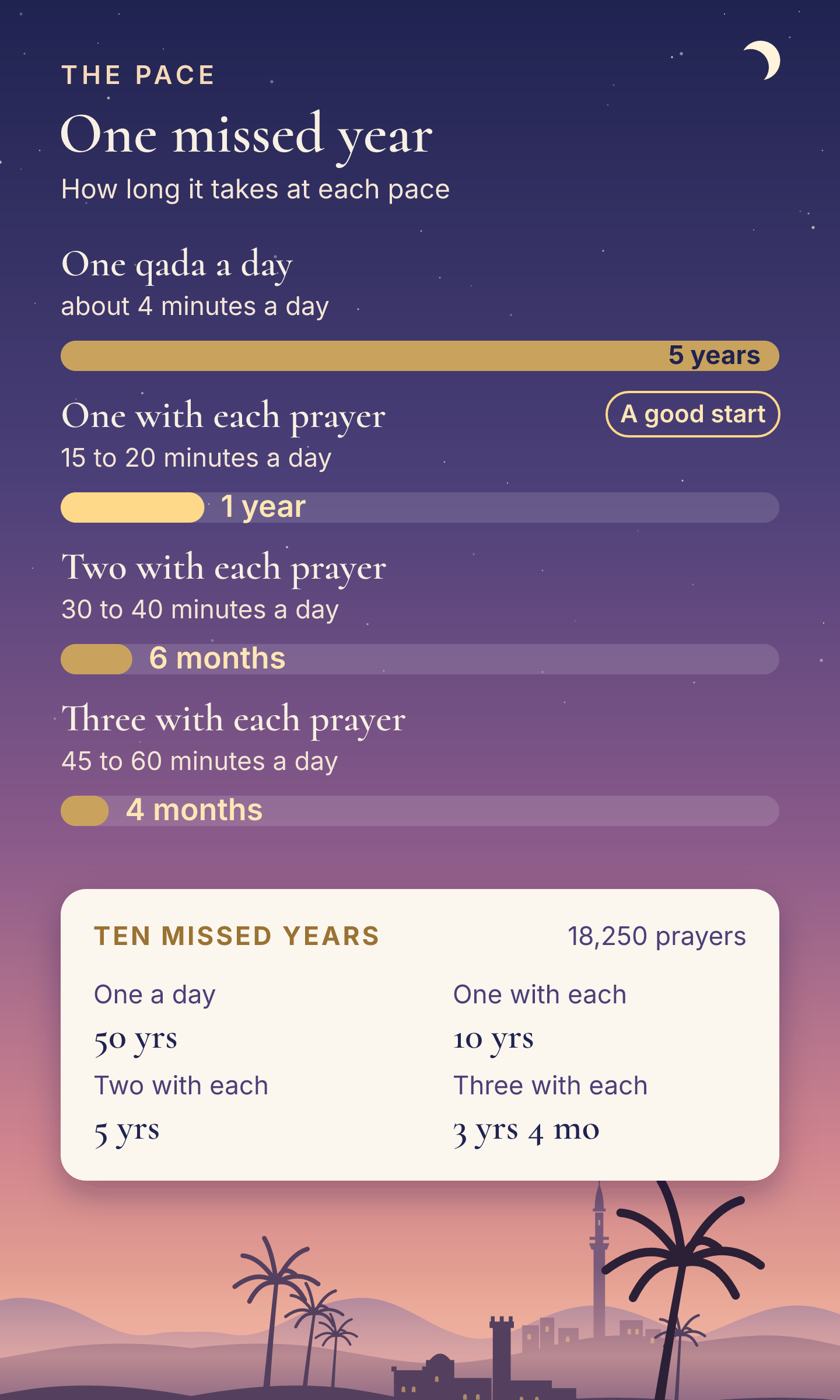
One full day of obligatory prayers is seventeen rak'ahs, about 15 to 20 minutes for most people (twenty rak'ahs with a Hanafi witr). That one number lets you plan everything:
Pace
Extra time a day
One missed year takes
Ten missed years take
One qada prayer a day
About 4 minutes
5 years
50 years
One with each daily prayer (one day's set)
15 to 20 minutes
1 year
10 years
Two with each daily prayer
30 to 40 minutes
6 months
5 years
Three with each daily prayer
45 to 60 minutes
4 months
3 years 4 months
The single most useful rule: one make-up with each daily prayer clears a year in a year.
For most people with several years owed, “one with each daily prayer” is the sweet spot: it attaches to a habit you already have, and each year of effort removes a year of debt.
A daily plan that lasts
Pick one of these and give it forty days before you judge it.
Plan A: pair each prayer (recommended)
After praying today's Fajr, pray one qada Fajr: two rak'ahs.
After today's Dhuhr, pray one qada Dhuhr. Do the same after Asr, Maghrib and Isha (a Hanafi adds a qada witr after Isha).
Tap it off as you go. Five ticks a day is one day of debt gone. In the Hanafi school, praying after Asr is fine until the sun begins to yellow.
Plan B: one daily block
Choose a fixed slot: straight after Isha, or twenty minutes before work.
Pray one full day in order: Fajr, Dhuhr, Asr, Maghrib, Isha. This suits people whose working day breaks up the prayers, and it keeps the order cleanly in every school.
Double it on weekends if you can. Two blocks on Saturday and Sunday alone shaves about a fifth off the timeline.
Plan C: the gentle ramp
If Plan A feels like too much, start with one qada after Fajr and one after Isha, then add a prayer each week until you reach five.
Three habits that keep a plan alive. Pray today's prayer first and on time, so the debt never grows. Keep a count you can see fall. And on a bad day, do one: a single prayer returned keeps the habit unbroken.
Special cases
Witr
In the Hanafi school witr is necessary, so missed witr is made up as three rak'ahs and belongs in your count. In the other schools witr is a confirmed sunnah. The Shafiʿi and Hanbali schools recommend making it up, based on the narration “whoever sleeps through witr or forgets it, let him pray it when he remembers it” (Sunan Abī Dāwūd 1431, graded ṣaḥīḥ by al-Albānī). The Maliki school makes it up only until the Fajr prayer is prayed. Outside the Hanafi school it is not part of the debt.
Prayers missed while travelling
Travel prayers are shortened to two rak'ahs for Dhuhr, Asr and Isha. When you make one up later:
Hanafi and Maliki: pray it as it was missed. A travel Dhuhr is made up as two even at home, and a home Dhuhr as four even on a journey.
Shafiʿi and Hanbali: a travel prayer made up at home is prayed in full, four rak'ahs, because the shortening belongs to the journey. The Shafiʿi school allows it shortened if you make it up while still on a journey.
Illness and unconsciousness
Illness does not lift the prayer while you are awake and aware; it changes the form. The Prophet ﷺ told ʿImrān ibn Ḥuṣayn: pray standing, and if you cannot, sitting, and if you cannot, lying on your side (Ṣaḥīḥ al-Bukhārī 1117). Prayers missed while ill but conscious are owed. A loss of consciousness is treated differently:
Hanafi: five prayers or fewer are made up; if it lasted beyond that, nothing is owed for that time.
Maliki and Shafiʿi: a prayer whose entire time passed while you were unconscious is not owed.
Hanbali: everything missed is made up, as with sleep.
Periods, postnatal bleeding and the edges of a prayer time
Prayers during a period or postnatal bleeding (nifās) are not owed. The questions sisters ask are about the edges:
If bleeding starts after a prayer time began and you had not yet prayed, the Shafiʿi and Hanbali schools ask you to make that prayer up once you are pure, provided enough time had passed to pray it. The Hanafi and Maliki schools do not.
If bleeding ends before a prayer time ends, all four schools ask you to pray that prayer. The Maliki, Shafiʿi and Hanbali schools add the prayer that can be joined with it: Dhuhr if it ends in Asr's time, Maghrib if it ends in Isha's.
Irregular bleeding beyond your normal period (istiḥāḍa) does not excuse prayer. If you once stopped praying through such bleeding, those days belong in your count.
Jumuʿah is not made up as Jumuʿah. If you missed it, pray Dhuhr, four rak'ahs, as you would on any other day.
Prayers you now doubt
Doubt that comes after a prayer is finished is set aside in all four schools. Re-pray only what you are sure was invalid, such as a prayer you know you prayed without wudu; constant second-guessing is a trap to ignore, not feed.
There is no shortcut prayer
Every Ramadan, messages circulate about a special prayer on the last Friday of the month (sometimes called qaḍāʾ ʿumrī) that is said to make up every prayer missed in a lifetime. It has no basis. Mullā ʿAlī al-Qārī, a leading Hanafi scholar, declared the narration certainly false; al-Shawkānī listed it among fabrications; and fatwa bodies from Cairo to Riyadh have repeated the warning. The Prophet ﷺ said of a missed prayer that there is “no expiation for it except that” (Ṣaḥīḥ al-Bukhārī 597): praying it. Any shortcut that promises otherwise takes away the very thing that heals.
Keep going: repentance, gentleness and voluntary prayer
Making up prayers repairs the record. Repentance repairs the relationship. Do both. The Qur'ān speaks of a generation that let the prayer slip, and in the same breath opens the door:
Fa-khalafa min baʿdihim khalfun aḍāʿu ṣ-ṣalāta wa-ttabaʿu sh-shahawāti fa-sawfa yalqawna ghayyā. Illā man tāba wa āmana wa ʿamila ṣāliḥan fa-ulā'ika yadkhulūna l-jannata wa lā yudhlamūna shay'ā.
Then there came after them a generation who neglected the prayer and followed their desires; they will meet ruin. Except those who repent, believe and do good: they will enter Paradise, and they will not be wronged in the least.
Qur'ān 19:59 to 60
The door is named in the same passage as the warning. Repentance means regret, stopping, and resolving not to return, not shame that keeps you from the prayer mat. If the size of the past tempts you to give up:
Say: O My servants who have transgressed against themselves, do not despair of the mercy of Allah. Allah forgives all sins. He is the Forgiving, the Merciful.
Qur'ān 39:53
Voluntary prayer has a special place for anyone repaying a debt of prayer. The Prophet ﷺ described how the record is weighed:
Inna awwala mā yuḥāsabu bihi l-ʿabdu yawma l-qiyāmati min ʿamalihi ṣalātuh ... fa-ini ntaqaṣa min farīḍatihi shay'un qāla r-Rabbu ʿazza wa jall: undhurū hal li-ʿabdī min taṭawwuʿin fa-yukammala bihā ma ntaqaṣa mina l-farīḍah.
The first of his deeds a servant will be brought to account for on the Day of Resurrection is his prayer ... If anything is lacking from his obligatory prayers, the Lord, Mighty and Majestic, will say: See whether My servant has any voluntary prayers, so that what is lacking in the obligatory may be completed with them.
Jāmiʿ al-Tirmidhī 413, from Abū Hurayra (excerpt). Al-Tirmidhī graded it ḥasan; al-Albānī graded it ṣaḥīḥ. Also in Sunan Abī Dāwūd 864
This is not a substitute for making up what you owe; on the majority view the obligatory comes first. It is a reason for hope that whatever falls short in your best efforts can still be completed. When the backlog is done, keep the habit of extra prayer you built while clearing it.
How Barakah Life helps
The qada planner does the counting for you. In the Barakah Life app, the qada planner (part of Premium) first asks which route you follow: making the prayers up, as the four schools teach, or repenting and going forward, as Ibn Taymiyya and Ibn ʿUthaymīn held. Then you enter a period of time or your own numbers for each of the five prayers, and it shows the arithmetic in full. Choose a rhythm (one with each fard, one a day, or your own pace) and it shows a Hijri month by which, at that pace, the last prayer is returned, insha'Allah. Tap “returned one” after each make-up and watch the count fall. Prayers you mark as missed in the salah tracker flow into the same ledger, and missed fasts with a fidya estimate sit alongside. Your counts stay on your device and are never shared or used in analytics.
Estimate what you owe from puberty, rounding up where unsure. Pray each one as it was due (two rak'ahs for Fajr, three for Maghrib, four for the others), intending that missed prayer, oldest first, at a steady pace such as one extra after each daily prayer.
Do I have to make up years of missed prayers?
In the four schools, yes, however long ago. A minority, including Ibn Taymiyya and Ibn ʿUthaymīn, hold that prayers deliberately left are repented from rather than made up. All agree that prayers missed through sleep or forgetting are made up.
What is the intention (niyyah) for a qada prayer?
In your heart, intend the specific missed prayer, such as “the Dhuhr I owe”. When you owe many, the Hanafi school teaches you to specify “the first Dhuhr I owe” or “the last Dhuhr I owe”. It does not need to be spoken.
Can I pray qada prayers at any time?
In the Maliki, Shafiʿi and Hanbali schools, yes, at any hour. The Hanafi school does not allow them at sunrise, when the sun is at its height, or at sunset, but allows them after Fajr and after Asr until the sun yellows.
Do I have to pray missed prayers in order?
For a few, order is required in the Hanafi, Maliki and Hanbali schools and recommended in the Shafiʿi. For six or more, the Hanafi requirement drops and the Hanbali one remains. Making them up oldest first satisfies every school.
How long will it take to make up ten years of prayers?
Ten calendar years is about 18,250 prayers. At one make-up with each daily prayer it takes about ten years; at two with each, about five; at three with each, about three years and four months.
Can I pray sunnah prayers if I still owe qada?
Keep the confirmed sunnahs, especially the two rak'ahs before Fajr and witr. All four schools advise putting your other voluntary time into qada.
Do women make up prayers missed during their period?
No. Prayers missed during a period or postnatal bleeding are not made up; this is agreed. Missed Ramadan fasts from those days are made up.
Is there a prayer that makes up all missed prayers at once?
No. The “qaḍāʾ ʿumrī” prayer on the last Friday of Ramadan rests on a fabricated narration. Each missed prayer is made up by praying it.
A closing word
It helps to see the count for what it is. Every number on your list is a prayer Allah is still waiting to hear from you, and every one you return is a conversation you once missed and now keep. The Qur'ān holds out more than forgiveness to those who turn back:
Illā man tāba wa āmana wa ʿamila ʿamalan ṣāliḥan fa-ulā'ika yubaddilu llāhu sayyi'ātihim ḥasanāt, wa kāna llāhu ghafūran raḥīmā.
Except those who repent, believe and do righteous work. For them Allah will replace their evil deeds with good deeds, and Allah is ever Forgiving, Merciful.
Qur'ān 25:70
Start tonight with one. Then tomorrow, five.
Sources
Qur'ān 4:103, 8:38, 19:59 to 60, 20:14, 25:70, 39:53 (quran.com).
Ṣaḥīḥ al-Bukhārī 596, 597, 1117, 1953, 6069, 6464; Ṣaḥīḥ Muslim 121, 335, 680, 681, 684; Sunan Abī Dāwūd 864, 1431; Jāmiʿ al-Tirmidhī 413. Gradings as recorded by al-Tirmidhī, al-Albānī and others on sunnah.com.
Wahba al-Zuḥaylī, al-Fiqh al-Islāmī wa Adillatuh, vol. 2, on making up missed prayers and the order between them (shamela.ws).
Dār al-Iftāʾ al-Miṣriyya, fatwa 13529 on whether qada is due immediately; Islamweb fatwa 436561 on prayers missed through unconsciousness.
Ibn Ḥazm, al-Muḥallā, Kitāb al-Ṣalāt; Ibn Taymiyya, Majmūʿ al-Fatāwā, vol. 22; Ibn ʿUthaymīn, al-Sharḥ al-Mumtiʿ, vol. 2, on prayers deliberately left.
Mullā ʿAlī al-Qārī, al-Asrār al-Marfūʿa, and al-Shawkānī, al-Fawāʾid al-Majmūʿa, on the last-Friday narration; the Permanent Committee for Research and Fatwa (fatwa collection, second series, vol. 3).
This guide summarises the positions of the four schools and of the scholars named above. It is a study aid, not a fatwa. Where your situation is unusual, or where the schools differ and it matters to you, follow a scholar whose knowledge you trust.
Tagsqadamissed prayerssalahrepentancefiqh
Pass it on
Know someone who needs this today? Send it to them.
“Whoever guides someone to good has a reward like the one who does it.” Sahih Muslim 1893