How to perform wudu step by step, with the du'a after
Wudu step by step with diagrams: the four acts every school makes fard, the sunnah acts, what breaks wudu and where the schools differ, wiping over socks, tayammum, and the du'a after wudu.
Wudu is the washing that opens the door to prayer. The Prophet ﷺ said: “No prayer is accepted without purification” (Muslim 224). It takes about two minutes once your hands know it, it can be done at any clean sink, and it carries a promise most people never hear about: sins leaving with the last drop of water. This guide gives you the steps in order, separates what is obligatory from what is recommended, shows plainly where the four schools of fiqh agree and where they differ, and answers the practical questions: socks, nail polish, bandages, the shower, and what to do when there is no water at all.
In short
Make the intention, say Bismillah, then wash the hands, mouth, nose, face, arms to the elbows, wipe the head and ears, and wash the feet to the ankles. Four of these are commanded by the Quran itself and every school agrees on them: the face, the arms, wiping the head, and the feet. Finish with the shahada, and the eight gates of Paradise are opened for you (Muslim 234).
Roll your sleeves above the elbows and find clean water. Running water from a tap is ideal, but a jug or a bottle works. You do not need to face the qiblah. The Prophet ﷺ made wudu with a single mudd of water, about what two cupped hands hold (Bukhari 201), so a gentle tap is enough. He liked to begin with the right side in everything, including purification (Bukhari 168).
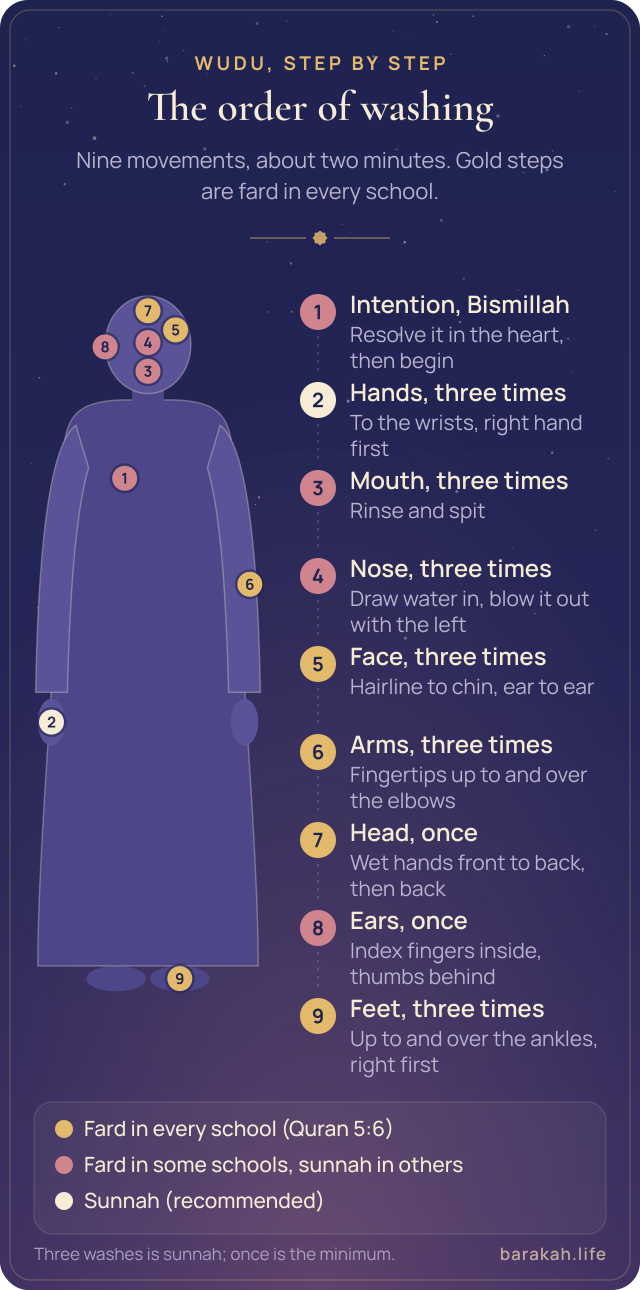
Intention, then Bismillah. Intend in your heart that you are purifying yourself for prayer; nothing needs to be said aloud. The Prophet ﷺ said “Actions are only by intentions” (Bukhari 1). Then say Bismillah, in the name of Allah.
Wash the hands three times. Up to the wrists, right hand first, letting water run between the fingers. Take off rings that are tight.
Rinse the mouth three times. Take water in with the right hand, move it around the mouth, and spit it out. A siwak or a toothbrush before this is a sunnah: he ﷺ said that were it not a hardship for his people he would have ordered the siwak at every prayer (Bukhari 887).
Rinse the nose three times. Draw a little water into the nostrils with the right hand and blow it out with the left. Be gentle if you are fasting.
Wash the face three times. From the hairline to under the chin, and from one ear to the other. If you have a beard, run wet fingers through it.
Wash the arms three times each. Right arm first, from the fingertips up to and including the elbows, then the left.
Wipe the head once. Wet your hands, place them at the front of the head, draw them back to the nape and return them to the front (Bukhari 185). This is a wipe with wet hands, not a wash.
Wipe the ears once. With the same wetness, the index fingers wipe inside the ears and the thumbs wipe behind them.
Wash the feet three times each. Right foot first, up to and including the ankles, with a little finger drawn between the toes. The Prophet ﷺ warned “Woe to the heels from the Fire” when he saw dry heels (Bukhari 60), so make sure the water reaches them.
Then say the du'a after wudu, given in full below. Washing each part three times is the sunnah; once, covering the whole area, is the minimum, and the Prophet ﷺ did each of these at different times: once (Bukhari 157), twice (Bukhari 158) and three times (Bukhari 159).
The order of washing. Gold marks the four acts the Quran commands, which every school treats as obligatory.
The fard acts of wudu, and the sunnah acts
The foundation of wudu is one verse of the Quran. Read it slowly and you can see the four obligatory acts inside it:
Yā ayyuha-lladhīna āmanū idhā qumtum ila-ṣ-ṣalāti fa-ghsilū wujūhakum wa aydiyakum ila-l-marāfiqi wa-msaḥū bi-ru'ūsikum wa arjulakum ila-l-kaʿbayn.
O you who believe, when you rise for prayer, wash your faces and your arms up to the elbows, wipe your heads, and wash your feet up to the ankles.
Qur'ān 5:6 (opening of the verse)
Washing the face, washing the arms to the elbows, wiping the head, and washing the feet to the ankles: these four are fard (obligatory) in all four schools, and a wudu missing any of them is not valid. Everything else the Prophet ﷺ did is either an extra condition that some schools add, or a sunnah that completes the wudu and brings its own reward. The table shows where each school places the acts people ask about most.
Act
Hanafi
Maliki
Shafi'i
Hanbali
Face, arms, head, feet
Fard
Fard
Fard
Fard
Intention (niyyah)
Sunnah
Fard
Fard
Fard
Keeping the order
Sunnah
Sunnah
Fard
Fard
No long pause between limbs
Sunnah
Fard
Sunnah
Fard
Rubbing the limbs (dalk)
Sunnah
Fard
Sunnah
Sunnah
Rinsing mouth and nose
Sunnah
Sunnah
Sunnah
Fard
Saying Bismillah
Sunnah
Sunnah
Sunnah
Wajib if remembered
Wiping the ears
Sunnah
Sunnah
Sunnah
Fard (part of the head)
How much of the head
A quarter
All of it
Any part
All of it
Two practical lessons come out of this. First, if you follow the full sunnah method above, your wudu is valid in every school, because it contains every act any school requires. Second, the differences are real scholarship, not carelessness: the Bismillah, for example, rests on the hadith “there is no wudu for the one who does not mention Allah's name over it” (Abu Dawud 101, Tirmidhi 25), which al-Albani graded authentic through its many routes while Imam Ahmad said he knew of no strong chain for it. The Hanbalis therefore make it binding when remembered, and the other schools a strong sunnah. Follow the school you were taught, and do not trouble anyone who follows another.
Does wudu have to be in order?
The Prophet ﷺ always made wudu in the order of the verse, and that is the way to learn it. Whether a wudu done out of order is still valid is one of the differences above: the Shafi'i and Hanbali schools say it is not, the Hanafi and Maliki schools say it is, though it falls short of the sunnah. In practice: if you realise mid-wudu that you skipped a limb, go back to that limb and continue in order from there. If you only notice after you have finished and the water has dried, the safest course in every school is to repeat the wudu. It costs you two minutes.
What breaks wudu
Wudu stays with you until something ends it. You can pray several prayers with one wudu; on the day of the conquest of Makkah the Prophet ﷺ prayed several prayers with a single wudu, and told ‘Umar he had done it deliberately (Muslim 277). Three things end wudu in every school:
Anything leaving the front or back passage: urine, stool, wind, and the like. Abu Hurayrah, explaining the hadith that Allah does not accept the prayer of one who has broken his wudu until he renews it, said this means passing wind (Bukhari 135).
Deep sleep that removes awareness. A light doze while sitting firmly does not break it in the four schools; lying down asleep does.
Losing your mind for a time: fainting, anaesthetic, or intoxication.
Beyond these, the schools differ, and the differences follow real evidence on both sides. Touching the private part breaks wudu in three schools because of the hadith of Busrah (Abu Dawud 181), while the Hanafis follow the hadith of Talq ibn ‘Ali, “it is only a part of you” (Abu Dawud 182). Eating camel meat breaks it for the Hanbalis because the Prophet ﷺ was asked and said yes (Muslim 360); the other schools read that as a recommendation or as abrogated.
Agreed in every school above; the differences below. Follow the school you were taught.
Doubt does not break wudu. If you are sure you made wudu and only unsure whether it broke, it has not broken. The Prophet ﷺ said not to leave the prayer “until he hears a sound or finds a smell” (Bukhari 137). This one hadith frees many people from endless repeating.
Wiping over socks and khuffs
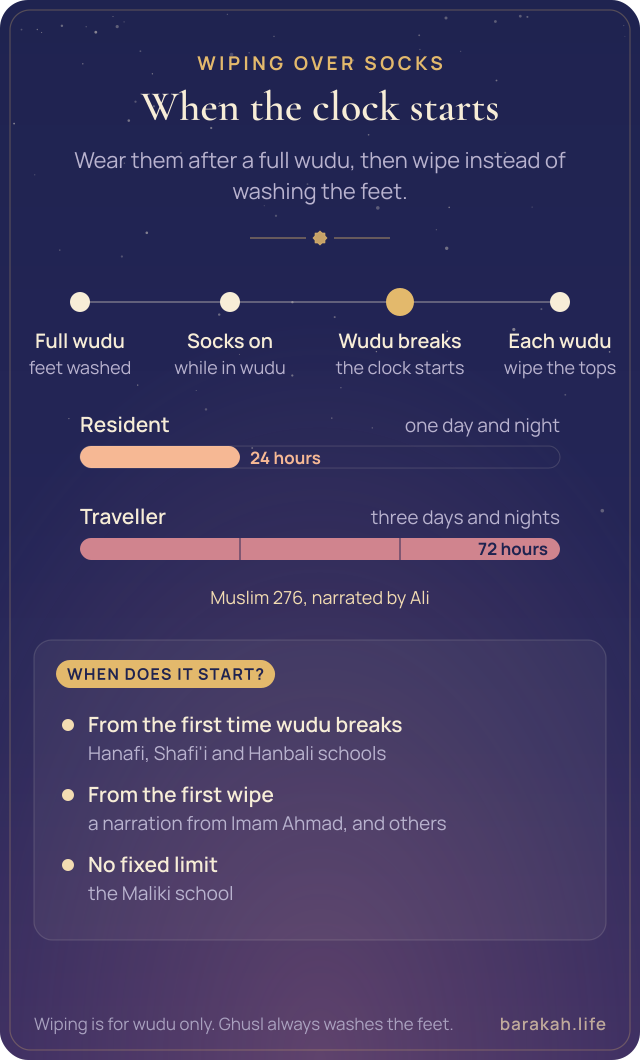
Instead of washing the feet, you may wipe over leather socks (khuffs) that you put on while in a state of wudu. When al-Mughirah moved to take off the Prophet's khuffs, he ﷺ said, “Leave them, I put them on while my feet were pure,” and wiped over them (Bukhari 206). The time allowed was set by the Prophet ﷺ: one day and night for a resident, three days and nights for a traveller (Muslim 276).
Make a full wudu, washing the feet.
Put the socks on while that wudu is still intact.
When you next make wudu, do everything as normal, but instead of washing the feet, pass wet fingers once over the top of each sock, from the toes towards the shin. ‘Ali said that if the religion were by opinion the underside would be wiped, but he saw the Prophet ﷺ wipe the top (Abu Dawud 162).
When the time runs out, or you take the socks off, wash the feet in your next wudu.
The time limit and when it starts. Wiping is for wudu only; ghusl always washes the feet.
What about ordinary cotton or wool socks? Leather khuffs are agreed on. For cloth socks the schools differ. The Hanbalis allow wiping over socks that cover the foot and stay up on their own, and later Hanafis allow it if the socks are thick enough to walk in; the Shafi'i and Maliki schools are stricter. A narration that the Prophet ﷺ wiped over socks (Abu Dawud 159, Tirmidhi 99) was graded sound by al-Tirmidhi and al-Albani but weakened by others, so the stronger support for the wider view is that a number of Companions wiped over their socks, as Abu Dawud records. Many scholars today take that wider view, especially in cold weather and at work. If your school is stricter, follow it.
Wudu for women: hair, makeup and nail polish
Wudu is the same for men and women; the Prophet ﷺ taught one method. A few practical points come up more often for women.
Nail polish. Water has to reach the nails. Ordinary nail polish forms a waterproof layer, so wudu is not valid over it in any school; remove it before wudu, or wear it only when you are not praying. Henna is a stain, not a layer, and is no barrier. “Breathable” polishes are disputed, so ask a scholar you trust before relying on one.
Makeup. Anything that sits on the skin as a waterproof film, such as waterproof foundation or mascara, must come off for wudu. Ordinary powder and colour that water passes through is not a barrier.
Hair and hijab. You wipe the head, not the length of the hair. If you are wearing a scarf, slip a wet hand under it and wipe the front of the head; the Hanbali school also allows completing the wipe over a scarf wrapped under the chin.
After a period. The end of menstruation or postpartum bleeding calls for ghusl, the full bath, not only wudu. A ghusl done with the intention, washing the whole body, covers wudu as well in the majority view.
Wudu at work, in the shower, or with a bandage
At work. A small bottle or cup at an office sink is enough for every step. If washing the feet in a shared bathroom is awkward, wiping over socks put on after your morning wudu is exactly what the concession is for.
In the shower. Standing under running water is not wudu by itself. If you intend wudu and pass the water over each part in order, it is valid; the order matters most for the Shafi'i and Hanbali schools.
With a cast or bandage. Wash everything you can, and wipe once over a dressing that cannot be removed without harm. All four schools allow this wipe over a splint or bandage.
The du'a after wudu
‘Umar narrated that the Prophet ﷺ said: whoever makes wudu well and then says these words, the eight gates of Paradise are opened for him and he may enter by whichever he wishes.
Ash-hadu an lā ilāha illa-llāhu waḥdahu lā sharīka lah, wa ash-hadu anna Muḥammadan ʿabduhu wa rasūluh.
I bear witness that there is no god but Allah alone, without partner, and I bear witness that Muhammad is His servant and His Messenger.
Ṣaḥīḥ Muslim 234
Two additions are reported and many people say them too. Al-Tirmidhi records this line after the shahada; al-Albani graded the addition authentic, while al-Tirmidhi himself noted that its chain is disrupted:
O Allah, make me among those who turn to You in repentance, and make me among those who purify themselves.
Jāmiʿ al-Tirmidhī 55, graded ṣaḥīḥ by al-Albānī
And Abu Sa'id al-Khudri taught that whoever says the following after wudu, it is written on a parchment and sealed, not to be broken until the Day of Resurrection. Al-Nasa'i and Ibn Hajar judged that it is authentic as Abu Sa'id's own words, which scholars treat as carrying the weight of the Prophet's teaching, since no one says such a thing from opinion:
Subḥānaka-llāhumma wa bi-ḥamdik, ash-hadu an lā ilāha illā ant, astaghfiruka wa atūbu ilayk.
Glory be to You, O Allah, and praise. I bear witness that there is no god but You. I seek Your forgiveness and turn to You in repentance.
al-Nasāʾī, ʿAmal al-Yawm wa-l-Layla 81, from Abū Saʿīd al-Khudrī
The du'a is said once wudu is complete. Some people look up at the sky while saying it, but the narration that mentions this is weak (Abu Dawud 170), so there is no need to make it part of the practice.
Tayammum: when there is no water
When water cannot be found, or using it would cause real harm through illness or severe cold, the Quran gives a dry purification. The same verse continues that if you find no water, you are to seek clean earth and wipe your faces and hands with it (5:6). The Prophet ﷺ counted it among the things given to him: “the earth has been made for me a place of prayer and a means of purification” (Bukhari 335).
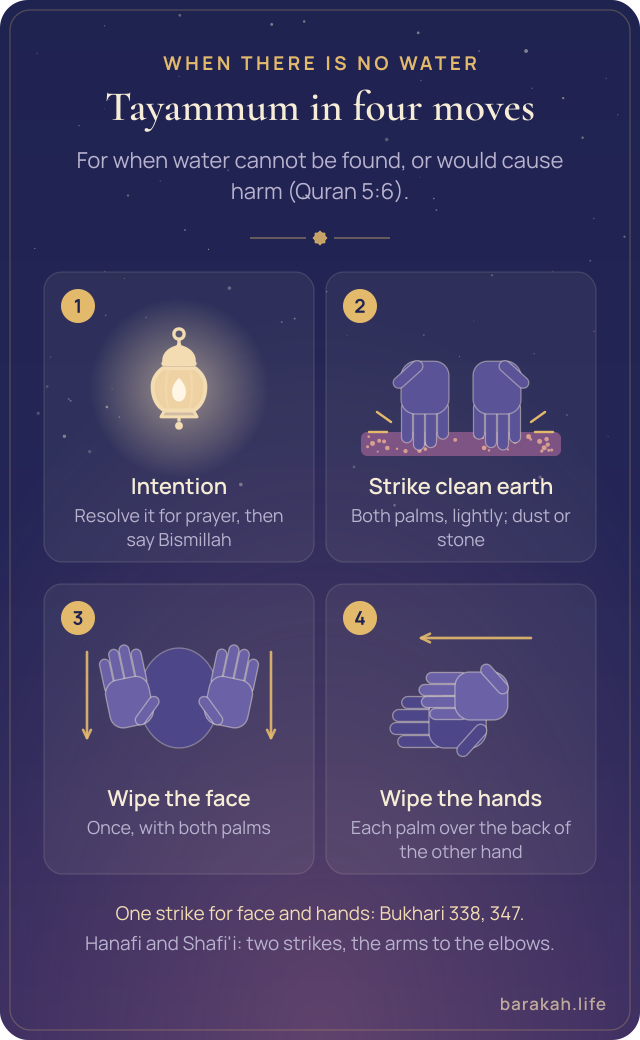
Tayammum as ‘Ammar ibn Yasir described it, with the main difference between the schools.
‘Ammar ibn Yasir described the Prophet ﷺ showing him: he struck the ground with his palms, blew on them lightly, and wiped his face and his hands (Bukhari 338, 347). The Hanbali school follows this single strike for face and hands; the Hanafi and Shafi'i schools use two strikes, one for the face and one for the arms up to the elbows, and the Maliki school one strike as the obligation with a second recommended. Tayammum is broken by whatever breaks wudu, and also by finding water.
Why it matters
Wudu is not only a gate to prayer; it is worship in its own right. “Purification is half of faith” (Muslim 223). The Prophet ﷺ said that when a believer washes his face, every sin his eyes looked at leaves with the water, or with the last drop; when he washes his hands, every sin his hands did leaves with it; and when he washes his feet, every sin his feet walked to, until he comes out cleansed (Muslim 244). On the Day of Resurrection his ummah will be called with faces, hands and feet shining from the traces of wudu (Bukhari 136). Two minutes at a sink, five times a day, and you will be known by it.
Learn it with Barakah Life. Our interactive wudu guide walks through each step with pictures you can follow at the sink, then hands you to the prayer guides, starting with Fajr. In the Barakah Life app you get accurate prayer times and a reminder before each prayer, a qibla compass, and the du'a after wudu with its audio, so the words settle in while your hands learn the steps.
Questions people ask
Does sleeping break wudu?
Deep sleep breaks wudu in all four schools, because awareness is lost. A light doze while sitting firmly, where you would notice if something happened, does not break it. If you slept lying down, renew your wudu.
Does bleeding break wudu?
In the Hanafi school, blood or pus that flows out of a wound breaks wudu; the Hanbalis say only a large amount does; the Maliki and Shafi'i schools say it does not. A small cut or a drop of blood breaks nothing in the majority view.
Is the du'a after wudu compulsory?
No. Wudu is complete without it. It is a sunnah with a great promise attached: the eight gates of Paradise are opened for whoever says it after a good wudu (Muslim 234).
Is wudu valid with nail polish?
Not with ordinary nail polish, because it stops water reaching the nails, and this is agreed in every school. Remove it before wudu. Henna is only a stain and is no barrier.
Do I need wudu to read the Quran?
The four schools require wudu to touch a printed mushaf. Reciting from memory without wudu is allowed, and most contemporary scholars also allow reading from a phone or screen without it. After major impurity, most scholars ask for ghusl before reciting, with a difference of opinion for a woman during her period.
Do I have to make wudu before every prayer?
Only if it has broken. One wudu can carry you through several prayers (Muslim 277). Renewing it for each prayer anyway is a virtue the Prophet ﷺ often practised.
Can tayammum replace ghusl?
Yes. When water is unavailable or harmful to use, tayammum stands in for ghusl as well as wudu; the same verse covers both. Once water becomes available, the ghusl is then done.
What if I forget a step?
Go back to the step you missed and continue in order from there. If you only notice after finishing and the limbs have dried, repeat the whole wudu to be safe in every school.
Wash well, and know what the water carries away. Then stand for prayer, and keep this page near the sink until your hands no longer need it.
Sunan Abī Dāwūd 101, 159, 162, 170, 181, 182; Jāmiʿ al-Tirmidhī 25, 55, 99; al-Nasāʾī, ʿAmal al-Yawm wa-l-Layla 81. Gradings as recorded by al-Albānī and others.
al-Mawsūʿa al-Fiqhiyya al-Kuwaytiyya, entries “Wuḍūʾ”, “Masḥ ʿala-l-khuffayn” and “Tayammum”, for the positions of the four schools.
This guide sets out the Prophetic method and the positions of the four schools. Where they differ, follow the school you were taught, or ask a scholar whose knowledge you trust.
Tagswudufiqhbeginnersprayer
Pass it on
Know someone who needs this today? Send it to them.
“Whoever guides someone to good has a reward like the one who does it.” Sahih Muslim 1893