How to pray salah step by step: a guide for new Muslims
A gentle, complete walkthrough of the Muslim prayer for new Muslims: the five prayers, wudu, every position illustrated, every word in Arabic, transliteration and English, and what to do while you are still learning.
If you have just taken your shahada, or you are about to, the prayer can look like the hardest part: five times a day, in a language you may not read yet, with movements everyone around you seems to have known since childhood. Take a breath. Every Muslim who has ever prayed learned it one line at a time. This guide walks you through one complete prayer, slowly, with every position drawn and every word given in Arabic, in transliteration so you can say it, and in English so you know what you are saying. Where the four schools differ, we say so plainly, so nobody can make you feel you are doing it wrong.
In short
Make wudu, face the qibla once the time has come in, and intend the prayer in your heart. Say Allahu Akbar, recite Al-Fatiha, bow, stand up, prostrate twice with a short sitting between, and that is one rak'ah. After every second rak'ah you sit for the tashahhud, and in the last sitting you end with as-salamu 'alaykum to the right and the left. Everything below fills in that outline.
Salah is the ritual prayer: the second pillar of Islam after the shahada, and the first act of worship the Prophet ﷺ taught people after they believed. When he sent Mu'adh ibn Jabal to Yemen, he told him to call people first to the testimony of faith, and then, once they accepted it, to teach them that Allah had made five prayers obligatory every day and night (Sahih al-Bukhari 1395). It is not a performance for anyone watching; it is a conversation, five times a day, with the One who made you. Allah said to Musa (Moses), when He called to him in the sacred valley:
Innanī anā-llāhu lā ilāha illā ana fa'budnī wa aqimi-ṣ-ṣalāta li-dhikrī.
Indeed, I am Allah. There is no god except Me, so worship Me, and establish the prayer for My remembrance.
Quran 20:14 (Surah Ta-Ha)
The Prophet ﷺ asked his companions whether any dirt would remain on a man who had a river at his door and bathed in it five times a day. None, they said. That, he told them, is the likeness of the five prayers: through them Allah wipes away sins (Sahih al-Bukhari 528, Sahih Muslim 667). You are not being tested on your Arabic. You are stepping into the river.
The five daily prayers and their rak'ahs
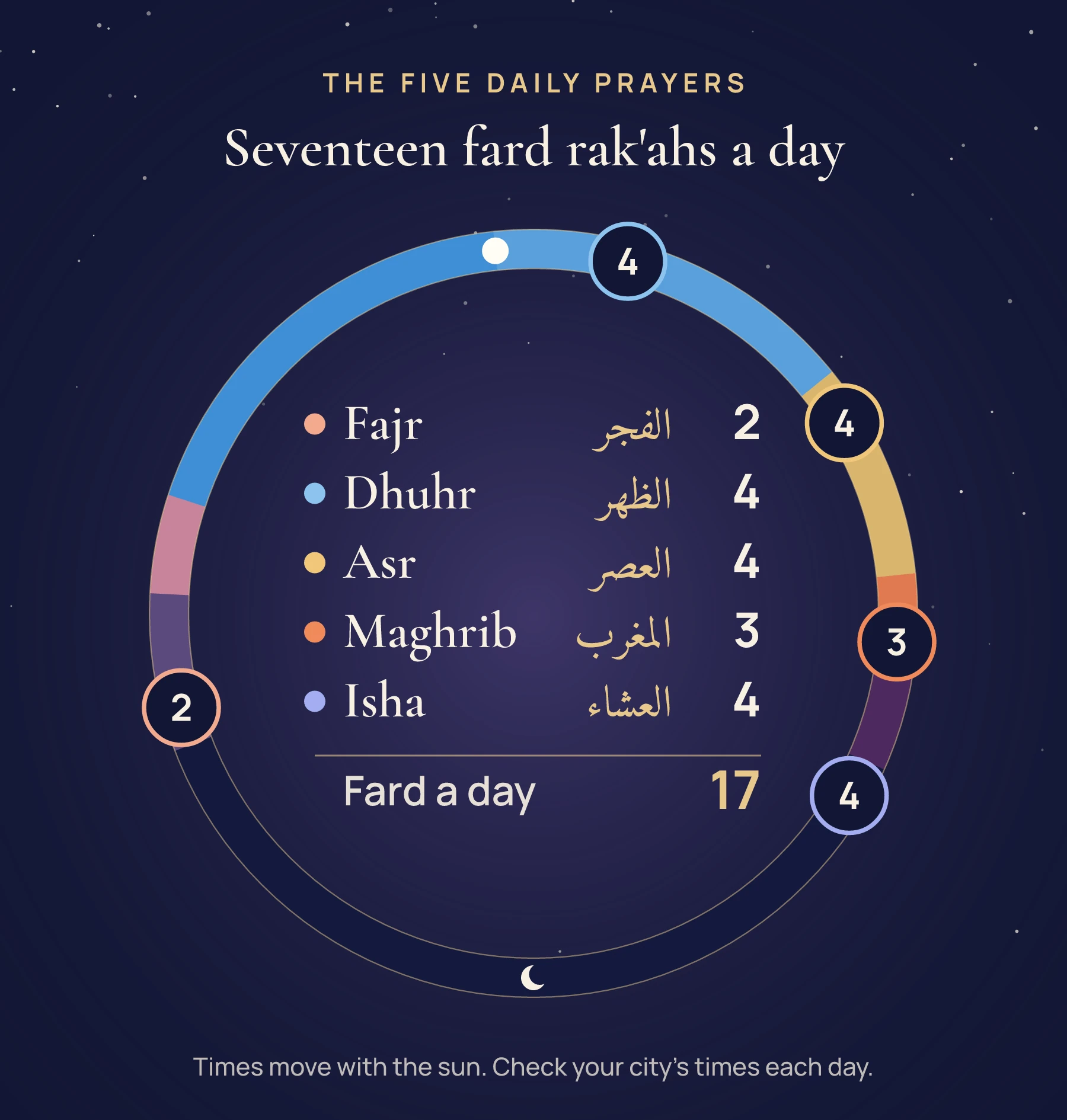
A rak'ah is one unit of the prayer: standing, bowing, rising and two prostrations. Each of the five prayers is a fixed number of these units, and together they make seventeen obligatory (fard) rak'ahs a day. The times are tied to the sun, which is why they move a little every day and differ from city to city.
The five prayers follow the sun. Seventeen fard rak'ahs, spread through the day.
Prayer
When
Fard rak'ahs
Fajr
From true dawn until sunrise
2
Dhuhr
Just after midday, once the sun passes its height
4
Asr
Mid to late afternoon
4
Maghrib
Just after sunset
3
Isha
After the evening twilight has gone
4
The Prophet ﷺ set out the window of each prayer, from its start to its end (Sahih Muslim 612), and the Quran describes the prayer as a duty at fixed times:
Indeed, prayer has been prescribed for the believers at fixed times.
Quran 4:103 (part of the verse)
You do not need to calculate any of this. Look up your city on our prayer times page, or let the app remind you. Scholars differ slightly on when Asr begins (the Hanafi school places it later), and calculation methods vary for Fajr and Isha, so a mosque timetable may not match an app to the minute.
Beyond the fard, the Prophet ﷺ said that whoever prays twelve voluntary rak'ahs in a day and night will have a house built for them in Paradise (Sahih Muslim 728): two before Fajr, four before Dhuhr, two after it, two after Maghrib and two after Isha (Jami' at-Tirmidhi 415, graded sahih). Witr at night is necessary (wajib) in the Hanafi school and a strongly recommended sunnah in the others. As a new Muslim, make the seventeen fard rak'ahs steady first. The rest will come.
Before you pray: the conditions
A few things need to be in place first. None is complicated, and soon you will barely notice them.
1. Purity, with wudu
The Prophet ﷺ said that no prayer is accepted without purification (Sahih Muslim 224). For the daily prayers that means wudu, the small ablution: washing the hands, mouth, nose, face and arms, wiping the head and ears, and washing the feet. It takes about two minutes and lasts until something breaks it, such as using the toilet, passing wind or deep sleep. Our step-by-step wudu guide covers it in full, with the du'a to say at the end.
After marital intimacy, and after a period or postnatal bleeding has ended, the larger wash, ghusl (a full shower with the intention of purification), is needed before praying. If you have just embraced Islam, scholars recommend (and some require) a ghusl as your first act, and our guide on taking the shahada explains why.
2. A clean body, clean clothes and a clean place
Your body, clothes and prayer spot should be free of impurities such as urine or blood. The Prophet ﷺ said that the earth was made a place of prayer for him (Sahih al-Bukhari 335), so a prayer mat is a convenience, not a requirement; a clean towel or patch of floor works just as well.
3. Covering the awrah
The awrah is the part of the body that must be covered in prayer. For a man, most scholars define it as from the navel to the knees, and the Prophet ﷺ also told men not to pray with their shoulders bare when they have the cloth to cover them (Sahih al-Bukhari 359). For a woman, most scholars define it as the whole body except the face and hands, with the hair covered (Sunan Abi Dawud 641, graded sahih); the Hanafi school also does not count the feet. Ordinary clothes are fine, as long as they are loose and thick enough not to show the body beneath.
4. Facing the qibla
Muslims everywhere pray towards the Ka'bah in Makkah, the qibla.
Fa-walli wajhaka shaṭra-l-masjidi-l-ḥarām, wa ḥaythu mā kuntum fa-wallū wujūhakum shaṭrah.
So turn your face towards the Sacred Mosque. And wherever you are, turn your faces towards it.
Quran 2:144 (part of the verse)
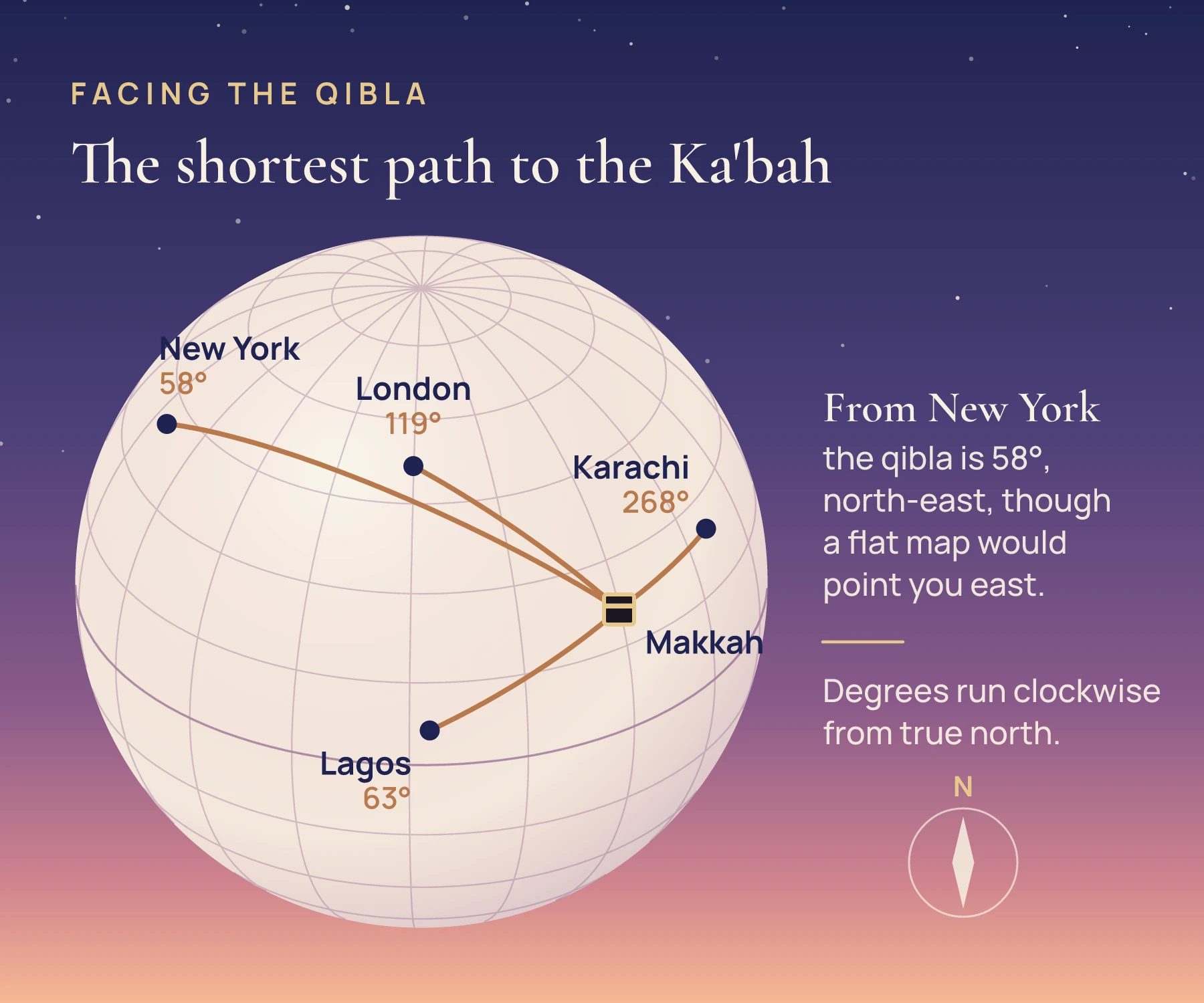
What surprises many new Muslims: the qibla follows the shortest path over the curve of the earth, not a line on a flat map. From New York it points north-east, at about 58 degrees, though a flat map makes Makkah look due east. From London it is about 119 degrees, south-east.
Great-circle paths to the Ka'bah. The bearing is measured clockwise from true north.
Use our qibla finder or the compass in the app, then note a landmark in your room. If you made a sincere effort and later learn you were slightly off, your prayer stands.
5. The time has entered
A prayer prayed before its time starts does not count, so check the start time, especially for Fajr and Maghrib, which are easy to misjudge by eye.
6. The intention
The Prophet ﷺ said that actions are judged by their intentions (Sahih al-Bukhari 1). The intention (niyyah) is simply knowing in your heart which prayer you are about to pray: this is Dhuhr. You do not need to say it aloud or recite a formula.
What makes the prayer valid
A man once prayed in the mosque and greeted the Prophet ﷺ, who told him to go back and pray, for he had not prayed. After the third time, the man asked to be taught. The Prophet ﷺ told him to make wudu properly, face the qibla, say the takbir, recite what he could of the Quran, then bow until he was at rest in the bow, rise until he stood straight, prostrate until he was at rest, sit until he was at rest, and do the same throughout his prayer (Sahih al-Bukhari 757 and 6251, Sahih Muslim 397).
The essentials. The schools group the parts of the prayer slightly differently, calling some pillars, some obligations and some sunnah, but every one of them teaches you to do all of these: stand if you are able, say the opening takbir, recite Al-Fatiha in every rak'ah, bow, rise upright, prostrate twice with a sitting between, stay still for a moment in each position, sit for the final tashahhud, and end with the salam. Learn these first. The other words, such as the opening du'a, add beauty and reward, and some of them (like the words of ruku and sujud) are obligatory in certain schools, so learn them early too.
Notice the phrase that keeps returning: until you are at rest. Stillness in each position, called tuma'ninah, is part of the prayer itself. A slow prayer with few words is better than a fast one with many.
How to pray two rak'ahs, step by step
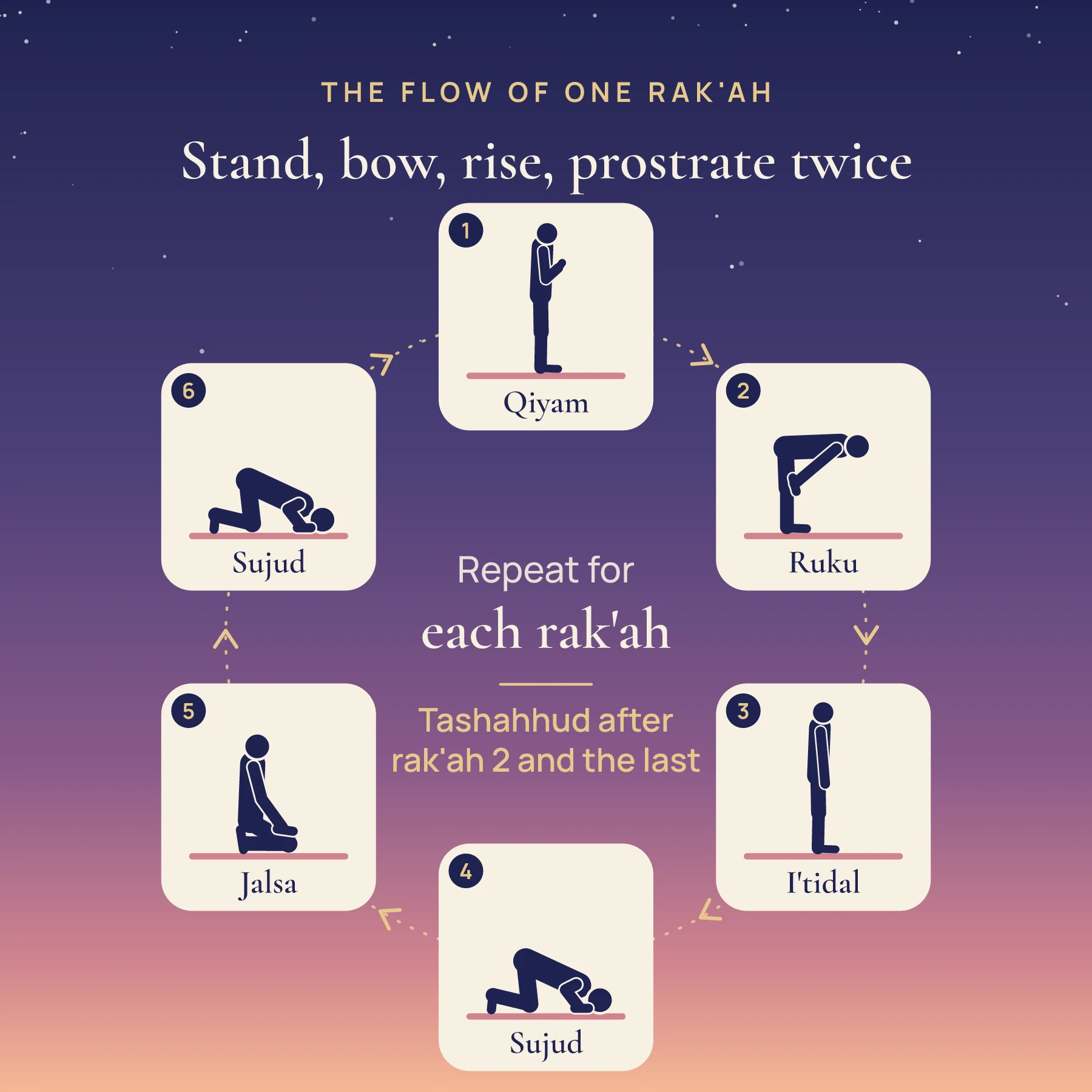
Here is one complete two-rak'ah prayer, the shape of Fajr and of most voluntary prayers. Every other prayer is the same pattern with more rak'ahs. The figures face right, towards the qibla.
One rak'ah is six movements. The sitting for the tashahhud comes after the second rak'ah and at the end.
Step 1: Stand and say the opening takbir
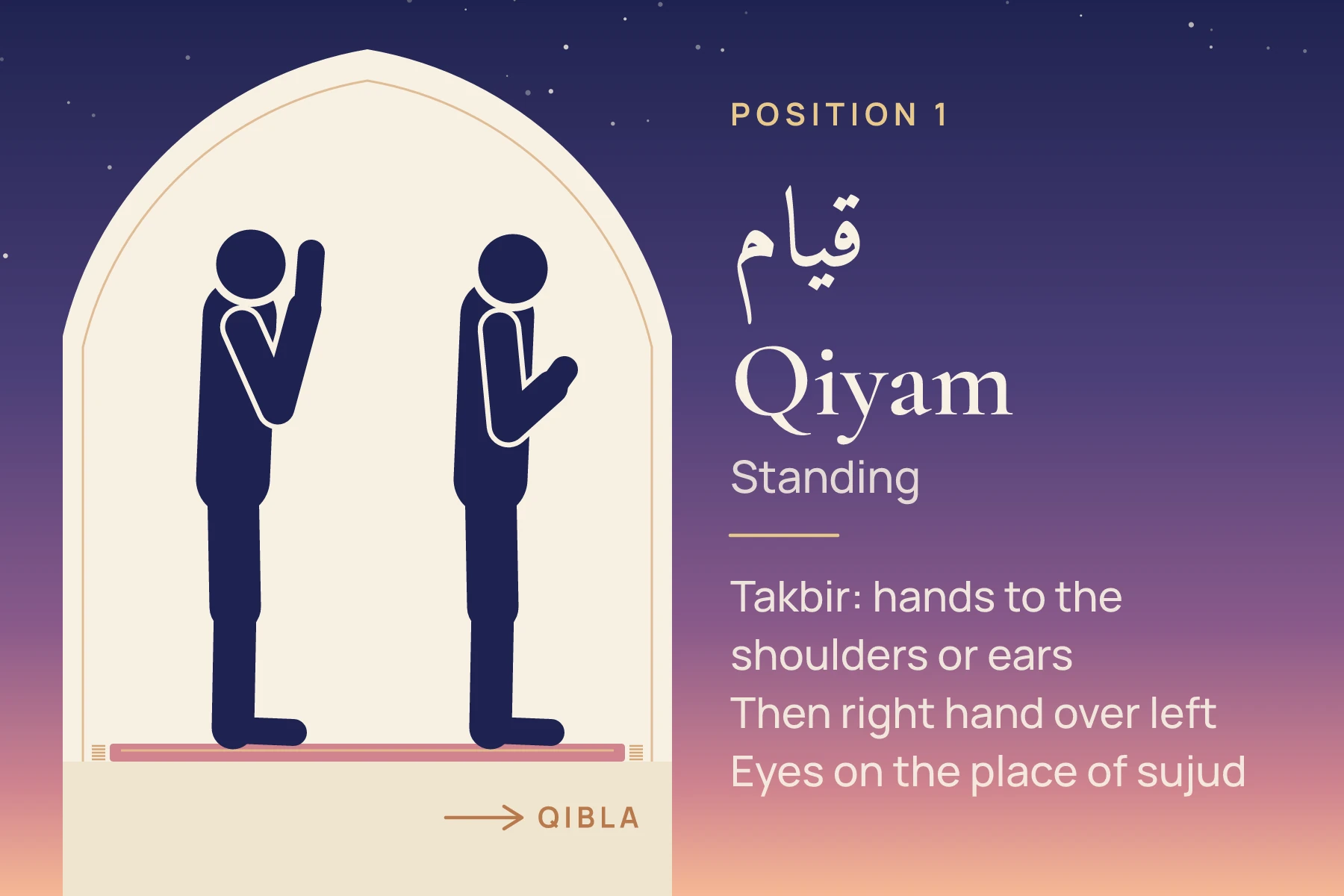
Stand facing the qibla, eyes lowered to the place where your forehead will rest. Raise your hands with the palms facing forward, level with your shoulders (Sahih al-Bukhari 735) or up to your ears (Sahih Muslim 391); both are from the Sunnah. As you raise them, say:
ٱللَّهُ أَكْبَرُ
Allāhu Akbar.
Allah is the Greatest.
The opening takbir, Sahih al-Bukhari 757 · Sahih Muslim 397
This is takbirat al-ihram, the takbir of sanctity: from now until the salam, you do not talk, eat or look around.
Qiyam: the opening takbir, then standing with the right hand over the left.
Step 2: Place your hands and say the opening du'a
Lower your hands and place the right hand over the left (Sahih Muslim 401). Where the hands rest is a known difference: some scholars teach on the chest, the Shafi'i school just below the chest, the Hanafi and Hanbali schools below the navel, and the well-known practice of the Maliki school is to let the arms rest at the sides. Each has scholarship behind it; follow the way you are taught.
Then quietly say an opening du'a, a sunnah of the first rak'ah only. A short one many people learn first:
Subḥānaka-llāhumma wa bi-ḥamdik, wa tabāraka-smuk, wa ta'ālā jadduk, wa lā ilāha ghayruk.
Glory be to You, O Allah, and all praise. Blessed is Your name, exalted is Your majesty, and there is no god but You.
Sunan Abi Dawud 776 · Jami' at-Tirmidhi 243, both graded sahih by al-Albani
The Prophet ﷺ used other openings too, such as the one asking Allah to put as much distance between you and your sins as between the east and the west (Sahih al-Bukhari 744).
Step 3: Seek refuge and say the Basmalah
Before reciting, seek Allah's protection from Satan, as the Quran instructs:
أَعُوذُ بِاللَّهِ مِنَ الشَّيْطَانِ الرَّجِيمِ
A'ūdhu bi-llāhi mina-sh-shayṭāni-r-rajīm.
I seek refuge in Allah from Satan, the outcast.
Based on Quran 16:98: “When you recite the Quran, seek refuge in Allah from Satan, the outcast”
بِسْمِ ٱللَّهِ ٱلرَّحْمَـٰنِ ٱلرَّحِيمِ
Bismi-llāhi-r-Raḥmāni-r-Raḥīm.
In the name of Allah, the Entirely Merciful, the Especially Merciful.
Quran 1:1
The schools differ on the Basmalah: the Shafi'i school counts it as the first verse of Al-Fatiha and recites it with the surah, the Hanafi and Hanbali schools say it quietly before the surah, and the Maliki school does not recite it in the obligatory prayers. Most new Muslims are taught to say it quietly.
Step 4: Recite Al-Fatiha
Al-Fatiha, the Opening, is the heart of every rak'ah: the Prophet ﷺ said there is no prayer for the one who does not recite it (Sahih al-Bukhari 756, Sahih Muslim 394). It is the first thing to memorise.
Al-ḥamdu li-llāhi Rabbi-l-'ālamīn. Ar-Raḥmāni-r-Raḥīm. Māliki yawmi-d-dīn. Iyyāka na'budu wa iyyāka nasta'īn. Ihdina-ṣ-ṣirāṭa-l-mustaqīm. Ṣirāṭa-lladhīna an'amta 'alayhim, ghayri-l-maghḍūbi 'alayhim wa la-ḍ-ḍāllīn.
All praise is for Allah, Lord of all the worlds, the Entirely Merciful, the Especially Merciful, Master of the Day of Judgement. You alone we worship, and You alone we ask for help. Guide us to the straight path: the path of those You have blessed, not of those who have earned Your anger, nor of those who have gone astray.
Quran 1:2-7 (Surah Al-Fatiha)
At the end, say Amin:
آمِين
Āmīn.
O Allah, answer our prayer.
Sahih al-Bukhari 780 · Sahih Muslim 410
The Prophet ﷺ said that whoever's Amin coincides with the Amin of the angels will have their past sins forgiven (Sahih al-Bukhari 780). In the prayers recited aloud, the Shafi'i and Hanbali schools say Amin aloud and the Hanafi and Maliki schools say it quietly. You will hear both.
Step 5: Recite a short surah
In the first two rak'ahs, recite something more from the Quran after Al-Fatiha: a short surah or a few verses. It is a sunnah in most schools (the Hanafi school counts it as necessary). The shortest surahs, Al-Kawthar (108), Al-Asr (103) and Al-Ikhlas (112), are where most people begin. Here is Al-Ikhlas:
Qul huwa-llāhu aḥad. Allāhu-ṣ-ṣamad. Lam yalid wa lam yūlad. Wa lam yakun lahū kufuwan aḥad.
Say: He is Allah, the One. Allah, the Eternal Refuge, whom all depend upon. He neither begets nor was He begotten. And there is none comparable to Him.
Quran 112:1-4 (Surah Al-Ikhlas)
Step 6: Bow (ruku)
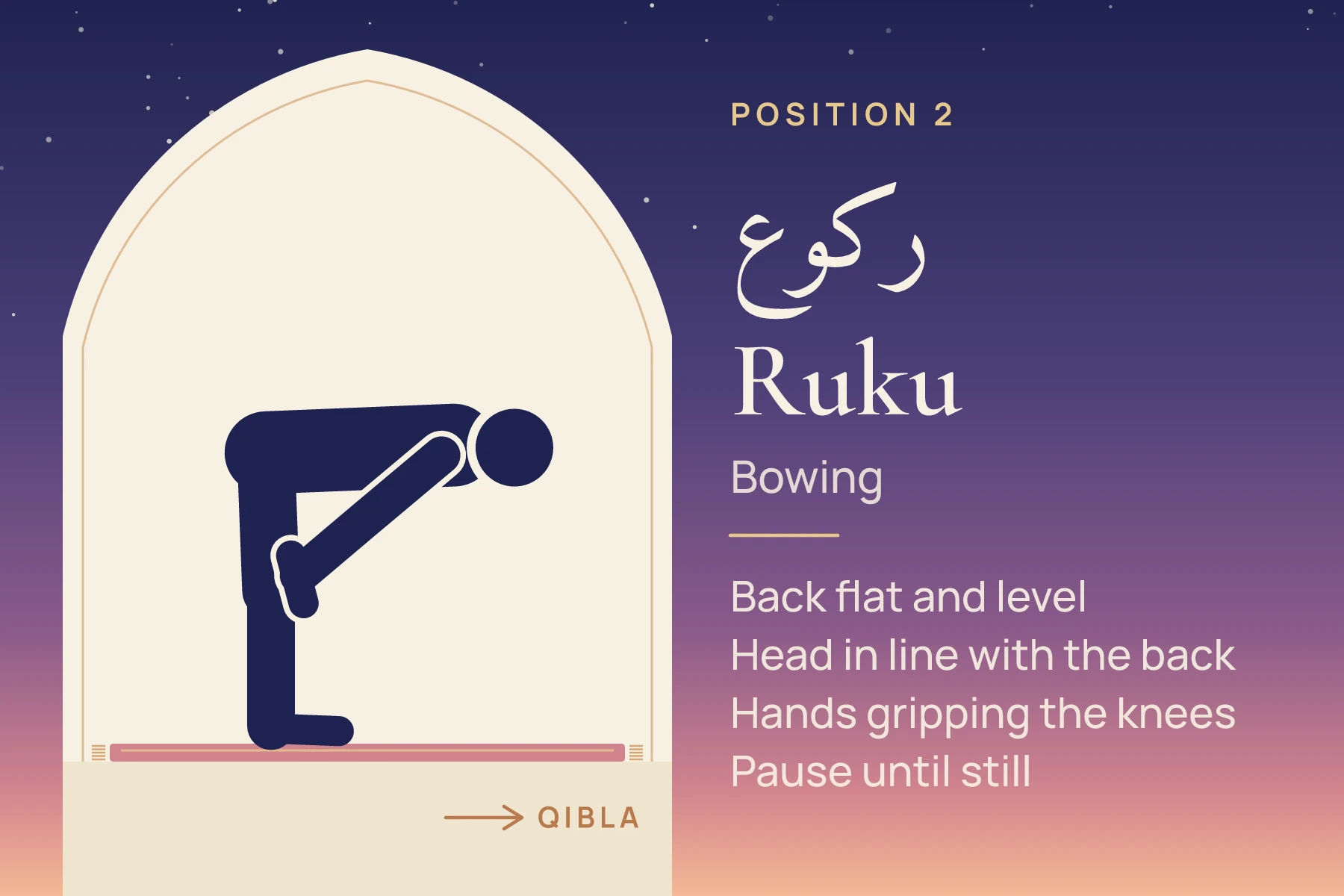
Say Allahu Akbar and bow from the hips. Place your hands on your knees with your fingers spread, keep your arms straight, and make your back flat, with your head level with it, neither drooping nor raised. Stay there until you are still, and say three times, or more:
Ruku: back level, head in line, hands on the knees, and a moment of stillness.
سُبْحَانَ رَبِّيَ الْعَظِيمِ
Subḥāna Rabbiya-l-Adheem.
Glory be to my Lord, the Magnificent.
Sahih Muslim 772
Step 7: Rise and stand upright (i'tidal)
Rise to standing, saying the first phrase as you come up and the second once you are upright and still.
سَمِعَ اللَّهُ لِمَنْ حَمِدَهُ
Sami'a-llāhu li-man ḥamidah.
Allah hears the one who praises Him.
Sahih al-Bukhari 789
رَبَّنَا وَلَكَ الْحَمْدُ
Rabbanā wa laka-l-ḥamd.
Our Lord, and to You belongs all praise.
Sahih al-Bukhari 789 · 796
When you pray behind an imam, he says the first line aloud, and the Prophet ﷺ told the people behind him to answer with the second (Sahih al-Bukhari 796).
Step 8: Prostrate (sujud)
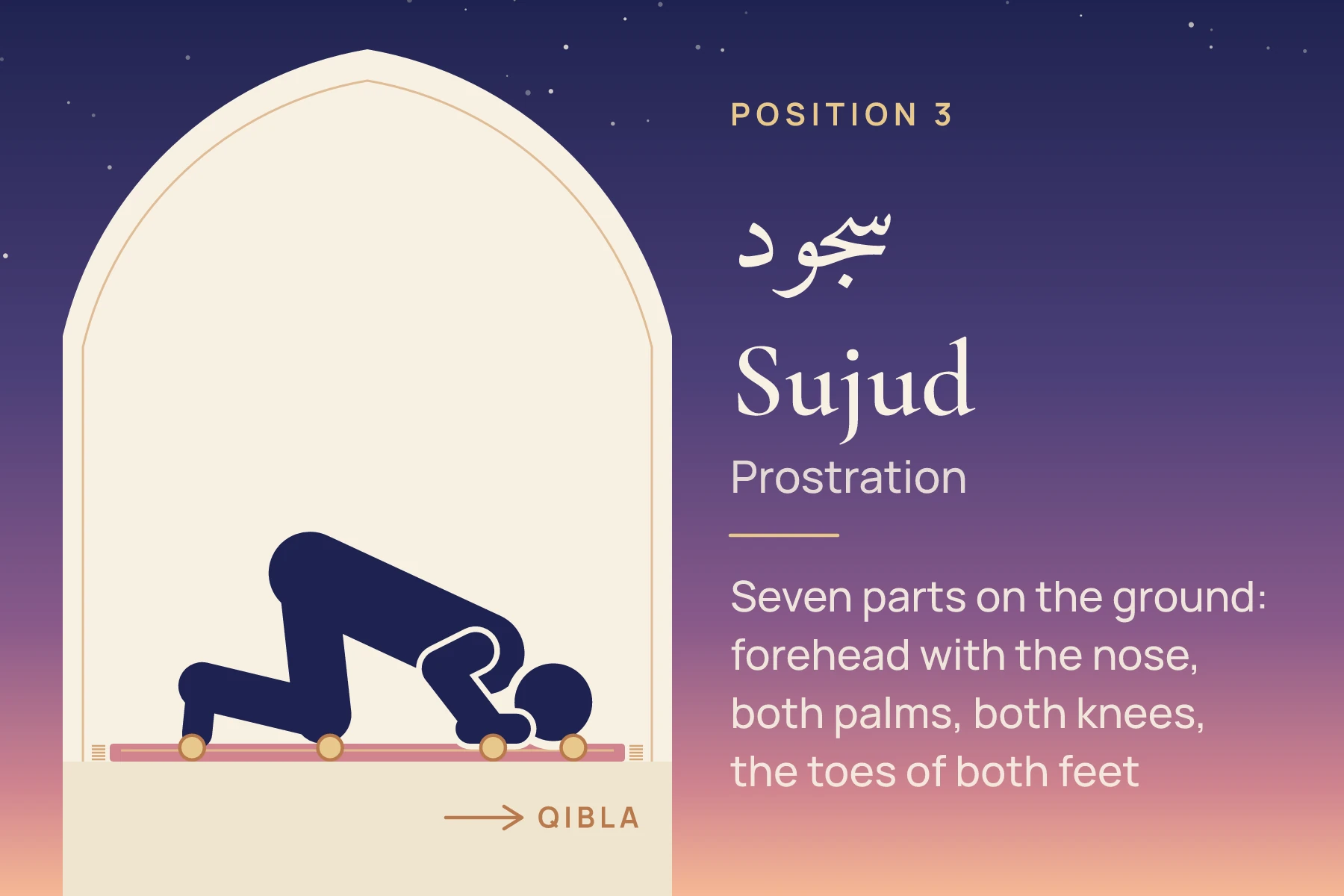
Say Allahu Akbar and go down into prostration. Seven parts of the body rest on the ground: the forehead together with the nose, both palms, both knees, and the toes of both feet (Sahih al-Bukhari 812, Sahih Muslim 490). Place your palms flat on the ground, level with your shoulders or your ears. Lift your elbows off the floor and away from your sides (Sahih Muslim 494); the Prophet ﷺ told us not to lay our forearms flat on the ground (Sahih al-Bukhari 822). Keep your toes bent so their tips face the qibla (Sahih al-Bukhari 828).
Most schools teach putting the knees down before the hands; the Maliki school teaches the hands first. Either way, go down gently.
Sujud: seven parts on the ground, elbows lifted, toes towards the qibla.
سُبْحَانَ رَبِّيَ الْأَعْلَى
Subḥāna Rabbiya-l-A'lā.
Glory be to my Lord, the Most High.
Sahih Muslim 772
Say it three times or more. The Prophet ﷺ said that a servant is nearest to his Lord while prostrating, so make plenty of du'a there (Sahih Muslim 482).
Step 9: Sit between the two prostrations
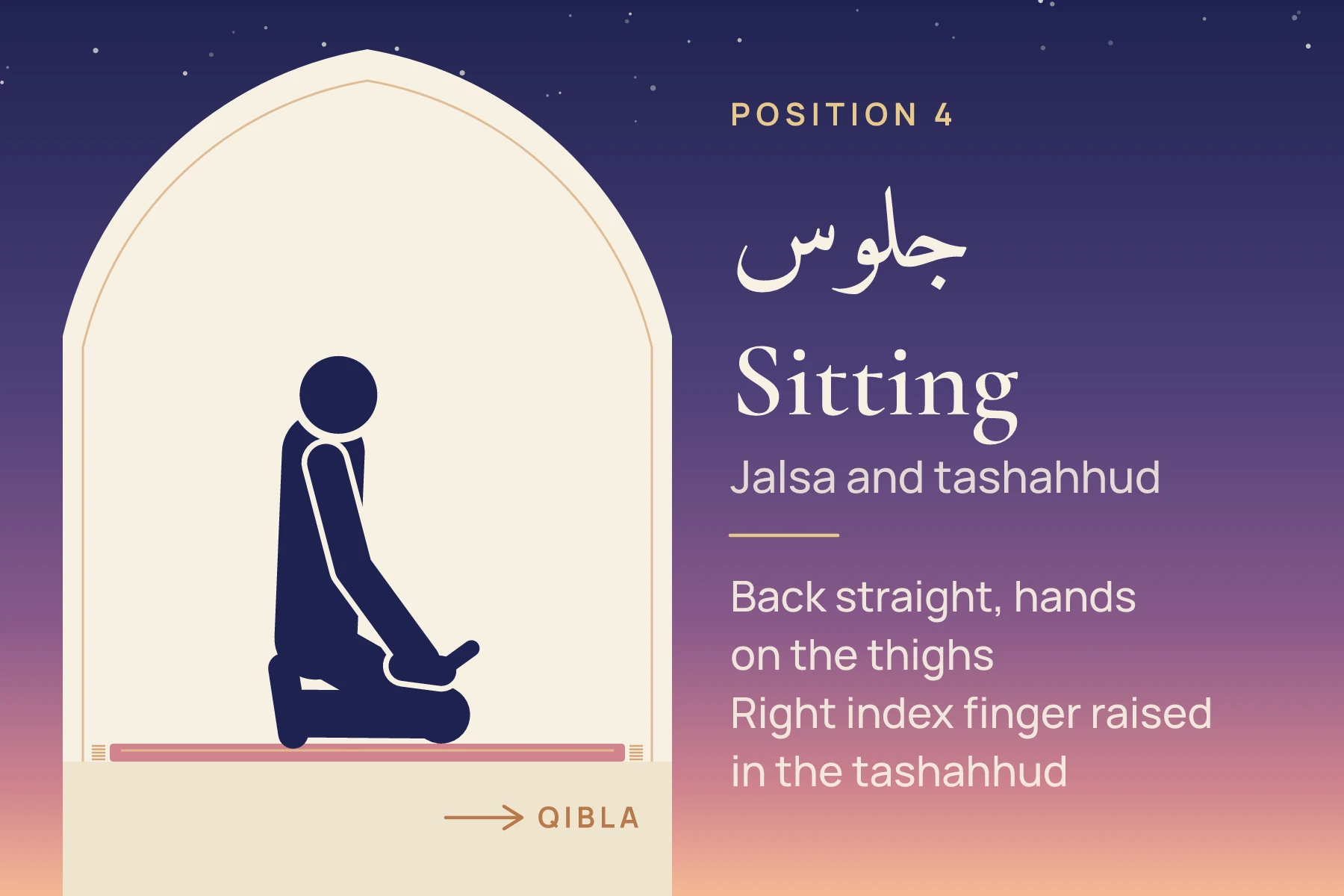
Say Allahu Akbar and sit up: the posture most often taught is sitting on your left foot laid flat, right foot upright with its toes bent towards the qibla, hands on your thighs. Sit until you are still, and say:
Sitting: the short sitting between the prostrations, and the longer one for the tashahhud.
رَبِّ اغْفِرْ لِي، رَبِّ اغْفِرْ لِي
Rabbi-ghfir lī, Rabbi-ghfir lī.
My Lord, forgive me. My Lord, forgive me.
Sunan Ibn Majah 897 · Sunan an-Nasa'i 1145, graded sahih by al-Albani
Step 10: The second prostration
Say Allahu Akbar and prostrate again exactly as before, saying Subhana Rabbiya-l-A'la three times. That completes your first rak'ah.
Step 11: Stand for the second rak'ah
Say Allahu Akbar and rise. The second rak'ah is the same as the first, without the opening takbir and opening du'a.
Step 12: Sit for the tashahhud
After the second prostration of the second rak'ah, stay seated for the tashahhud, the testimony. Rest your hands on your thighs and raise your right index finger to point during the testimony (Sahih Muslim 580); the schools differ on exactly when to raise it and whether to move it, so follow your teacher. The Prophet ﷺ taught this to Ibn Mas'ud with his hand held between his own, the way he would teach a surah of the Quran (Sahih al-Bukhari 6265).
At-taḥiyyātu li-llāhi wa-ṣ-ṣalawātu wa-ṭ-ṭayyibāt. As-salāmu 'alayka ayyuha-n-nabiyyu wa raḥmatu-llāhi wa barakātuh. As-salāmu 'alaynā wa 'alā 'ibādi-llāhi-ṣ-ṣāliḥīn. Ash-hadu an lā ilāha illa-llāh, wa ash-hadu anna Muḥammadan 'abduhu wa rasūluh.
All greetings, prayers and good words belong to Allah. Peace be upon you, O Prophet, and the mercy of Allah and His blessings. Peace be upon us and upon the righteous servants of Allah. I bear witness that there is no god but Allah, and I bear witness that Muhammad is His servant and His Messenger.
Sahih al-Bukhari 831 · Sahih Muslim 402
Step 13: Send blessings on the Prophet ﷺ
In the final sitting, after the tashahhud, recite the salawat, the blessings on the Prophet ﷺ that he taught his companions:
Allāhumma ṣalli 'alā Muḥammadin wa 'alā āli Muḥammad, kamā ṣallayta 'alā Ibrāhīma wa 'alā āli Ibrāhīm, innaka Ḥamīdun Majīd. Allāhumma bārik 'alā Muḥammadin wa 'alā āli Muḥammad, kamā bārakta 'alā Ibrāhīma wa 'alā āli Ibrāhīm, innaka Ḥamīdun Majīd.
O Allah, send Your blessings on Muhammad and the family of Muhammad, as You sent blessings on Ibrahim and the family of Ibrahim; You are Praiseworthy, Glorious. O Allah, bless Muhammad and the family of Muhammad, as You blessed Ibrahim and the family of Ibrahim; You are Praiseworthy, Glorious.
Sahih al-Bukhari 3370 · Sahih Muslim 406
Step 14: A du'a before you finish
The Prophet ﷺ told us that after the final tashahhud we should seek refuge in Allah from four things (Sahih Muslim 588). After this, you may ask Allah for anything good.
Allāhumma innī a'ūdhu bika min 'adhābi jahannam, wa min 'adhābi-l-qabr, wa min fitnati-l-maḥyā wa-l-mamāt, wa min sharri fitnati-l-masīḥi-d-dajjāl.
O Allah, I seek refuge in You from the punishment of Hell, from the punishment of the grave, from the trials of life and death, and from the evil of the trial of the False Messiah.
Sahih Muslim 588
Step 15: End with the salam
Turn your head to the right and say the greeting of peace, then turn to the left and say it again. The Prophet ﷺ turned so far that the people behind him could see the whiteness of his cheek (Sahih Muslim 582).
السَّلَامُ عَلَيْكُمْ وَرَحْمَةُ اللَّهِ
As-salāmu 'alaykum wa raḥmatu-llāh.
Peace be upon you, and the mercy of Allah.
Sunan an-Nasa'i 1325 · Sunan Abi Dawud 996, graded sahih by al-Albani
Your prayer is complete. Staying seated for a few moments of remembrance afterwards is a good habit to grow into.
Prayers of three and four rak'ahs
Dhuhr, Asr and Isha have four rak'ahs and Maghrib has three. They follow the same pattern, with three changes:
The middle sitting is short. After the second rak'ah, sit and recite the tashahhud only, up to 'abduhu wa rasuluh. Then say Allahu Akbar and stand for the third rak'ah. Many scholars also raise the hands here, as Ibn 'Umar reported (Sahih al-Bukhari 739).
Al-Fatiha only after the second rak'ah. In the third and fourth rak'ahs, recite Al-Fatiha without a second surah (Sahih al-Bukhari 776).
The final sitting comes at the end. After the last rak'ah, sit for the full tashahhud, the salawat and the du'a, then end with the salam. In this last sitting of a three or four rak'ah prayer, the Sunnah also describes a sitting called tawarruk: your seat rests on the floor, the left foot is brought forward under the right leg, and the right foot stays upright (Sahih al-Bukhari 828). The schools differ on which sittings use it, and the Hanafi school keeps the same sitting as in the middle, so either is sound.
Rak'ah
Standing
Then
1
Opening du'a, Al-Fatiha, a surah
Ruku, rise, two sujud
2
Al-Fatiha, a surah
Two sujud, then the tashahhud
3
Al-Fatiha
Two sujud (Maghrib ends here)
4
Al-Fatiha
Two sujud, final sitting, salam
Which parts are aloud, and which are silent
In some prayers the recitation of Al-Fatiha and the surah is aloud; in others it is quiet. The Prophet's companions knew he recited in Dhuhr and Asr from the movement of his beard (Sahih al-Bukhari 746), and they heard him recite in Maghrib and Isha.
Prayer
Recitation
Fajr
Aloud in both rak'ahs
Dhuhr and Asr
Silent throughout
Maghrib
Aloud in the first two, silent in the third
Isha
Aloud in the first two, silent in the last two
Jumu'ah
Aloud
The opening du'a, the words of ruku and sujud, the tashahhud and the salawat are always quiet; an imam says the takbirs, Sami'a-llahu li-man hamidah and the salam aloud so everyone can follow. Praying alone, you may recite the aloud prayers aloud or quietly; the schools differ on which is better, and both are valid. “Silent” still means moving your lips and tongue, not only thinking the words.
Common mistakes, and gentle fixes
Rushing. The most common mistake of all. Hudhayfah saw a man who did not complete his bowing and prostrations and told him he had not truly prayed (Sahih al-Bukhari 791). Pause until you are still in every position.
Lifting the nose or feet in sujud. All seven parts touch the ground. Check your toes especially.
Forearms flat on the floor in sujud. Hands down, elbows up.
Looking up or around. The Prophet ﷺ warned people against raising their eyes to the sky in prayer (Sahih al-Bukhari 750). Keep your gaze on the place of prostration.
Moving ahead of the imam. In congregation, follow just after the imam, never before him (Sahih al-Bukhari 691).
Clothes that ride up. A short top can expose the lower back in ruku and sujud. Check it once on your mat.
Waiting until you are “ready”. You will never feel ready. Pray with what you know today; the next section explains how.
Endless doubt. If you are unsure whether you prayed three rak'ahs or four, go with the number you are sure of, three, complete the prayer, and do the two prostrations of forgetfulness (Sahih Muslim 571).
If you forget something: sujud as-sahw
Forgetting in prayer happened to the Prophet ﷺ himself. He said: “I am only human; I forget as you forget, so when I forget, remind me” (Sahih al-Bukhari 401). Once he stood up after two rak'ahs of Dhuhr without sitting for the first tashahhud, carried on, and made two prostrations before the salam to make up for it (Sahih al-Bukhari 829, Sahih Muslim 570).
So if you leave out one of the necessary parts that is not a pillar, such as the first tashahhud, add a rak'ah by mistake, or are unsure how many you have prayed, finish your prayer and make two extra prostrations, with a short sitting between, saying the same words as in any sujud. The schools differ on the details: the Hanafi school does them after one salam to the right and then repeats the tashahhud, the Shafi'i school before the salam, and the Maliki and Hanbali schools before or after depending on the mistake. If you miss a pillar itself, such as a whole ruku or a sujud, that rak'ah is not complete, so it needs to be made up as well; ask a teacher you trust to walk you through it once.
Still learning the Arabic? Start where you are
This is the part that worries new Muslims most, so read it slowly.
لَا يُكَلِّفُ ٱللَّهُ نَفْسًا إِلَّا وُسْعَهَا
Lā yukallifu-llāhu nafsan illā wus'ahā.
Allah does not burden a soul beyond what it can bear.
Quran 2:286 (part of the verse)
The Prophet ﷺ said: “When I command you to do something, do as much of it as you are able” (Sahih al-Bukhari 7288). When he taught the man who prayed badly, he told him that if he knew some of the Quran he should recite it, and if not, he should praise Allah, say Allahu Akbar and say la ilaha illa-llah (Jami' at-Tirmidhi 302, Sunan Abi Dawud 861, graded sahih by al-Albani). So scholars teach that someone who has not yet learned Al-Fatiha keeps praying, saying what remembrance they can in its place while they learn, such as:
Al-ḥamdu li-llāh, wa-llāhu akbar, wa lā ilāha illa-llāh.
All praise is for Allah, Allah is the Greatest, and there is no god but Allah.
The three praises named in Jami' at-Tirmidhi 302
This is a bridge, not a place to stay: learning Al-Fatiha is an obligation and your first project. And the struggle itself is rewarded. The Prophet ﷺ said that the one who recites the Quran with difficulty, stumbling over it, has a double reward (Sahih Muslim 798, Sahih al-Bukhari 4937).
A learning order that works
Days 1 to 3:Allahu Akbar, Subhana Rabbiya-l-Adheem, Subhana Rabbiya-l-A'la and as-salamu 'alaykum wa rahmatu-llah. With these and the praises above, you can pray every movement.
Week 1 to 2: Al-Fatiha, one verse a day. Listen, repeat, then say it in prayer.
Week 2 to 3:Sami'a-llahu li-man hamidah, Rabbana wa laka-l-hamd, Rabbi-ghfir li, and Al-Ikhlas.
Week 3 to 5: The tashahhud, then the salawat.
After that: an opening du'a, the du'a before the salam, and more short surahs.
Two questions come up early. Reading from a card or phone during the prayer: the Hanafi school holds that it breaks the prayer, while other scholars allow it, especially in voluntary prayers, so the safest path is to say what you have memorised and practise with the card between prayers. Du'a in your own language: some scholars allow a short personal du'a in your language in sujud, while others hold that everything inside the prayer should be in Arabic. After the salam there is no difference: ask Allah for anything, in any language. And pray in congregation when you can; you follow the imam and hear the recitation, and the Prophet ﷺ said a prayer in congregation is twenty-seven times better than praying alone (Sahih al-Bukhari 645).
Praying at work, at school and while travelling
At work or school. Dhuhr and Asr usually fall in working hours, and each takes five to ten minutes. Any clean, quiet corner will do, such as an empty meeting room; keep a small mat or a clean scarf in your bag. Many employers and universities will make room if you ask simply and early, and each prayer's window is usually long enough to pick a moment that suits your day.
Travelling. When you are on a journey, the four-rak'ah prayers (Dhuhr, Asr and Isha) are shortened to two (Quran 4:101; Sahih al-Bukhari 1081). Fajr and Maghrib stay as they are; Aisha said the prayer was first prescribed as two rak'ahs, and the travel prayer stayed that way (Sahih al-Bukhari 350). On a journey the Prophet ﷺ also combined Maghrib and Isha when he was in a hurry (Sahih al-Bukhari 1106), and most scholars allow joining Dhuhr with Asr and Maghrib with Isha while travelling; the Hanafi school allows combining only at Arafah and Muzdalifah during Hajj. What counts as travel is defined slightly differently by the schools, with many using a distance of roughly 80 kilometres.
On a plane, train or bus. The Prophet ﷺ prayed voluntary prayers on his mount facing wherever it went, and dismounted to pray the obligatory prayers facing the qibla (Sahih al-Bukhari 1099). If you cannot stand or prostrate for an obligatory prayer on board, pray as you are able: he said to pray standing, and if you cannot, then sitting, and if you cannot, then lying on your side (Sahih al-Bukhari 1117). The same rule covers anyone who is ill or injured.
Your printable salah checklist
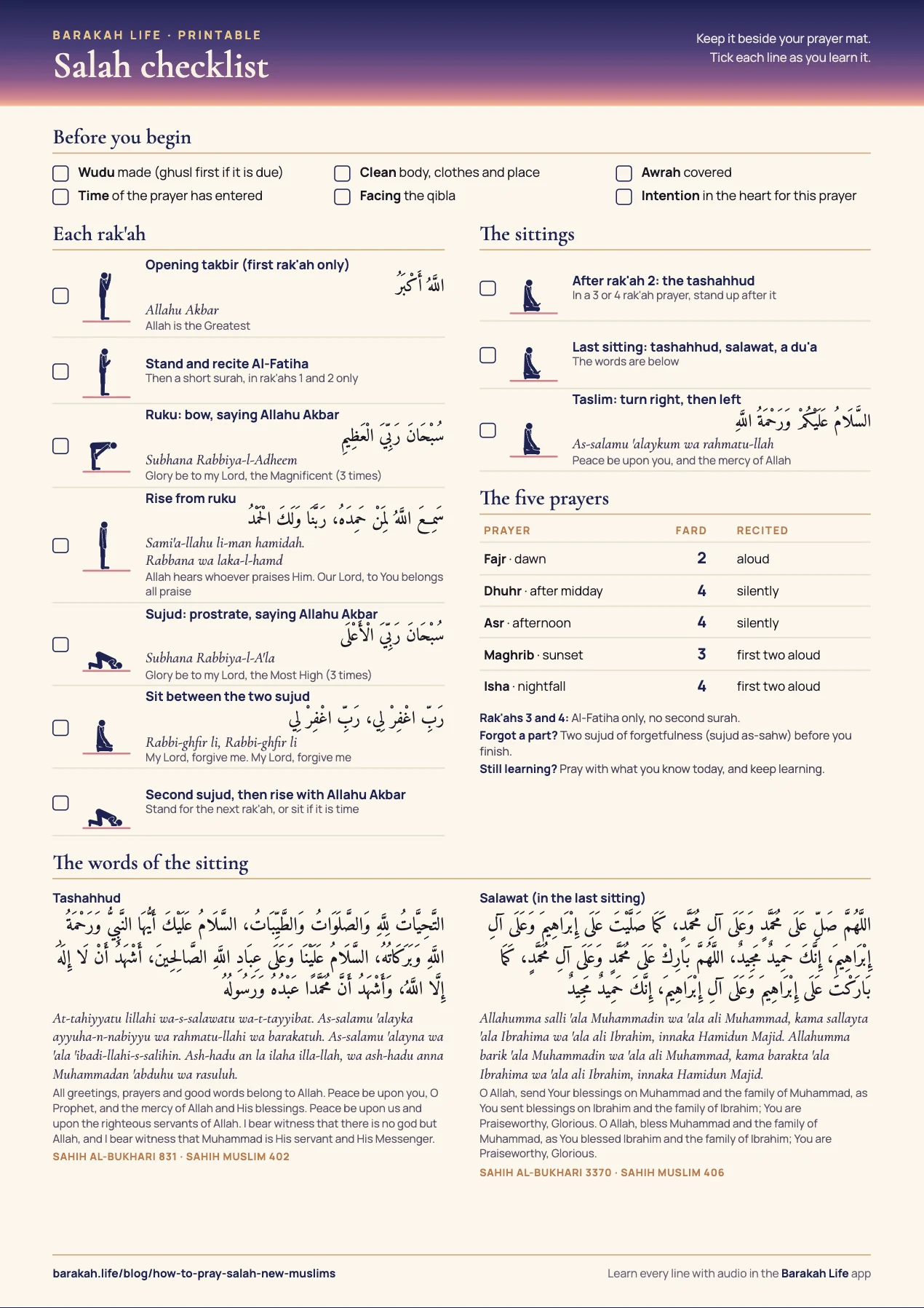
Print this, keep it beside your mat, and tick each line as you learn it. It has every step of the rak'ah, the words for each position in Arabic, transliteration and English, the full tashahhud and salawat, and the five prayers at a glance.
A two-rak'ah prayer takes about three to five minutes when you are learning, and a four-rak'ah prayer five to ten. Slower is better than faster.
What if I miss a prayer?
Pray it as soon as you remember. The Prophet ﷺ said that whoever forgets a prayer or sleeps through it should pray it when they remember, and that this is its only expiation (Sahih al-Bukhari 597, Sahih Muslim 684). Then keep going. Every prayer is a fresh start.
Is the prayer different for women?
The prayer is the same: the same words, the same pillars and the same sequence. The Prophet ﷺ said “Pray as you have seen me praying” (Sahih al-Bukhari 631) to everyone. Some schools, notably the Hanafi, teach women to keep the body more gathered in ruku and sujud, based on later reports and scholarly reasoning; if your teacher follows that, it is a recognised position. Two real differences are the awrah, described above, and that a woman does not pray during her period or postnatal bleeding and does not make those prayers up afterwards (Sahih al-Bukhari 304, Sahih Muslim 335). Women may pray at home or at the mosque; the Prophet ﷺ said “Do not prevent the female servants of Allah from the mosques of Allah” (Sahih al-Bukhari 900).
Do I have to pray at the mosque?
Your daily prayers are valid anywhere clean, including at home. For men, praying in congregation is strongly emphasised (the Hanbali school counts it as obligatory when a mosque is within reach), and Jumu'ah, the Friday midday prayer in congregation, is an obligation on men.
What if I am not sure I prayed it right?
If you did the essentials listed above, your prayer stands, and Allah sees your effort. Ask a trusted teacher at your local mosque to watch you pray once, and keep improving a little each week.
Keep learning with Barakah Life
The Barakah Life prayer guide walks you through every prayer, from Fajr to witr, Jumu'ah and the funeral prayer. In the app, its guided mode takes you through each position one step at a time and plays every line aloud, so you can loop a phrase and slow it down until it sits on your tongue. It also has prayer times for your city with gentle reminders, a qibla compass, and a salah tracker. If you are new to Islam, the 30-day new Muslim path takes you from the shahada to a steady prayer life, one day at a time. Download Barakah Life, free on iPhone and Android.
Your first prayer will not be perfect, and it does not need to be. Stand, say Allahu Akbar, and bring what you have. The One you are standing before already knows the rest.
Tagssalahprayernew muslimbeginnersrevert
Pass it on
Know someone who needs this today? Send it to them.
“Whoever guides someone to good has a reward like the one who does it.” Sahih Muslim 1893