How to convert to Islam: the shahada and your first week
Two sentences make you Muslim. The shahada in Arabic, transliteration and English, exactly how to take it, witnesses and certificates, a gentle first week, and where to find support.
The way into Islam has one door, and it is two sentences wide. You say them with belief in your heart, and you are Muslim. There is no ceremony to book, no fee, no waiting period, no exam and no one whose permission you need. The Prophet ﷺ accepted people into Islam in his masjid, in the desert and on journeys, always with the same testimony. This guide gives you those words in Arabic, transliteration and English, explains what they mean, walks you through exactly how to take the step, answers the practical questions people search for (witnesses, ghusl, certificates, names, family), and lays out a gentle first week, with the support you can lean on along the way.
In short
Believe in your heart that there is no god but Allah and that Muhammad ﷺ is His Messenger, then say so: Ash-hadu an lā ilāha illa-llāh, wa ash-hadu anna Muḥammadan rasūlu-llāh. That is the shahada. Then bathe (ghusl), learn wudu, and begin the five prayers as best you can. Witnesses and certificates are useful, but they are not conditions. Your Islam begins the moment you finish the sentence.
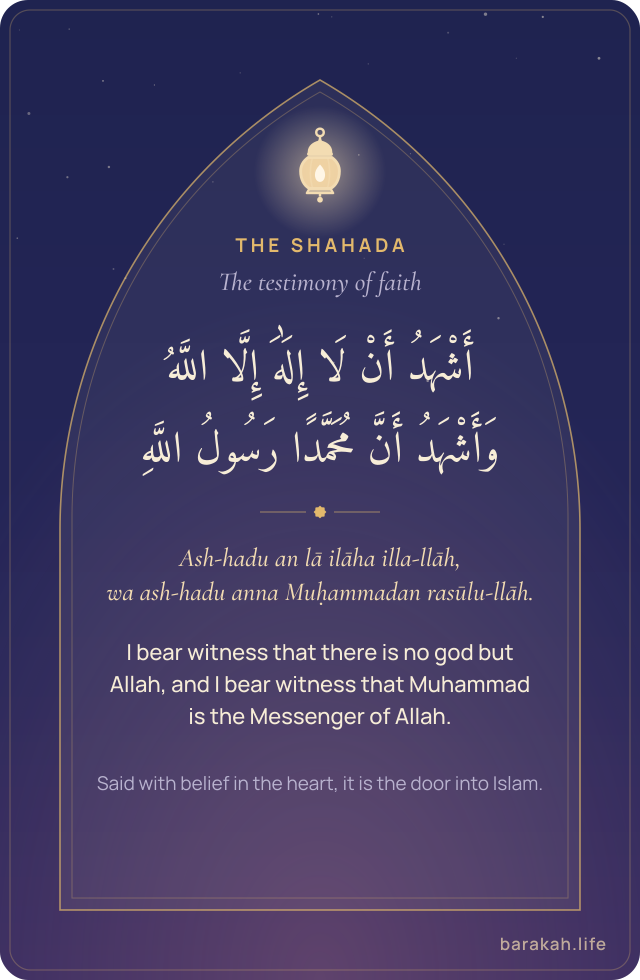
Ash-hadu an lā ilāha illa-llāh, wa ash-hadu anna Muḥammadan rasūlu-llāh.
I bear witness that there is no god but Allah, and I bear witness that Muhammad is the Messenger of Allah.
The shahāda, the first pillar of Islam (Ṣaḥīḥ al-Bukhārī 8)The two sentences, in Arabic, transliteration and English. Save it and practise it at your own pace.
How to pronounce it. Say it slowly in four pieces: Ash-hadu an (I bear witness that) / lā ilāha illa-llāh (there is no god but Allah) / wa ash-hadu anna (and I bear witness that) / Muḥammadan rasūlu-llāh (Muhammad is the Messenger of Allah). If the Arabic sounds are new to you, that is fine. Say it as well as you can; a new tongue is not a barrier, and you can say the meaning in your own language too.
What the two sentences mean
The first sentence is a denial followed by an affirmation. Lā ilāha: nothing deserves worship. Illa-llāh: except Allah. In a few syllables you clear away everything else people worship, ancient or modern, and place the One who made you at the centre of your life. This is tawhid, the oneness of God, and it is the message of every prophet.
The second sentence accepts how Allah has chosen to guide us: through Muhammad ﷺ, His final messenger. You affirm that the Quran he brought is Allah's word, and that his teaching and example, the Sunnah, show how to live the first sentence.
How to take your shahada, step by step
Be sure you believe it. The shahada is a testimony, so it must be true for you. You do not need to know everything about Islam first, only to accept its core: one God, and Muhammad ﷺ as His Messenger. No one may be forced: the Quran says there is no compulsion in religion (2:256).
Say the shahada. Alone or with others, in a masjid or in your kitchen, aloud with your own voice. Say it in Arabic as best you can; many people say the English meaning first so the Arabic carries its full weight.
Take a bath (ghusl). When Thumamah ibn Uthal accepted Islam, he went and bathed, then came back and said the shahada (Bukhari 462), and the Prophet ﷺ told Qays ibn ‘Asim to bathe with water and lote leaves when he became Muslim (Abu Dawud 355, Tirmidhi 605, graded sahih by al-Albani). The Maliki and Hanbali schools hold that this bath is obligatory, the Hanafi and Shafi'i schools that it is recommended, and obligatory if you were in a state needing ghusl. Either way, bathe: wash your whole body with the intention of purifying yourself for your new life.
That is all. You are Muslim. Allah heard your testimony before anyone else did. Everything from here is learning and growing.
If you prefer, you can bathe first and then say the shahada, as Thumamah did. The order does not affect your Islam.
Do you need witnesses or a mosque?
No. Between you and Allah, the shahada is valid when you say it sincerely, with or without witnesses. Saying it at a masjid, though, has real benefits: people meet you, you gain a community, and someone can point you to a class or a mentor. Most masjids are delighted to welcome a new Muslim and will gladly witness your shahada.
About certificates. There is no central registry of Muslims and no paperwork that makes Islam “official”. A certificate of Islam from a masjid or Islamic centre is still useful for practical things: Hajj and Umrah visas commonly ask new Muslims for one, and some countries need it for an Islamic marriage or for official records. If you take your shahada alone, you can visit a masjid later, repeat it in front of witnesses, and ask for a certificate then.
Can you take your shahada alone, online or over the phone?
Yes. Your Islam is valid the moment you say the shahada with belief, wherever you are. Many people take it alone at night, or on a video call with an imam, or over the phone. If a certificate matters to you, an Islamic centre can witness it by video and issue one, or you can repeat it in person later. Saying it again in front of others does not mean the first time did not count.
What you are agreeing to believe
In the famous hadith of Jibril, the angel asked the Prophet ﷺ what faith (iman) is, and he answered with six things (Muslim 8). The Quran gathers most of them in one verse:
Kullun āmana bi-llāhi wa malā'ikatihī wa kutubihī wa rusulih, lā nufarriqu bayna aḥadin min rusulih.
Each of them believes in Allah, His angels, His books and His messengers: “We make no distinction between any of His messengers.”
Qur'ān 2:285
Allah. One God, with no partner, no child and no equal, the Creator of everything.
His angels. Beings created by Allah who carry out His commands.
His books. The scriptures He revealed, including the Torah, the Psalms and the Gospel in their original form, and the Quran, His final, preserved word.
His messengers. From Adam through Nuh, Ibrahim, Musa and ‘Isa (Jesus), peace be upon them all, every messenger called to the same One God. Muhammad ﷺ is the last of them.
The Last Day. Death is not the end. Every soul will be raised and will answer for its life.
The decree (qadar). Allah knows all things, and nothing happens, good or hard, outside His knowledge and will.
Islam is then built on five pillars (Bukhari 8): the shahada you have just said; the five daily prayers; zakat, the yearly charity on savings above a threshold; fasting the month of Ramadan; and Hajj, the pilgrimage to Makkah once in a lifetime for those able to make it.
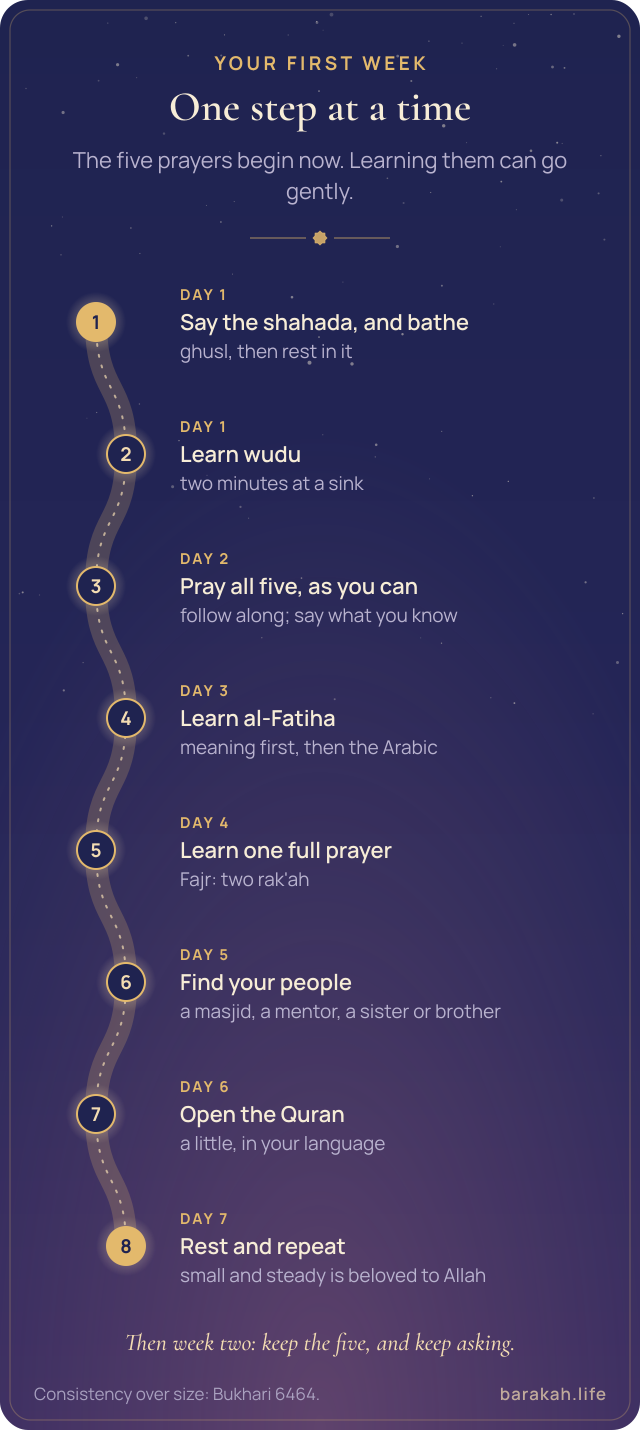
Your first week, one step at a time
The five daily prayers are part of your life from the day you become Muslim, but no one expects you to know them perfectly on day one. When the Prophet ﷺ sent Mu'adh to Yemen, he told him to teach the shahada first, then the prayers, then zakat, one after another (Bukhari 1395). Take the same gentle order. Pray from the start as best you can, and learn a little more each day.
The five prayers begin now; learning them can go gently.
Day 1: say the shahada, bathe, and rest in it
Reread the meaning of what you said. Eat, rest, and let it be true. You owe no one an announcement today.
Day 1 or 2: learn wudu
The short washing before prayer: hands, mouth, nose, face, arms, head, ears and feet. It takes two minutes once your hands know it. Our step-by-step wudu guide shows each movement.
Day 2: pray all five, as you can
Follow along with a guide, or stand beside someone at the masjid. If you cannot yet recite anything in Arabic, the Prophet ﷺ taught a man who could not learn any Quran to say in its place: Subḥāna-llāh, wa-l-ḥamdu li-llāh, wa lā ilāha illa-llāh, wa-llāhu akbar, wa lā ḥawla wa lā quwwata illā bi-llāh, glory be to Allah, praise be to Allah, there is no god but Allah, Allah is the greatest, and there is no power and no strength except with Allah (Abu Dawud 832, graded hasan by al-Albani). Allah asks of no soul more than it can bear.
Day 3: learn al-Fatiha
The opening chapter, seven verses recited in every unit of every prayer, beginning with Bismillah. Read the meaning first, then learn the Arabic a line at a time.
Day 4: learn one full prayer
Start with Fajr: two units (rak'ah), the shortest of the five. Once you know two rak'ah, every other prayer is built from the same pattern.
Day 5: find your people
Visit a masjid, ask whether it runs a class or a circle for new Muslims, and find one trustworthy person you can ask anything. The Companions asked the Prophet ﷺ about everything imaginable; no question is too small.
Day 6: open the Quran
Read a little in a translation you trust. Many people begin with the short chapters at the end of the Quran, or with al-Baqarah, the second chapter, from the start.
Day 7: rest and repeat
Look back at the week and keep what you have built. The Prophet ﷺ said the deeds most beloved to Allah are the most consistent, even if small (Bukhari 6464).
Your first-week checklist
Said the shahada, with belief.
Took a ghusl.
Learned wudu.
Prayed the five prayers as well as I could, and learned the times of each in my city.
Began learning al-Fatiha.
Found a masjid and one person I can ask.
Read a little Quran in my language.
Know the direction of prayer (qiblah) from where I live.
What does not need to happen yet
A new name. You do not need one. Keep your name unless its meaning is contrary to Islam, such as a name declaring worship of something other than Allah. The Prophet ﷺ changed names with bad meanings, such as ‘Asiyah (disobedient) to Jamilah (beautiful) (Muslim 2139), but kept most people's names as they were.
Telling everyone. Share the news when and with whom you are ready. There is no requirement to announce it.
Leaving your family. Islam commands kindness to parents and family whatever their faith. Even parents who pressure a child to leave Islam are to be accompanied in this world with kindness (31:15).
Changing everything overnight. Clothing, food, habits and friendships settle over months, not days. Learn what is obligatory first, and grow from there.
Lā yanhākumu-llāhu ʿani-lladhīna lam yuqātilūkum fi-d-dīni wa lam yukhrijūkum min diyārikum an tabarrūhum wa tuqsiṭū ilayhim, inna-llāha yuḥibbu-l-muqsiṭīn.
Allah does not forbid you from being good and just to those who have not fought you over your faith or driven you from your homes. Allah loves those who are just.
Qur'ān 60:8
Your past is forgiven
When ‘Amr ibn al-‘As came to accept Islam, he held back his hand and asked for a condition: that his past sins be forgiven. The Prophet ﷺ said: “Did you not know that Islam wipes out what came before it?” (Muslim 121). Your record opens clean. And for those who turn to Allah, believe and do good, the Quran promises even more:
Illā man tāba wa āmana wa ʿamila ʿamalan ṣāliḥan fa-ulā'ika yubaddilu-llāhu sayyi'ātihim ḥasanāt, wa kāna-llāhu ghafūran raḥīmā.
Except those who repent, believe and do righteous deeds: for them Allah will replace their bad deeds with good. Allah is ever Forgiving, Merciful.
Qur'ān 25:70
From now on, the Prophet ﷺ said, each good deed of one whose Islam is sincere is recorded ten to seven hundred times over, and each bad deed only as it is (Bukhari 42).
Where to find support
Your local masjid. Ask the imam or the office about classes for new Muslims, a mentor, or a sisters' or brothers' circle. Many larger masjids and Islamic centres run regular programmes.
A mentor. One knowledgeable, kind Muslim of your own gender whom you can message with questions makes a huge difference in the first year.
Structured learning. Established Islamic centres and universities offer beginner courses, in person and online. Choose teachers who cite the Quran and Sunnah and who are known in their community.
Your own path, at your own pace. Our 30-day path for new Muslims gives you one small step a day, sourced from the Quran and Sunnah, and the shahada page covers the journey from the first prayer to the first Ramadan.
Start with Barakah Life. The Barakah Life app was built with new Muslims in mind. It gives you accurate prayer times for your city with a gentle reminder before each one, a qibla compass, step-by-step prayer guides you can follow as you pray, and the Quran with transliteration, translation and audio, so you can read along before you can read Arabic. Every du'a comes with Arabic, transliteration and meaning.
Questions people ask
Is converting to Islam easy?
Becoming Muslim is simple: you believe and you say the shahada. Living as a Muslim is a lifelong journey that you take step by step, and Islam was revealed gradually for exactly that reason.
Do I need witnesses for my shahada?
No. Your shahada is valid between you and Allah without witnesses. Saying it in front of others brings community support and makes a certificate possible, but it is not a condition.
Can I take my shahada alone or online?
Yes. Your Islam begins the moment you say the shahada sincerely, wherever you are. Imams and Islamic centres can also witness it by video or phone if you would like support or a certificate.
Do I need to do ghusl after taking my shahada?
Yes, take a full bath. The Maliki and Hanbali schools consider it obligatory and the Hanafi and Shafi'i schools recommended, based on the Prophet's instruction to Qays ibn ‘Asim (Abu Dawud 355). It is not a condition for your shahada to count.
Do I have to change my name?
No. Keep your name unless its meaning is contrary to Islam. Many new Muslims choose an additional Muslim name; it is a choice, not a requirement.
Can new Muslims pray in English at first?
The prayer itself is recited in Arabic, so learn al-Fatiha and the short phrases as soon as you can. Until you can, the Prophet ﷺ taught one who could not recite to say short phrases of remembrance instead (Abu Dawud 832). Du'a outside the fixed words of prayer can be in any language.
How do I get a certificate of conversion?
Visit a masjid or Islamic centre, say the shahada in front of witnesses, and ask for a certificate of Islam. You may need it for Hajj or Umrah visas, or for an Islamic marriage in some countries.
Are my past sins forgiven when I become Muslim?
Yes. The Prophet ﷺ said Islam wipes out what came before it (Muslim 121), and the Quran promises that Allah replaces the bad deeds of those who repent, believe and do good with good deeds (25:70).
Whatever brought you here, a book, a friend, a question that would not leave you, it brought you to a door that has never been locked. Welcome home.