How to pray istikhara step by step, the full du'a of Bukhari 1166 in Arabic with transliteration and meaning, when to pray it, and what to expect after. No dream required.
Istikhara means asking Allah to choose for you. When the Companions faced a decision, the Prophet ﷺ gave them a prayer for it, and Jabir ibn ‘Abdullah said he taught it to them “in all matters, as he taught us a surah of the Quran” (Bukhari 1166). That comparison matters. Istikhara is not a vague hope or a ritual for reading signs; it is a short prayer with exact words, memorised the way you memorise al-Fatiha. This guide covers when it applies, how to pray it step by step, the du'a in full with what each line asks for, the times to avoid, and the question everyone asks afterwards: how do I know what Allah chose?
In short
For a lawful decision you are unsure about, pray two voluntary rak'ah at any permitted time, then say the du'a of istikhara, naming your matter where it says “this matter”. Consult people you trust, then act on your best judgement. No dream or feeling is required. Allah answers through how the way opens or closes, and the du'a ends by asking Him to make you content with what He chooses.
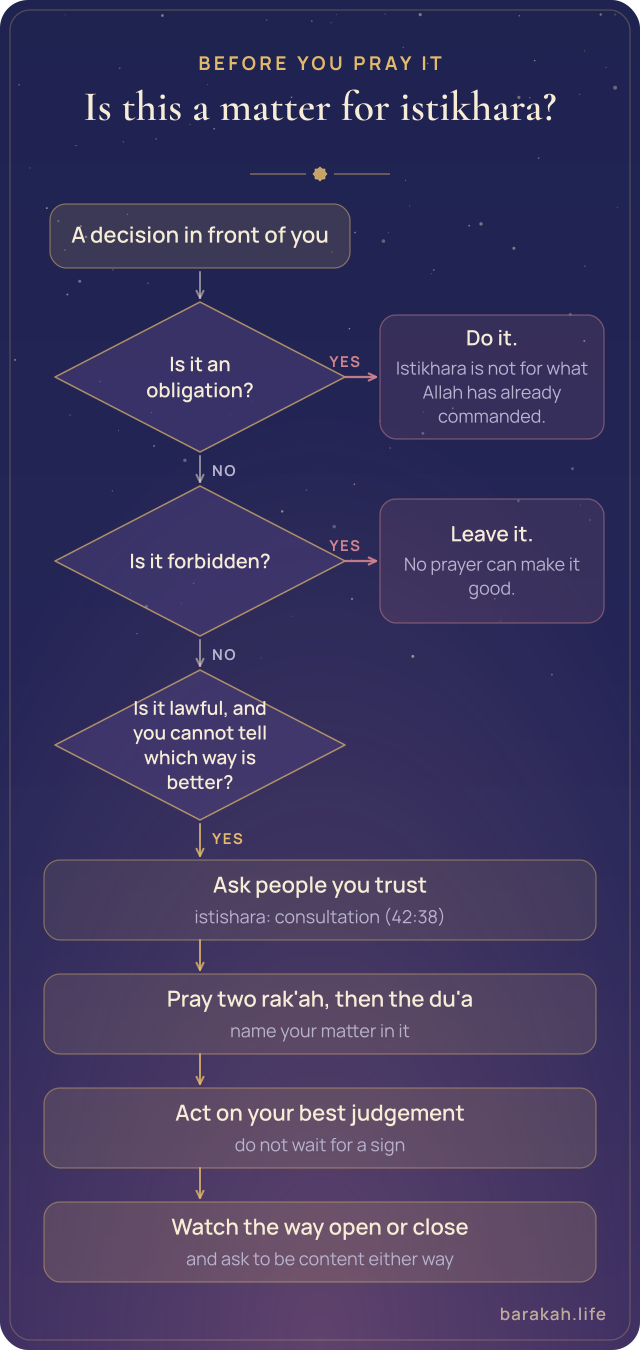
Istikhara is for the wide middle ground of life: decisions that are lawful but uncertain. Which job to take, whether to accept a proposal, whether to move, which course to study, whether to start a business or sign a lease. If both paths are permissible and you cannot tell which is better for you, istikhara is the Sunnah way to hand the choice to the One who knows.
It is not for things Allah has already decided. You do not pray istikhara about whether to pray Fajr or pay zakat; obligations are settled. You do not pray it about something forbidden; no prayer makes a haram choice good. And it is not fortune-telling: it does not reveal the unseen, and it does not replace your own thinking, research and advice.
Istikhara sits beside consultation and your own judgement, never in place of them.
The Quran pairs the two halves of a good decision in one verse addressed to the Prophet ﷺ himself: consult, then decide, then rely on Allah.
Wa shāwirhum fi-l-amr, fa-idhā ʿazamta fa-tawakkal ʿala-llāh, inna-llāha yuḥibbu-l-mutawakkilīn.
And consult them in the matter. Then, once you have decided, put your trust in Allah. Allah loves those who put their trust in Him.
Qur'ān 3:159
How to pray istikhara, step by step
Make wudu. The same ablution as for any prayer. If you need a refresher, our wudu guide covers it step by step.
Intend two rak'ah of voluntary prayer for istikhara. The hadith says “two rak'ah other than the obligatory prayer”. Pray them like any two-rak'ah prayer, at a time when voluntary prayer is allowed (see below).
Recite al-Fatiha and any surah. No surah is named in the hadith. Imam al-Nawawi recommended al-Kafirun in the first rak'ah and al-Ikhlas in the second; that is a scholar's good suggestion, not a condition.
After the salam, say the du'a of istikhara. This is the view of most scholars, since the hadith says to pray two rak'ah and then say it. Ibn Taymiyyah held it may also be said before the salam, in the final sitting. Both are acceptable. Raise your hands if you wish; it is a du'a like any other.
Name your matter. Where the du'a says hādha-l-amr, “this matter”, name it plainly, in Arabic or in your own language: “this matter, accepting the job at the hospital”. The hadith ends: “and he names his need”.
Then act. Take the next sensible step toward what your reasoning and your advisers suggest, and keep watching how the way unfolds.
The du'a of istikhara: Arabic, transliteration and translation
From the hadith of Jabir ibn ‘Abdullah, in the wording of Sahih al-Bukhari:
Allāhumma innī astakhīruka bi-ʿilmik, wa astaqdiruka bi-qudratik, wa as'aluka min faḍlika-l-ʿadhīm. Fa-innaka taqdiru wa lā aqdir, wa taʿlamu wa lā aʿlam, wa anta ʿallāmu-l-ghuyūb. Allāhumma in kunta taʿlamu anna hādha-l-amra khayrun lī fī dīnī wa maʿāshī wa ʿāqibati amrī, fa-qdurhu lī wa yassirhu lī, thumma bārik lī fīh. Wa in kunta taʿlamu anna hādha-l-amra sharrun lī fī dīnī wa maʿāshī wa ʿāqibati amrī, fa-ṣrifhu ʿannī wa-ṣrifnī ʿanh, wa-qdur liya-l-khayra ḥaythu kān, thumma arḍinī bih.
O Allah, I ask You to choose for me by Your knowledge, and I ask You to empower me by Your power, and I ask You of Your immense favour. For You are able and I am not; You know and I do not; and You are the Knower of the unseen. O Allah, if You know that this matter is good for me in my religion, my livelihood and the outcome of my affairs, then decree it for me, make it easy for me, and then bless me in it. And if You know that this matter is bad for me in my religion, my livelihood and the outcome of my affairs, then turn it away from me and turn me away from it, and decree for me the good wherever it may be, and then make me content with it.
Ṣaḥīḥ al-Bukhārī 1166 (also 6382, 7390), from Jābir ibn ʿAbdullāh
Two small notes on the text. In each half the narrator adds “or he said: fī ʿājili amrī wa ājilih”, in my affairs now and later, so either phrase is correct and some people say both. And the final words appear as thumma arḍinī bih in this narration and thumma raḍḍinī bih in the others; both mean “then make me content with it”. You will often see this hadith cited as Bukhari 1162: that is its number in the Fath al-Bari edition, while sunnah.com numbers it 1166. It is the same hadith.
Cannot read the Arabic yet? Read it from this page or your phone; there is no need to memorise it first. If you cannot pronounce it yet, say the meaning in your own language while you learn. Allah hears every tongue, and the Prophetic words are worth learning for the day you can say them yourself.
What the du'a is actually asking for
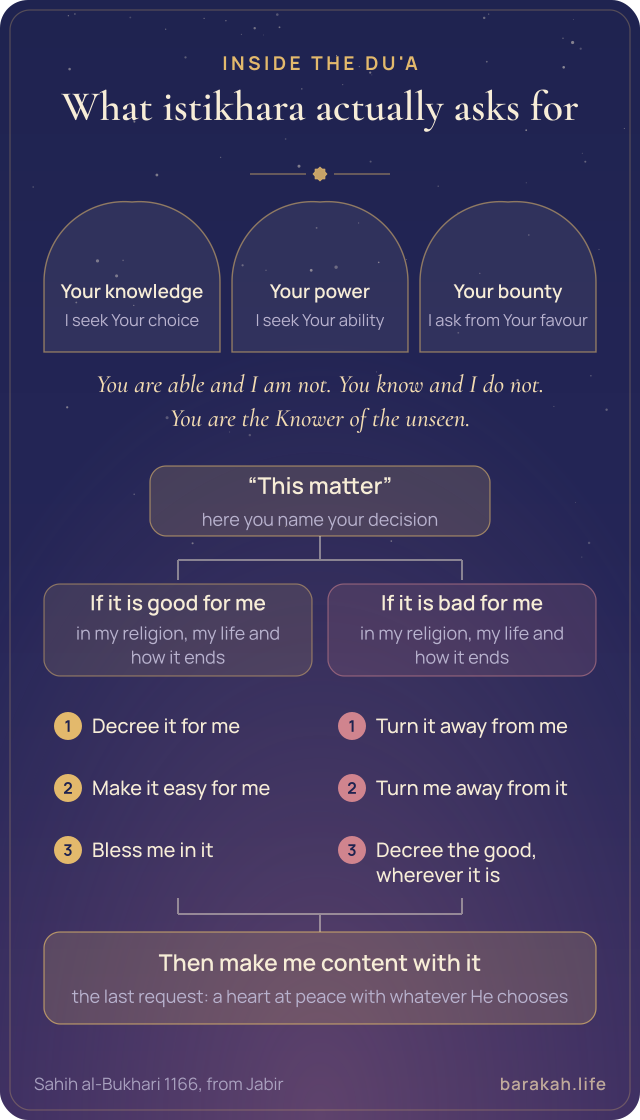
Read it slowly once and its shape opens up. It begins by putting knowledge, power and generosity where they belong: Your knowledge, Your power, Your favour. Then it says out loud what anxiety about a decision tries to hide: You are able and I am not; You know and I do not.
Then it names the matter and asks for exactly one of two outcomes. If it is good for you, three things: decree it, ease it, bless it. If it is bad for you, three mercies: turn it away from me, turn me away from it, and decree the good wherever it is. Notice the second of those. You are not only asking Allah to close a door; you are asking Him to take your heart away from it, so you do not spend years staring at the closed door.
One matter, two branches, one ending. The last request may be the most important.
The last line is the one people overlook: then make me content with it. You are not only asking for the right outcome. You are asking for a heart at peace with whatever outcome comes. The Quran describes the gap between what we want and what is good for us:
Wa ʿasā an takrahū shay'an wa huwa khayrun lakum, wa ʿasā an tuḥibbū shay'an wa huwa sharrun lakum, wa-llāhu yaʿlamu wa antum lā taʿlamūn.
It may be that you dislike something while it is good for you, and it may be that you love something while it is bad for you. Allah knows, and you do not know.
Qur'ān 2:216
When to pray istikhara
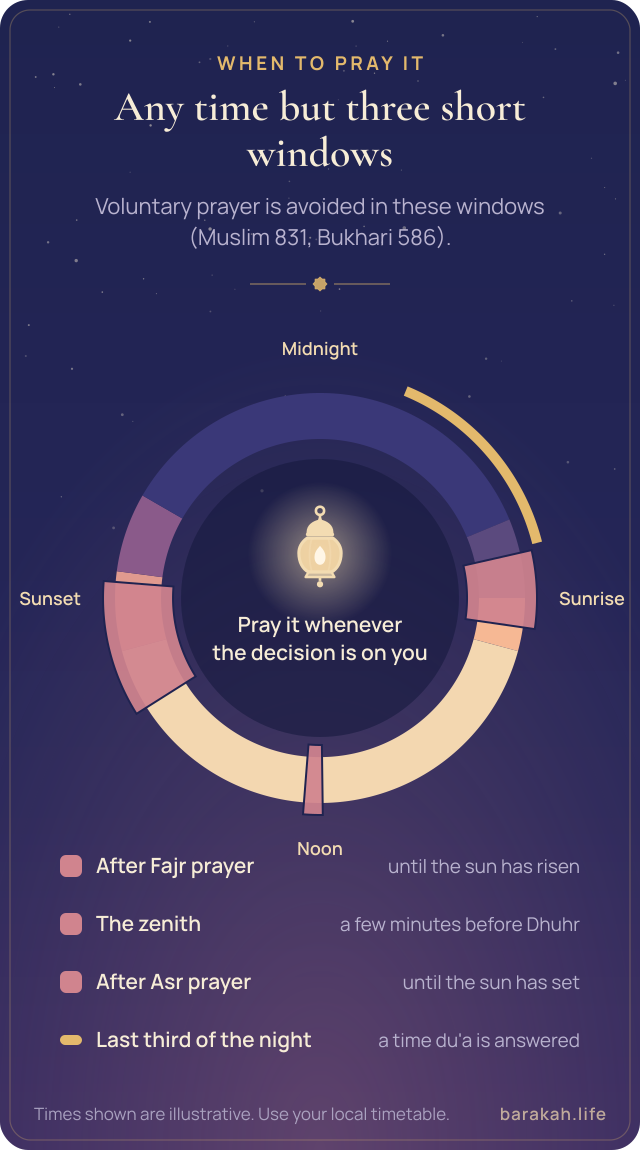
Pray it whenever the decision is in front of you, day or night, except in the three short windows when voluntary prayer is avoided: from after the Fajr prayer until the sun has risen, at the sun's zenith shortly before Dhuhr, and from after the ‘Asr prayer until the sun has set (Muslim 831, Bukhari 586). If you are in one of those windows, wait a little, or say the du'a on its own for now and pray the two rak'ah later.
Any time but three short windows. The last third of the night is an especially good time to ask.
If you can, choose the last third of the night. The Prophet ﷺ said that Allah descends to the lowest heaven when the last third of the night remains and says: “Who is calling on Me, that I may answer him? Who is asking of Me, that I may give him?” (Bukhari 1145). Your local prayer times show when Fajr and Maghrib fall, so you can find that last third.
After istikhara: signs, dreams and the heart
This is where most confusion lives, so it is worth being precise about what the sources say.
A dream is not required. The hadith of istikhara says nothing about dreams, and scholars agree that seeing one is not a condition or the expected answer. If you do see a dream, it is not a ruling; treat it at most as one small input among many. Waiting for a dream before acting is the most common misunderstanding about this prayer.
What about the heart's inclination? Imam al-Nawawi wrote that after istikhara a person proceeds with what his heart opens to. Ibn Hajar added a caution worth remembering: an inclination you already had before the prayer, driven by your own wish, is not to be trusted as the answer. Other scholars, such as al-‘Izz ibn ‘Abd al-Salam, said simply to proceed with whatever comes easily, since what follows is the choice Allah has made. These views meet in practice: pray, consult, decide sensibly, and then pay attention to how things unfold.
What does an answer look like? Usually like ordinary life. A door opens with unusual ease, or closes firmly despite your best effort. A conversation settles a question. A practical obstacle appears that you could not have foreseen. Feeling uneasy is not, by itself, a “no”: many good paths feel demanding, and many harmful ones feel attractive. Weigh feelings alongside reason, advice and events.
The answer is the outcome. You asked Allah, if the matter is good, to decree it and ease it, and if it is bad, to turn it away and turn you from it. Whatever then happens after honest effort is His answer to exactly that request. The only thing left to ask for is the contentment the du'a ends with.
How many times should you pray istikhara?
There is no fixed number. If the matter is still unclear, you may pray it again, and there is no limit. You will sometimes hear that it should be repeated seven times; that comes from a narration in Ibn al-Sunni's collection which al-Nawawi said contains narrators he did not know, and which Ibn Hajar called extremely weak. So repeat it because you still need guidance, not to reach a number. Equally, you do not need to keep praying it once the matter is settled.
Istikhara for marriage
Marriage is the decision people most often bring to istikhara, and rightly so. When the Prophet ﷺ sent a proposal to Zaynab bint Jahsh, she said, “I will not do anything until I consult my Lord,” and went to her place of prayer (Muslim 1428). Pray it, and pair it with the questions the Sunnah tells you to ask. The Prophet ﷺ said a woman is married for her wealth, her lineage, her beauty and her religion, and told the man to choose the one with religion (Bukhari 5090); the same weight belongs on character and faith whoever is choosing. Ask family and trusted people who know the person. Then let istikhara guide the decision you have made with your eyes open.
Istikhara on your period, for someone else, or in English
During a period, or when you cannot pray. Say the du'a of istikhara on its own. Al-Nawawi stated that if prayer is not possible, istikhara is done with the du'a alone, and contemporary scholars give the same answer for a woman during her period. The prayer and du'a together are better when they become possible.
For someone else. Istikhara, as taught, is for the person whose decision it is. You can always make du'a for a friend or a child, and parents often pray their own istikhara about decisions that are partly theirs, such as accepting a proposal for their daughter. Encourage the person to pray it themselves.
In English, or from a phone. Reading the Arabic from a page or screen is fine. If you cannot yet pronounce it, saying the meaning in your own language is still du'a; keep learning the Prophetic wording.
Pray it with Barakah Life. Our interactive istikhara guide walks you through the two rak'ah and shows the du'a with transliteration and meaning as you go. More prayers for moments of decision are in du'as for guidance and decisions. In the Barakah Life app the du'a is a tap away with audio, and your prayer times show you when the last third of the night begins.
Questions people ask
How many times can you pray istikhara?
As many times as you need. There is no fixed number in the authentic hadith, and the narration about repeating it seven times is very weak. Pray it again if the matter is still unclear; stop once it is settled.
Do you have to see a dream after istikhara?
No. The hadith of istikhara does not mention dreams, and a dream is neither a condition nor the expected answer. Act on your best judgement after praying and consulting, and watch how the matter unfolds.
What if I feel no sign after istikhara?
That is normal. Proceed with the option your reasoning and your advisers favour. If it is good for you, you asked Allah to make it easy and bless it; if not, you asked Him to turn it away. The unfolding of events is the answer.
Can I pray istikhara after Fajr or at any time?
Any time except three short windows: after the Fajr prayer until sunrise, at the zenith before Dhuhr, and after the ‘Asr prayer until sunset. In those windows, say the du'a alone or wait. The last third of the night is an excellent time.
Can I read the istikhara du'a from my phone or in English?
Yes. Reading the Arabic from a page or screen is fine, and if you cannot pronounce it yet, saying its meaning in your own language is still a du'a. Keep learning the Prophetic words.
Can someone else pray istikhara for me?
Istikhara is taught for the person making the decision, so it is best to pray it yourself. Others can and should make du'a for you, and a parent may pray istikhara about a decision that is also theirs.
Can a woman on her period do istikhara?
Yes, with the du'a alone, without the prayer. Al-Nawawi stated that when prayer is not possible, istikhara is made with the du'a.
Can istikhara be wrong?
Allah's choice is never wrong, but our reading of signs can be. That is why istikhara is not about interpreting feelings or dreams. You asked for the good to be decreed and the harm turned away; what follows after honest effort is that answer.
You are not left alone with the choice. The one who sincerely asks Allah to choose, consults the people who care about him, and then acts, has done everything the Sunnah asks. The rest is His, and the du'a has already asked Him to make you content with it.
al-Nawawī, al-Adhkār, chapter on istikhāra; Ibn Ḥajar, Fatḥ al-Bārī, commentary on the istikhāra hadith (including the grading of Ibn al-Sunnī's seven-times narration); Ibn Taymiyya, al-Fatāwā al-Kubrā, on the du'a before the salām.
This guide follows the authentic Sunnah and notes where scholars differ. For a decision with serious consequences, also seek the advice of a scholar and of people with knowledge of the matter.
Tagsistikharaduaguidanceprayer
Pass it on
Know someone who needs this today? Send it to them.
“Whoever guides someone to good has a reward like the one who does it.” Sahih Muslim 1893