How to check if packaged food is halal: the complete label guide
Read a label the way a careful Muslim shopper does: the words that settle it, the ingredients whose source decides, how to verify a halal mark, and the fiqh of doubt, with a checklist for the aisle.
You turn a packet over in the supermarket aisle and read the back. Nothing says pork. Nothing says alcohol. And yet the list holds gelatine, E471, whey powder and "flavouring", and you are not sure. That pause is a good instinct. This guide turns it into a method: what the Quran and Sunnah ask of us, which words settle the question, which only raise it, how to check a halal logo, and what to do when it is still unclear.
In short
To check if packaged food is halal: first look for anything clearly haram (pork, lard, blood, wine, beer, spirits). Then look for a halal mark from a named certifier and confirm it on that certifier's own list. Without one, treat meat, poultry and animal fat as doubtful, because a label cannot show how the animal was slaughtered. Finally, look for ingredients whose source decides (gelatin, E471, E472, rennet, whey, enzymes, E542, E920, flavourings) and ones scholars differ on (E120 carmine, E904 shellac, alcohol used as a carrier). If any remain, ask the maker or leave it.
The starting point is generous. Allah addresses all of humanity and invites us to eat what is on the earth, on two conditions: that it is ḥalāl, lawful, and ṭayyib, good and wholesome.
Innamā ḥarrama ʿalaykumu-l-maytata wa-d-dama wa laḥma-l-khinzīri wa mā uhilla bihī li-ghayri-llāh. Fa-mani-ḍṭurra ghayra bāghin wa lā ʿādin fa-lā ithma ʿalayh. Inna-llāha ghafūrun raḥīm.
He has only forbidden to you carrion, blood, the flesh of swine, and what has been dedicated to other than Allah. But whoever is compelled by necessity, neither desiring it nor going beyond the need, there is no sin on him. Allah is Forgiving, Merciful.
Quran 2:173
Sūrat al-Māʾidah repeats the four and spells out what counts as carrion, unless the animal was properly slaughtered while still alive. This is the verse behind the question of slaughter below.
Ḥurrimat ʿalaykumu-l-maytatu wa-d-damu wa laḥmu-l-khinzīri wa mā uhilla li-ghayri-llāhi bihī wa-l-munkhaniqatu wa-l-mawqūdhatu wa-l-mutaraddiyatu wa-n-naṭīḥatu wa mā akala-s-sabuʿu illā mā dhakkaytum.
Forbidden to you are carrion, blood, the flesh of swine, what has been dedicated to other than Allah, the strangled, the beaten to death, the one killed by a fall, the one gored to death, and what a wild animal has eaten from, except what you slaughter properly.
Quran 5:3 (opening of the verse)
Two verses later comes a mercy that shapes how Muslims in non-Muslim countries eat: the food of the People of the Book.
Al-yawma uḥilla lakumu-ṭ-ṭayyibāt, wa ṭaʿāmu-lladhīna ūtu-l-kitāba ḥillun lakum wa ṭaʿāmukum ḥillun lahum.
Today all good things have been made lawful for you. The food of those who were given the Scripture is lawful for you, and your food is lawful for them.
Quran 5:5 (opening of the verse)
Notice the shape of this. For most food, the default (al-aṣl) is permissibility: plants, grains, fruit, milk, eggs and fish are lawful unless something specific makes them otherwise. Meat is the exception. Classical scholars such as an-Nawawī, Ibn Rajab and Ibn al-Qayyim state the principle plainly: the basic rule for an animal's flesh is prohibition, until a valid slaughter is established. That is why meat gets its own section below.
The principle of doubt
Between the clearly lawful and the clearly forbidden lies a grey zone, and the Prophet ﷺ described it in one of the hadiths scholars count among the foundations of the religion:
Al-ḥalālu bayyinun wa-l-ḥarāmu bayyin, wa baynahumā mushabbahātun lā yaʿlamuhā kathīrun mina-n-nās. Fa-mani-ttaqa-l-mushabbahāti-stabraʾa li-dīnihī wa ʿirḍih.
The lawful is clear and the unlawful is clear, and between them are doubtful matters that many people do not know. Whoever guards against the doubtful matters has protected his religion and his honour.
Ṣaḥīḥ al-Bukhārī 52, Ṣaḥīḥ Muslim 1599 (wording of al-Bukhārī)
The hadith goes on: whoever grazes his flock around a private pasture is close to straying into it, and Allah's pasture on earth is what He has forbidden. A second hadith gives the practical rule:
دَعْ مَا يَرِيبُكَ إِلَى مَا لَا يَرِيبُكَ
Daʿ mā yarībuka ilā mā lā yarībuk.
Leave what makes you doubt for what does not make you doubt.
Two balancing points keep this healthy. First, a doubtful item is not the same as a forbidden one. Avoiding it is caution and piety; eating it is not declared a sin in the way pork is. Second, doubt has to have a reason. ʿĀʾishah reported that some people told the Prophet ﷺ that others brought them meat and they did not know whether Allah's name had been mentioned over it. He said: "Mention the name of Allah over it yourselves and eat." She added that those people had recently entered Islam (Ṣaḥīḥ al-Bukhārī 5507). Scholars read this as a lesson against suspicion without grounds: meat from Muslims is presumed properly slaughtered. It does not turn unknown slaughter into known slaughter, and saying Bismillāh over meat that was never properly slaughtered does not make it lawful. The goal of this guide is informed caution, not anxiety in the aisle.
Step one: read the whole label, not just the list
The ingredient list is only one of five places on a pack that matter:
The list itself, brackets included. "Emulsifier (E471)" and "flavouring (contains alcohol)" keep the important part in brackets.
A halal mark, and whose it is.
Vegetarian or vegan marks: useful clues, not the same as halal.
The name and description. "Chicken flavour noodles" and "rum and raisin" tell you what the list might bury.
The market it was made for. One brand can use different recipes, and hold different certificates, in different countries.
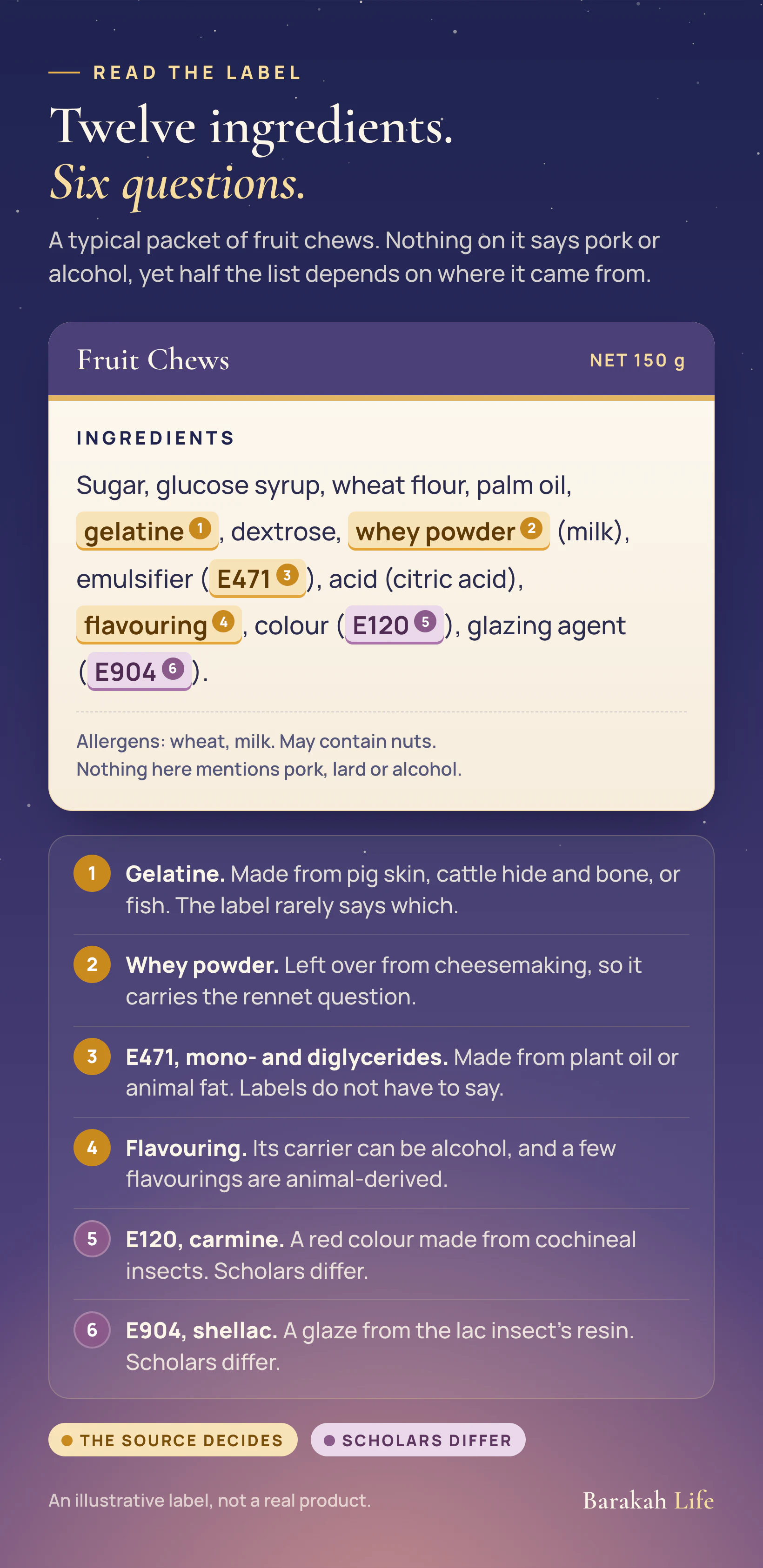
Nothing on this label says pork or alcohol, yet six of its twelve ingredients raise a question.
Know, too, what a label may leave out. In the EU and UK, the list need not show processing aids, enzymes used in processing, additives carried over from another ingredient, or the carriers used for additives and flavourings (Regulation 1169/2011, Article 20); US law has a similar exemption for "incidental additives" (21 CFR 101.100). So a clean list is a good sign, not a guarantee. This is where certification earns its keep: an auditor checks what you cannot see.
Step two: the words that settle it
Some words end the inquiry immediately. If any of these appear, the product is not halal, whatever else is on the pack:
Pork and everything made from it: pork, pig, ham, bacon, lard, gammon, salami, pepperoni, chorizo, prosciutto, pancetta, pork gelatine, porcine anything. On imported goods, also porc, jambon, saindoux (French), Schwein, Schinken, Speck (German), cerdo (Spanish), maiale, strutto (Italian), babi (Malay and Indonesian), domuz (Turkish) and خنزير (Arabic).
Blood as an ingredient, and black pudding or blood sausage.
Wine, beer and spirits named as ingredients: wine, beer, rum, brandy, whisky, vodka, liqueur, sherry, sake, mirin.
Two cautions save you from false alarms. "Turkey ham" and "beef pepperoni" are not pork; the meat word in front decides, and then the meat rule below applies. "Bacon flavour" crisps are usually made without any pork, but some flavourings do contain pork extract or fat, so treat a pork-named flavouring as doubtful until a vegetarian or halal mark settles it. And "wine vinegar" is a separate question from wine: most scholars hold that once wine has fully turned to vinegar it is lawful, which is the principle of istiḥālah discussed below.
Step three: meat, poultry and why unlabelled meat is doubtful
This is where most well-meaning shoppers go wrong. A chicken sandwich or a beef lasagne can have a perfect ingredient list and still not be halal, because what makes meat lawful is how the animal was slaughtered, and no ingredient list records that.
A valid slaughter (dhabḥ or dhakāh) has conditions the schools discuss in detail: a slaughterer who is Muslim or from the People of the Book, a sharp instrument, a cut across the throat that severs the windpipe, gullet and blood vessels, the animal alive at the time of slaughter, and the name of Allah. The Quran says: "Do not eat of that over which the name of Allah has not been mentioned" (6:121). Scholars differ on details, such as forgetting the name of Allah, but none hold that the conditions can be assumed from a supermarket label.
Then there is meat sold in Western countries. Some scholars hold that, on the strength of 5:5, meat from Christian or Jewish slaughterhouses is lawful when the method is valid. Others hold that industrial slaughter generally fails the conditions, pointing to stunning that can kill before the cut, mechanical blades, and no mention of God at all. Certifiers differ too: some accept stunning or mechanical slaughter under conditions, others only hand slaughter without stunning. Our guide to halal certification bodies sets out where each stands.
What all of these positions share is that meat needs assurance. That is why the Barakah Life halal scanner treats any meat or poultry without a halal certification as doubtful, never "likely halal", however clean the rest of the list is. Watch for meat that hides in less obvious words too: chicken stock, beef extract, meat flavouring, animal fat, tallow, suet, dripping and gelatine.
Fish and seafood are a different case. The Quran says "lawful to you is the game of the sea and its food" (5:96), and fish needs no slaughter. Most scholars hold all sea creatures lawful; the Hanafi school limits this to fish. Either way, a tuna sandwich does not carry the slaughter question a chicken sandwich does.
Step four: the ingredients whose source decides
Here is the grey zone the hadith describes. Each of the following can come from a plant, a microbe, a halal-slaughtered animal, an unslaughtered animal or a pig. The ingredient is the same chemical; its source is what makes it lawful or not, and the label usually does not say.
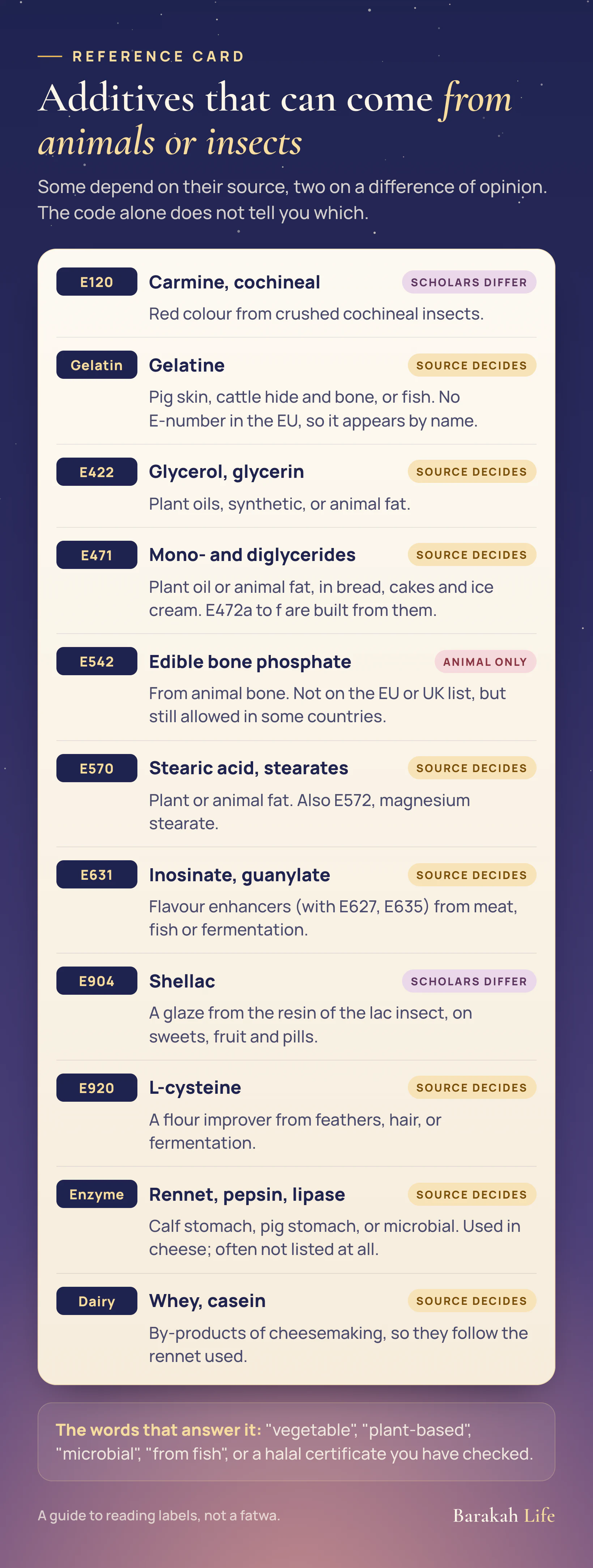
Save this card for the shop. "Vegetable", "microbial", "from fish" or a checked certificate answers the question.
Gelatine
Gelatine sets sweets, marshmallows, mousses and some yoghurts. In the EU it is not classed as an additive, so it has no current E-number and appears by name; lists that still show "E441" are out of date. Gelatine Manufacturers of Europe state that about 80% of the edible gelatine made in Europe comes from pork rind, and most of the rest from cattle hide and bone, with a little from fish. Fish gelatine and gelatine from halal-slaughtered cattle are lawful by agreement. Most scholars do not permit pork gelatine, holding that processing does not change it completely into a new substance. Unspecified gelatine is doubtful; agar (E406), pectin (E440) and carrageenan (E407) are plant-based and raise no question.
E471 and E472: mono- and diglycerides
The most common emulsifiers in bread, cakes, margarine and ice cream. The European Food Safety Authority lists their raw materials as plant oils and also tallow and lard, and EU labels need only give the name or number. Many are plant-based, but "many" is not "this one". "E471 (vegetable origin)" answers the question; a bare "E471" is doubtful until the maker confirms. The E472 family (E472a to E472f) is built from the same fats.
E120 carmine and E904 shellac
Carmine is a red colour made from cochineal insects, used in yoghurts, sweets, drinks and processed meats. US labels must name it as "carmine" or "cochineal extract"; EU and UK labels may just say "colour: E120". Shellac (E904, "confectioner's glaze") is a resin secreted by the lac insect, used to glaze sweets, fruit and tablets. Here the question is a genuine difference among scholars, not the source. Insects have no flowing blood, and many fatwa bodies, including Malaysia's National Fatwa Committee (2012), the Indonesian Ulema Council (2011) and the Iftaa' Department of Jordan, permit carmine when harmless. Hanafi muftis generally hold that insects may not be eaten, citing the prohibition of al-khabāʾith, impure things (7:157), and avoid it in food. Shellac divides scholars in a similar way. Neither view is a fringe one; follow the scholar you trust.
E920 L-cysteine and E542 bone phosphate
L-cysteine softens dough in industrial bread, bagels and pizza bases. It has traditionally been extracted from keratin, meaning poultry feathers, hog bristles or human hair; newer production uses fermentation, and the label will not say which. Edible bone phosphate (E542) is made from animal bones. It is not on the EU or UK list of approved additives, but other countries still allow it, so you may meet it on imported goods. It is acceptable only from halal-slaughtered animals.
Rennet, enzymes and whey
Rennet sets milk into cheese. Traditional rennet comes from the stomach of a young calf, kid or lamb, pepsin is often from pigs, and some lipases used for sharp Italian cheeses and feta come from calves, kids and lambs. Microbial rennet, plant rennet and fermentation-produced chymosin raise no question. On rennet from an animal that was not slaughtered Islamically, scholars differ: Abu Hanifa held it pure and the cheese lawful, a view Ibn Taymiyyah also favoured, while the Shafi'i school and many others hold it impure. Rennet from a pig is impermissible by agreement. Whey is the liquid left after cheesemaking, so it carries the same question into biscuits, crisps, chocolate and protein powders. Because EU cheese made only from milk, salt, cultures and enzymes needs no ingredient list, look for "microbial" or "vegetarian rennet", a vegetarian mark or a halal certificate.
The rest of the watch list
E422 glycerol and E570 stearic acid (with E572 magnesium stearate): from plant oils or animal fats. Common in sweets and supplements.
E627, E631 and E635: flavour enhancers in crisps and noodles, made by fermentation or from meat or fish.
Bone char: some cane sugar is filtered through charred cattle bone. No bone remains in the sugar and nothing appears on any label; scholars differ on whether it matters, and beet sugar avoids the question.
Keep a sense of proportion. Most E-numbers have nothing to do with animals: E300 is vitamin C, E330 is citric acid, E322 lecithin is usually soya or sunflower. "Has E-numbers" is not a reason to avoid a product. The watch list is short on purpose.
Step five: alcohol in flavourings and vanilla extract
Wine and beer listed as ingredients are clear. The harder case is alcohol you cannot see. Flavourings are often dissolved in ethanol, and carriers do not have to be declared. In the US, "vanilla extract" must by law contain at least 35% ethyl alcohol (21 CFR 169.175). In a cake most of it bakes off; in ice cream, a trace remains. Scholars weigh three ideas here, and learned people land in different places:
Istiḥālah, complete transformation. When a substance changes into something entirely new, it takes the ruling of what it has become. Wine that turns to vinegar is the classic example, and it is accepted widely. The Hanafi and Maliki schools, and Ibn Taymiyyah and Ibn al-Qayyim among the Hanbalis, apply transformation broadly. The Shafi'i school and the mainstream Hanbali position limit it to the cases in the texts.
Istihlāk, dissolution. When a tiny amount of a substance dissolves into a much larger lawful one so that no colour, taste or smell of it remains, many scholars hold that it no longer carries its ruling. This is the reasoning used for trace solvent in a finished food.
The source of the alcohol. Most food-grade ethanol is made from grain, cane, beet or petrochemicals, not from grapes or dates. The majority of scholars hold that every intoxicant is khamr, whatever it is made from, on the basis of the hadith "every intoxicant is khamr" (Ṣaḥīḥ Muslim 2003). Abu Hanifa and Abu Yusuf held that the strict ruling of khamr belongs to drinks from grapes and dates. Contemporary Hanafi scholars such as Mufti Taqi Usmani draw on this to explain that alcohol from other sources is not impure, though it is still unlawful to drink.
Contemporary bodies have tried to turn this into practical limits. The International Islamic Fiqh Academy (Resolution 210, 2015) held that food containing wine is not permissible even in a small proportion, but that a slight amount of alcohol used as a solvent for ingredients that do not dissolve in water is excused as a widespread necessity (ʿumūm al-balwā), since most of it evaporates. Malaysia's National Fatwa Committee (2011) permits flavourings and colourings stabilised with alcohol that does not come from making alcoholic drinks, provided the final product contains no more than 0.5%. The Indonesian Ulema Council (Fatwa 10 of 2018) separates ethanol from the alcoholic drinks industry, which is haram, from other ethanol, which it permits in food when harmless, with a 0.5% ceiling for drinks. Many individual scholars take a stricter line and advise avoiding added alcohol wherever an alternative exists.
In practice: where a product says "contains alcohol" or lists an alcoholic drink, most Muslims and most certifiers will leave it. Where the only question is an undeclared carrier in a flavouring, you are in the zone of difference, and the person you take your fiqh from is the right one to ask. If you want to avoid the question entirely, look for vanilla flavouring made with glycerin, "alcohol-free" vanilla, or vanillin, and for a halal certificate, since certifiers set their own limits on alcohol in flavourings.
"Suitable for vegetarians" is not the same as halal
A vegetarian mark is a genuinely useful clue. The UK Vegetarian Society's criteria, for example, exclude meat, fish and insects (so carmine is out), gelatine, animal rennet, shellac and other by-products of slaughter, including processing aids made from them. That clears most of steps three and four in one symbol.
But wine, beer and spirits are vegetarian, so a "suitable for vegetarians" trifle, sauce or chocolate can contain them. And "vegetarian" has no binding legal definition in EU law, so a maker's own claim rests on its own judgement. Vegan marks also allow alcohol. The rule: a vegetarian or vegan mark clears the animal questions; read for alcohol yourself.
What about kosher? Kosher is a separate system with its own rules. It prohibits pork and blood, but permits wine and wine-derived ingredients, and kosher slaughter follows its own law. Scholars differ on whether kosher meat meets the conditions of Islamic slaughter under 5:5. A kosher mark is not a halal mark, though it can help answer some questions, such as whether a product contains pork.
How to check a halal logo
A halal mark from a credible body is the strongest thing a packet can tell you, because certification covers what the label cannot: the source of every additive, the processing aids and carriers, shared lines and, for meat, the slaughter itself. But a mark is only as good as the certificate behind it.
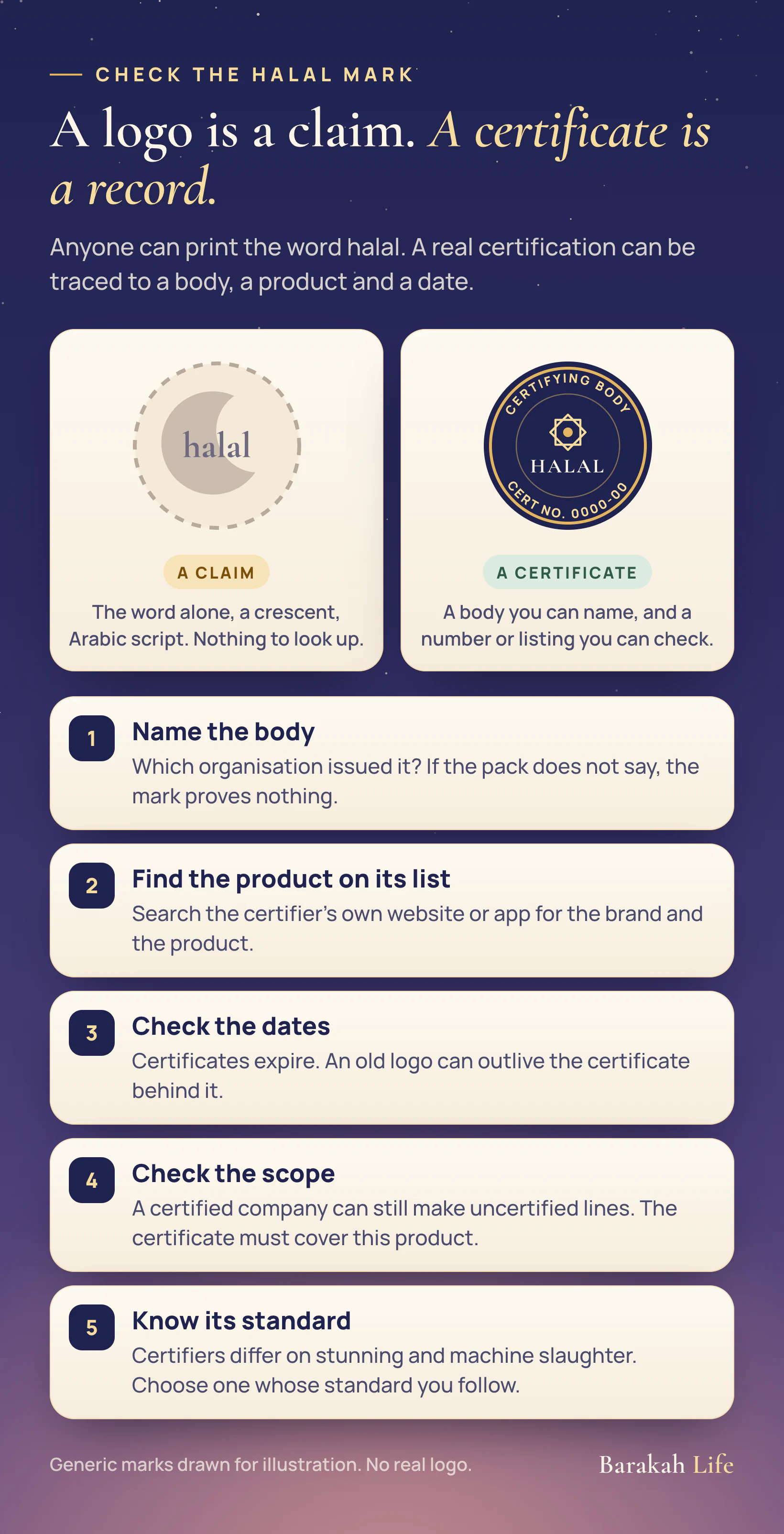
Generic marks drawn for illustration. A real certification can be traced to a body, a product and a date.
Name the body. A crescent, Arabic calligraphy or the word "halal" alone is the maker's claim, not a certification.
Find the product on the certifier's own list. Most publish searchable directories on their website or app. If it is not there, ask them.
Check the dates. Certificates expire; packaging printed years ago can outlive the certificate behind its logo.
Check the scope. A company can make certified and uncertified lines side by side, and one brand can be certified in one country and not another.
Know its standard. Certifiers differ on stunning, mechanical slaughter and alcohol in flavourings. Choose one whose standard you follow.
Which bodies are widely recognised?
This is a factual map, not a ranking. Several Muslim-majority countries run national schemes through government bodies: JAKIM in Malaysia; BPJPH in Indonesia, which took over certification from the Indonesian Ulema Council in 2019 (MUI keeps the fatwa role) and introduced the national "Halal Indonesia" label in 2022; MUIS in Singapore; the Ministry of Industry and Advanced Technology in the UAE, which issues the UAE Halal National Mark; and the Saudi Food and Drug Authority's Saudi Halal Center. Each gives the public a way to check: JAKIM's Verify Halal app and the search on halal.gov.my, BPJPH's search at info.halal.go.id, and the MUIS directory, whose digital certificates since October 2025 carry a QR code that shows whether they are valid and in date.
These authorities also publish the foreign certifiers they recognise. JAKIM recognised 88 bodies in 49 countries in late 2024, and the UAE and Saudi authorities keep their own registers. That makes their lists a useful cross-check when an imported pack carries a logo you do not know.
In the UK, the Halal Monitoring Committee (HMC) certifies hand slaughter without stunning, while the Halal Food Authority (HFA) accepts controlled electric stunning of poultry and sheep under strict conditions and does not accept mechanical slaughter. In North America, long-established bodies include IFANCA, ISNA Halal and HFSAA, which certifies only meat slaughtered by hand. In the US, the government approves meat labels that say "halal", but it does not define or certify the religious standard itself, so the certifier behind the word is what matters. Internationally, standards such as OIC/SMIIC 1 and GSO 2055-1 set out general requirements for halal food, and accreditation bodies such as the GCC Accreditation Center assess certifiers against them.
Fake and lapsed marks are a real problem, not a theory. Malaysia's government told Parliament it had found 56 cases of fraudulent halal logos and certificates in 2024 alone. If a mark cannot be traced, treat the product as uncertified.
Cross-contamination and shared lines
A product can have a spotless list and still run on a line shared with pork sausages, or be fried in the same oil as bacon. Labels do not say. The "may contain" line is a voluntary allergen warning about nuts, milk, gluten and the like; pork and alcohol are not on that list, so it tells you nothing about them.
Halal standards deal with this directly. GSO 2055-1, for example, sets requirements across the whole food chain, so a certified product has had its production line, cleaning and storage assessed, not only its recipe. Without a certificate, the default for non-meat food still applies: it is presumed lawful unless there is a real reason to think otherwise. A specific reason, such as knowing that a dish was cooked in pork fat or that a fryer is shared with bacon, changes that.
For factory-made packs a certificate is the only real assurance. In restaurants, especially for fryers and grills, it is fair and polite to ask.
When the label cannot answer: ask the maker
Manufacturers answer more often than people think, and every question tells a company that Muslim customers are reading. Keep it short and specific:
Subject: Ingredient sources for [product name, pack size, barcode]
Hello, and thank you for your help. I would like to know whether this product is suitable for a Muslim diet. Could you tell me: (1) the source of the [gelatine / E471 / whey / rennet / flavouring], whether plant, microbial, fish or animal, and if animal, which animal; (2) whether any flavouring uses alcohol as a carrier or solvent; (3) whether the product holds a halal certificate, and if so from which body and for which factory. Thank you.
A clear written answer that an ingredient is plant-based or microbial moves it out of the doubtful column. A vague answer, or "we cannot disclose our suppliers", leaves it where it was.
The aisle checklist
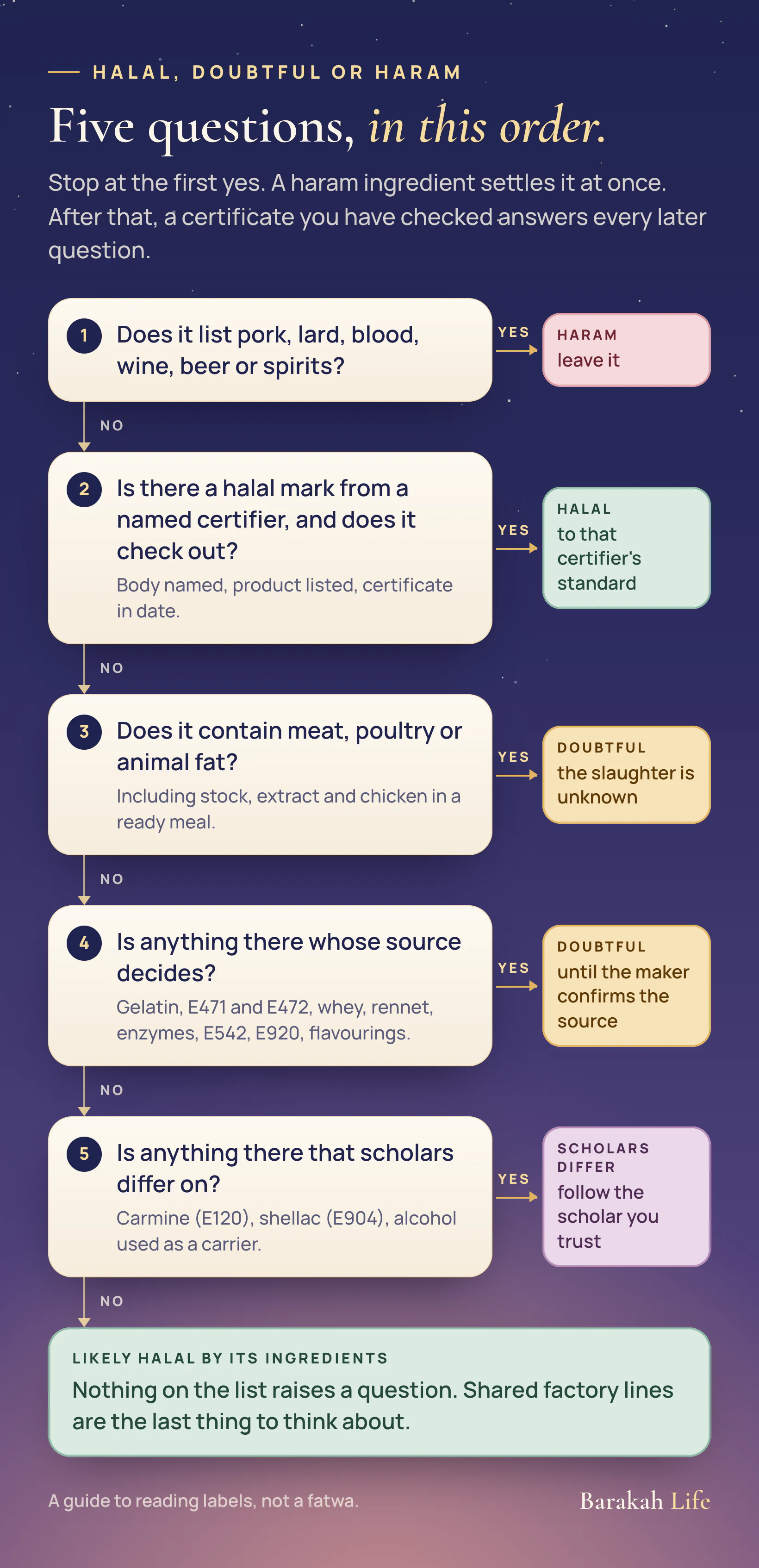
Put it all together and the decision runs in a fixed order. Stop at the first yes.
Halal, doubtful or haram: five questions in this order.
Read the whole pack: list, brackets, name, marks, country.
Scan for the haram words: pork and its products, lard, blood, wine, beer, spirits.
Verify any halal mark: named body, product listed, in date, right scope.
Treat unlabelled meat as doubtful, including stock, extract and animal fat.
Find what the source decides: gelatine, E471, E472, whey, rennet, E542, E920, flavourings. Look for "vegetable", "microbial" or "from fish".
Note the differences: carmine, shellac, alcohol as a carrier. Follow the scholar you trust.
Still unclear? Ask the maker or leave it.
How the Barakah Life halal scanner helps
The Barakah Life halal scanner runs this checklist for you. Scan a barcode, or type it in, and it looks the product up in Open Food Facts, a free, open database of millions of products, then reads the ingredients against our rules. It is built to be careful rather than reassuring:
Meat without a halal mark is "doubtful", never "likely halal". The rule above is built into the engine.
Whole-word matching. "Ham" never fires inside "champignon", "turkey ham" falls to the meat rule, and "wine vinegar" is not wine.
Labels in several languages. The key words, pork above all, are recognised on labels in English, French, German, Spanish, Italian, Malay, Indonesian, Turkish, Arabic and Urdu.
A reason with every flag, and "not enough information" when a product has no ingredient list, never a guess.
On the website, the scanner is free with no account needed. In the Barakah Life app you get 3 free barcode scans every day; Premium unlocks unlimited scans, the full ingredient analysis and a personal ingredient watchlist that is checked on every scan. The latest version of the app also checks cosmetics for free: lipsticks, creams and nail polish, including whether a product lets water reach the skin for wuḍūʾ. Alongside it sits our directory of halal certification bodies, with each body's position on stunning and machine slaughter and a link to its own product list.
A scanner is a strong first filter, not a fatwa. Databases can be out of date, recipes change, and the source of a doubtful additive is something only the maker or a certifier can confirm. Always read the physical label, and for serious questions, ask a scholar you trust.
Common questions
Does "suitable for vegetarians" mean halal?
No. It rules out meat, gelatine and animal rennet, and under the strictest schemes carmine and shellac too, but not alcohol. Read for wine, beer, spirits and "contains alcohol" yourself.
Are E-numbers haram?
No. An E-number is just a code for an approved additive, and most have nothing to do with animals. A short list can be animal- or insect-derived: chiefly E120, E422, E471, E472, E542, E570, E631, E904 and E920.
Is E471 halal?
When made from plant oils, which most is, yes. A bare "E471" is doubtful until the label, a vegetarian mark, the maker or a halal certificate confirms the source.
Is gelatine halal?
Fish gelatine and gelatine from halal-slaughtered cattle are halal. Pork gelatine, the largest share in Europe, is not permitted by most scholars. Unspecified gelatine is doubtful.
Are cheese and whey halal?
With microbial, plant or fermentation-produced rennet, yes. With rennet from an unslaughtered animal, scholars differ; Abu Hanifa permitted it. Halal-certified cheese and whey settle it for everyone.
Is vanilla extract halal?
It is made with alcohol, and scholars differ on the trace left in finished food. Vanillin, glycerin-based vanilla and alcohol-free vanilla avoid the question.
Is carmine (E120) halal?
Scholars differ. Fatwa bodies in Malaysia, Indonesia and Jordan permit it; many Hanafi muftis do not, holding that insects may not be eaten.
I ate something that turned out to be doubtful, or even haram. Have I sinned?
No. "There is no blame on you for what you did by mistake, but only for what your hearts intended" (Quran 33:5). Learn from it, check next time, and let it go.
Checking food is not about suspicion of everyone and everything. It is a small act of taqwā, repeated in the most ordinary place there is. Read the label, verify what you can, ask when you need to, and leave the rest with a calm heart. Then say بِسْمِ ٱللَّٰهِ, Bismillāh, in the name of Allah, and eat. To check your next packet in seconds, open the halal scanner, and keep our certification guide to hand.
Tagshalalfoode-numbershalal certificationfiqh
Pass it on
Know someone who needs this today? Send it to them.
“Whoever guides someone to good has a reward like the one who does it.” Sahih Muslim 1893