
Zakat is the pillar of Islam that comes with arithmetic. Prayer asks for your presence and fasting for your patience; zakat asks for a number. Most people are comfortable with the 2.5%. What troubles them is everything that comes before it. Does the house deposit fund count? The interest the bank added? The index fund, the pension you cannot touch for twenty years, the crypto, the money your brother still owes you? This guide gives you one method from start to finish, answers each of those, and shows exactly where the schools differ, so you can follow the view you have learned with your eyes open.
خُذْ مِنْ أَمْوَٰلِهِمْ صَدَقَةً تُطَهِّرُهُمْ وَتُزَكِّيهِم بِهَا وَصَلِّ عَلَيْهِمْ ۖ إِنَّ صَلَوٰتَكَ سَكَنٌ لَّهُمْ ۗ وَٱللَّهُ سَمِيعٌ عَلِيمٌ
Khudh min amwālihim ṣadaqatan tuṭahhiruhum wa tuzakkīhim bihā wa ṣalli ʿalayhim, inna ṣalātaka sakanun lahum, wa-llāhu samīʿun ʿalīm.
Take from their wealth a charity by which you cleanse them and cause them to grow, and pray for them. Your prayer is a comfort to them, and Allah is All-Hearing, All-Knowing.
Zakat cleanses and it grows. When the Prophet ﷺ sent Muʿādh to Yemen, he described it in one line: it is taken from their rich and given back to their poor (Ṣaḥīḥ al-Bukhārī 1395). Every figure below is somebody's rent, school fees or next meal.
The method in one line
Zakat due = 2.5% of (everything zakatable you own on your zakat date, minus the debts that are due).
It is owed only if that net figure reaches the nisab, and only once you have held the nisab for a full lunar year. Everything else in this guide is detail about what goes into each side of that line.
Five steps, start to finish
- Fix your zakat date. It is the Hijri date on which your zakatable wealth first reached the nisab. Every year on that date you take a snapshot and calculate. Many people choose a date in Ramadan for its reward; if it falls before your true anniversary, the payment counts as paid early, which most schools allow.
- List what you own on that date. Cash in every account and currency, gold and silver, investments (each by its own rule below), crypto, business stock, and money owed to you by people who will repay. Leave out your home, car, furniture, clothes and the tools of your work.
- Take out what was never yours. Interest (riba) credited to your accounts is not your wealth. Set it aside to give away in full, outside your zakat.
- Subtract the debts that are due. Bills and card balances you owe now, and for long loans such as a mortgage only the instalments due in the coming year. Never the whole balance, and never interest. (The Shafiʿi school deducts no debts at all; see the section on debts.)
- Check the nisab, then pay 2.5% of the whole figure. If the net total reaches the nisab, zakat is 2.5% of all of it, not only of the part above the nisab. On a Gregorian year instead of a lunar one, AAOIFI's standard uses 2.577% to cover the extra eleven days.
The rate itself is in the letter Abū Bakr wrote setting out the zakat the Prophet ﷺ had made obligatory, narrated by Anas:
وَفِي الرِّقَةِ رُبْعُ الْعُشْرِ، فَإِنْ لَمْ تَكُنْ إِلاَّ تِسْعِينَ وَمِائَةً فَلَيْسَ فِيهَا شَىْءٌ، إِلاَّ أَنْ يَشَاءَ رَبُّهَا
Wa fi r-riqqati rubʿu l-ʿushr, fa-in lam takun illā tisʿīna wa mi'atan fa-laysa fīhā shay', illā an yashā'a rabbuhā.
And on silver, a quarter of a tenth. If there are only one hundred and ninety [dirhams], nothing is due on it, unless its owner wishes to give.
A quarter of a tenth is one fortieth, which is 2.5%. Paper money, bank balances and trade goods are measured against the same rate, because the scholars, and the International Islamic Fiqh Academy in its Resolution 21 (1986), gave currency the ruling of gold and silver.
Your zakat date and the lunar year (hawl)
Zakat on cash, gold, silver, investments and trade goods falls due once a full lunar year has passed while you hold at least the nisab. Scholars call that year the hawl. A lunar year is about 354 days, so your zakat date moves about eleven days earlier on the Gregorian calendar each year.
لاَ زَكَاةَ فِي مَالٍ حَتَّى يَحُولَ عَلَيْهِ الْحَوْلُ
Lā zakāta fī mālin ḥattā yaḥūla ʿalayhi l-ḥawl.
There is no zakat on wealth until a year has passed over it.
Some chains of this narration carry weakness (al-Tirmidhī preferred the version that stops at Ibn ʿUmar), but the rule itself stands on the practice of the Companions and is agreed by the four schools.
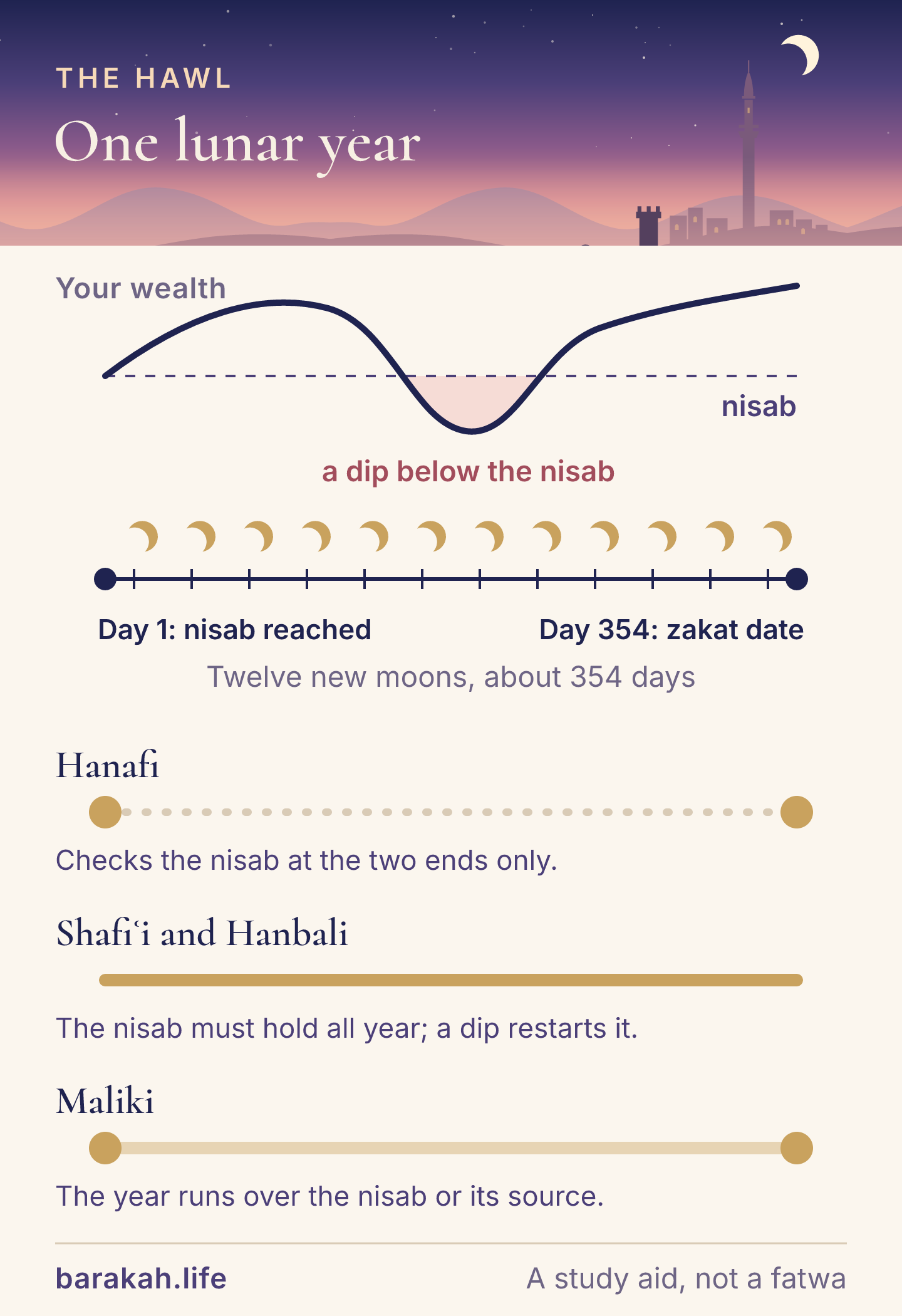
What if my balance dipped below the nisab during the year?
The Hanafi school looks only at the two ends of the year: a dip in between does not matter unless your wealth was wiped out completely. The Shafiʿi and Hanbali schools require the nisab all year, so a dip restarts the count. The Maliki school requires the year to pass over the nisab or its source, so trade profit joins the original year while a gift starts its own.
Money that arrived during the year
In the Hanafi school, new money such as salary or a gift joins the nisab you already hold and is counted on your zakat date, even if it arrived the day before. The Shafiʿi and Hanbali schools give each unrelated sum its own year, but allow zakat to be paid early once you own the nisab, so most of their followers pay on the whole balance on their date and treat the newer money as paid in advance. Early payment rests on the report that al-ʿAbbās asked to pay his zakat before it fell due and the Prophet ﷺ allowed it (Sunan Abī Dāwūd 1624, graded ḥasan by al-Albānī, weak by al-Arnaʾūṭ). The Maliki school tolerates only about a month of early payment on cash, so a Maliki follower may track large mid-year sums separately.
Salary is not taxed as it arrives. The four schools require the year to pass; whatever you still hold on your zakat date is counted. Yūsuf al-Qaraḍāwī's view that earned income is zakatable on receipt is a contemporary minority opinion.
The nisab: gold or silver?
The nisab is the minimum you must hold before zakat is owed at all. It was set in the Sunnah in metal: twenty mithqal (dinars) of gold or two hundred dirhams of silver. The silver figure is in the most authenticated text on the subject:
لَيْسَ فِيمَا دُونَ خَمْسِ ذَوْدٍ صَدَقَةٌ مِنَ الإِبِلِ، وَلَيْسَ فِيمَا دُونَ خَمْسِ أَوَاقٍ صَدَقَةٌ، وَلَيْسَ فِيمَا دُونَ خَمْسَةِ أَوْسُقٍ صَدَقَةٌ
Laysa fīmā dūna khamsi dhawdin ṣadaqatun mina l-ibil, wa laysa fīmā dūna khamsi awāqin ṣadaqah, wa laysa fīmā dūna khamsati awsuqin ṣadaqah.
There is no zakat on fewer than five camels, no zakat on less than five awāq [of silver], and no zakat on less than five awsuq [of produce].
Five awāq is two hundred dirhams. The gold figure of twenty dinars is reported from ʿAlī in Sunan Abī Dāwūd 1573 (graded ṣaḥīḥ by al-Albānī) and is agreed by the four schools. Converted to grams, the common figures are:
- Gold: 85 g (a mithqal of 4.25 g, used by al-Qaraḍāwī, AAOIFI and the Kuwaiti Fiqh Encyclopedia) or 87.48 g (7.5 tola, used in many South Asian Hanafi fatwas).
- Silver: 595 g (a dirham of 2.975 g) or 612.36 g (52.5 tola).
The two sets of grams convert old weights differently; nobody disagrees about the Sunnah amount itself.
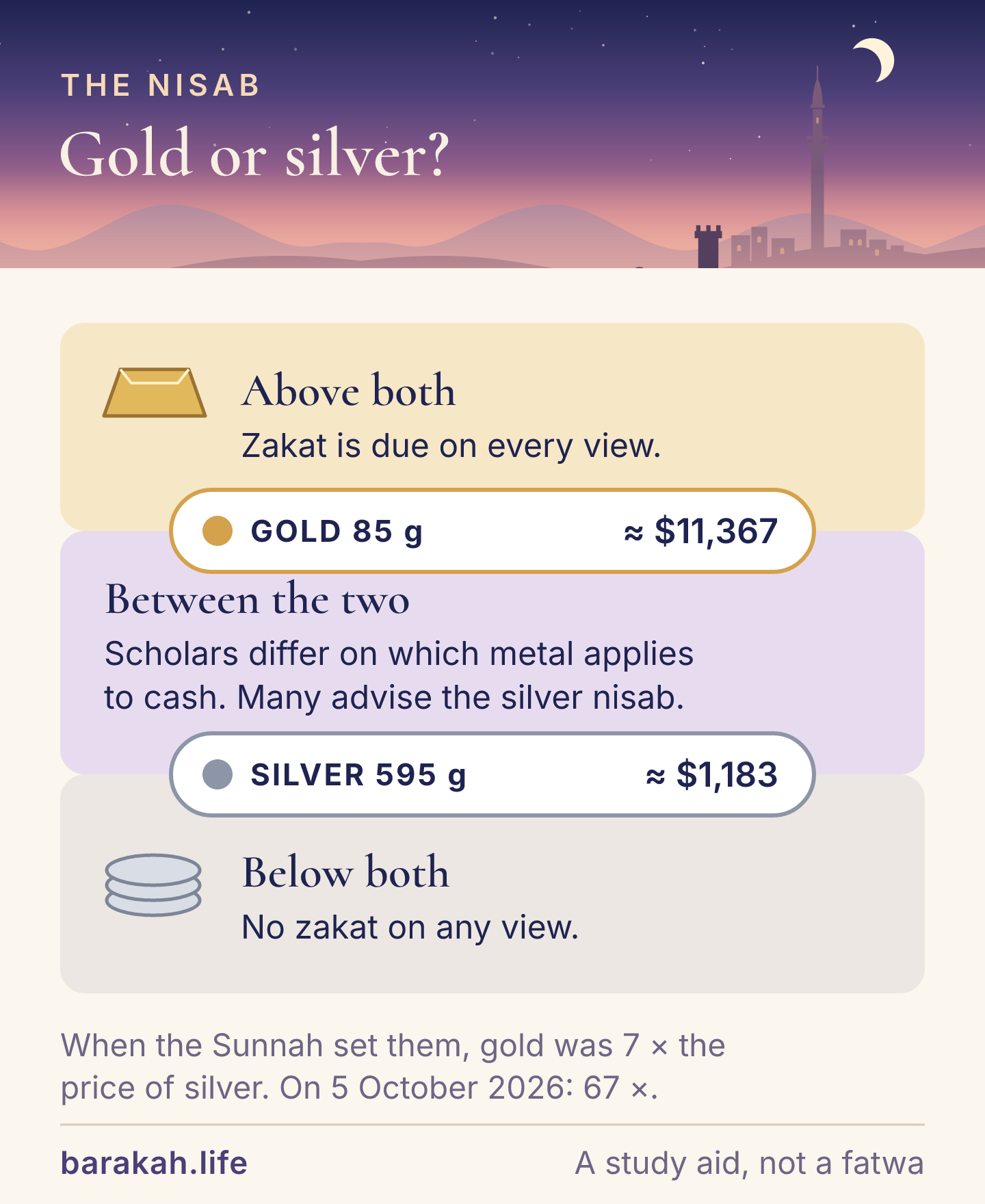
When the two thresholds were set they were worth about the same: 85 g of gold against 595 g of silver implies gold at seven times the price of silver. On 5 October 2026 gold was about sixty-seven times the price of silver, so the gold nisab was about $11,367 (£8,590) and the silver nisab about $1,183 (£894). Someone with $5,000 in the bank owes zakat on the silver measure and nothing on the gold one.
Which one applies to cash?
Paper money did not exist when the nisab was set, so scholars differ on which metal to measure cash against.
- Silver. The classical principle (Hanafi, and Hanbali for trade goods) is to use the measure more beneficial to the poor, which today is silver. Darul Uloom Deoband applies it, especially for a mix of cash, gold and goods.
- Gold. Al-Qaraḍāwī argued that 595 g of silver no longer marks the wealth the nisab was meant to mark. Dar al-Iftaʾ al-Miṣriyya uses 85 g of 21-karat gold, and DarulIftaa.us (Hanafi) recommends gold in Western contexts while encouraging those who reach only the silver nisab to pay as a precaution.
Many scholars recommend the silver nisab for cash, for three reasons. It is where the classical rule of benefit to the poor points. It is the cautious choice: if you pay and it was not strictly due, you have given charity that Allah rewards; if you hold back and it was due, a pillar has been left undone. And it brings more people into the circle of givers. If your scholar uses the gold nisab, you are following a recognised view.
In practice. Above the gold nisab, the question disappears: zakat is due on every view. Below the silver nisab, nothing is due on any view. Between the two, the silver nisab is the precautionary choice many scholars recommend.
Add everything together first
You do not test each asset against the nisab separately. Cash, trade goods and precious metals are added together by value and the total is compared with the nisab. This is the position of the Hanafi, Maliki and Hanbali schools; the Shafiʿi school also adds trade goods to currency but does not add gold and silver to each other.
What counts, and what does not
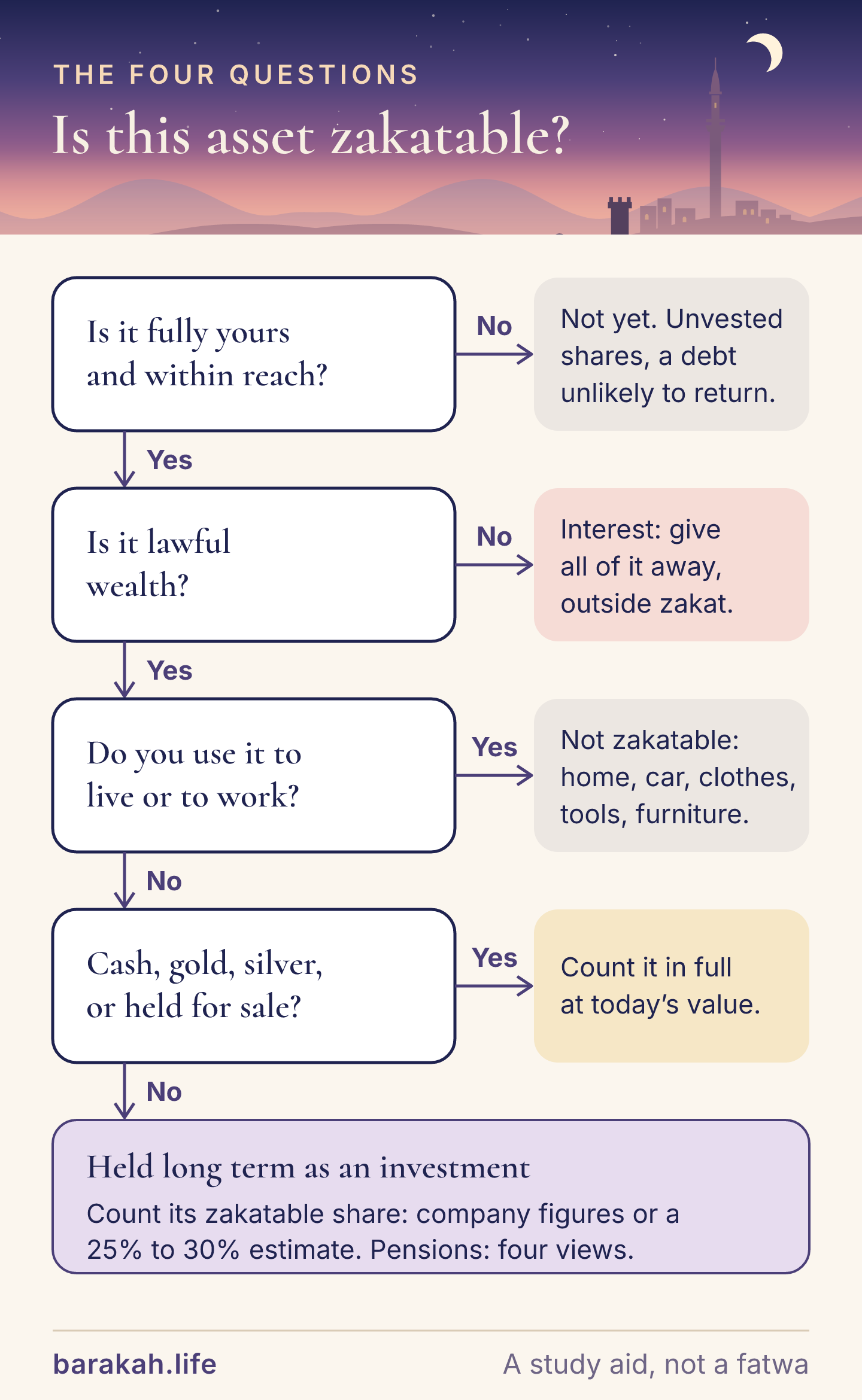
Zakat falls on wealth that is fully yours and can grow: money, gold and silver, and things held for sale. It does not fall on what you use to live and work.
| What you hold | Counted? | How |
|---|---|---|
| Cash, current and savings accounts, e-wallets | Yes | Full balance on your zakat date |
| Savings for a house, wedding or Hajj | Yes | Counted until spent |
| Interest received | No | Give it away in full, outside zakat |
| Profit from an Islamic bank account | Yes | Added to your cash |
| Gold and silver bars, coins, savings jewellery | Yes | Pure weight at the market price |
| Jewellery you wear | Differs | Hanafi: yes. Maliki, Shafiʿi, Hanbali: no, within custom |
| Shares you trade | Yes | Full market value |
| Shares and funds held long term | Yes, in part | Their zakatable assets, or a 25% to 30% estimate |
| Defined contribution pension, 401(k), superannuation | Differs | Four contemporary views, below |
| Final salary or state pension | No | Payments join your cash once received |
| Crypto | Yes, for those who accept it | Market value on your zakat date |
| Money owed to you by a reliable person | Yes | Timing differs by school |
| Business stock | Yes | Market value on your zakat date |
| Home, car, furniture, clothes, tools of trade | No | Agreed by the four schools |
| A property you rent out | Not the property | Rent you still hold counts as cash |
Cash and savings
This part is agreed. Every form of money you own counts at its balance on your zakat date: current accounts, savings accounts, cash at home, money in payment apps and e-wallets, and foreign currency converted at that day's rate. A fixed-term deposit counts too; the International Islamic Fiqh Academy (Resolution 143, 2005) ruled that restrictions on withdrawal do not remove zakat from an account you own.
Money saved for something specific is still zakatable. The house deposit, the wedding fund, the Hajj savings: until spent, it is cash, and the schools agree that a plan for money does not remove its zakat. Money for this month's spending counts too if it is still there on the date; bills already due are deducted.
Bank interest: purify it, do not count it
يَـٰٓأَيُّهَا ٱلَّذِينَ ءَامَنُوا۟ ٱتَّقُوا۟ ٱللَّهَ وَذَرُوا۟ مَا بَقِىَ مِنَ ٱلرِّبَوٰٓا۟ إِن كُنتُم مُّؤْمِنِينَ فَإِن لَّمْ تَفْعَلُوا۟ فَأْذَنُوا۟ بِحَرْبٍ مِّنَ ٱللَّهِ وَرَسُولِهِۦ ۖ وَإِن تُبْتُمْ فَلَكُمْ رُءُوسُ أَمْوَٰلِكُمْ لَا تَظْلِمُونَ وَلَا تُظْلَمُونَ
Yā ayyuha lladhīna āmanu ttaqu llāha wa dharū mā baqiya mina r-ribā in kuntum mu'minīn. Fa-in lam tafʿalū fa'dhanū bi-ḥarbin mina llāhi wa rasūlih, wa in tubtum fa-lakum ru'ūsu amwālikum, lā tadhlimūna wa lā tudhlamūn.
O you who believe, be mindful of Allah and give up what remains of riba, if you are believers. If you do not, then be warned of war from Allah and His Messenger. And if you repent, you may keep your principal: you do no wrong, and you are not wronged.
Read the last line closely. The one who repents keeps his principal. The principal is yours and is zakatable. The interest is not.
Many guides get this wrong. Interest is not part of your zakat base, and paying 2.5% of it does not make it clean. The schools agree that unlawful gain is not owned by the one holding it: it is returned to its owner where possible, otherwise given away in full (Kuwaiti Fiqh Encyclopedia, vol. 23, pp. 248 to 249). The National Zakat Foundation says the same: give it away as charity, not as zakat.
- Find the figure. Add up the interest credited to every account during the year from your statements.
- Remove it from your zakat total. Count only the principal.
- Give all of it away to people in need or to public benefit, without counting it as your own charity for reward.
- Keep it separate. It is not zakat, and it does not reduce the zakat you owe.
For completeness: Dar al-Iftaʾ al-Miṣriyya and the Islamic Research Academy of al-Azhar (2002) hold a minority view that fixed returns on bank deposits are an investment return rather than riba; on that view the return is simply part of your savings. Most scholars and zakat bodies do not hold it.
Gold and silver
Gold and silver bars, coins and anything kept as savings are zakatable by agreement. The scholars read the warning in Sūrat al-Tawba as falling on gold and silver whose due is withheld:
وَٱلَّذِينَ يَكْنِزُونَ ٱلذَّهَبَ وَٱلْفِضَّةَ وَلَا يُنفِقُونَهَا فِى سَبِيلِ ٱللَّهِ فَبَشِّرْهُم بِعَذَابٍ أَلِيمٍ
Wa-lladhīna yaknizūna dh-dhahaba wa l-fiḍḍata wa lā yunfiqūnahā fī sabīli llāhi fa-bashshirhum bi-ʿadhābin alīm.
And those who hoard gold and silver and do not spend it in the way of Allah, give them tidings of a painful punishment.
Value it by its pure metal content at the market price on your zakat date: weight × purity × price per gram. Do not use what you paid for it or what a shop would charge to make it.
| Purity | Pure fraction | Example: 100 g |
|---|---|---|
| 24 karat | 0.999 | 99.9 g of gold |
| 22 karat | 0.9167 | 91.7 g |
| 21 karat | 0.875 | 87.5 g |
| 18 karat | 0.75 | 75 g |
| Sterling silver (925) | 0.925 | 92.5 g of silver |
For the nisab test only, the Hanafi school counts an item that is mostly gold at its full weight, while the Shafiʿi and Hanbali schools count its pure content; the zakat itself comes out nearly the same. Ibn ʿUthaymīn advised valuing jewellery at what it would fetch as used gold on the day.
Jewellery you wear
- Hanafi school: due on all gold and silver jewellery, worn or not. Evidence includes the girl wearing two heavy gold bangles whose mother the Prophet ﷺ asked whether she paid their zakat (Sunan Abī Dāwūd 1563, ḥasan per al-Albānī; similar in Jāmiʿ al-Tirmidhī 637, ḥasan) and ʿĀʾisha's silver rings (Sunan Abī Dāwūd 1565, ṣaḥīḥ per al-Albānī). Ibn Bāz and Ibn ʿUthaymīn held the same.
- Maliki, Hanbali and the relied-upon Shafiʿi view: not due on permissible jewellery worn within custom, based on the practice of ʿĀʾisha and Ibn ʿUmar reported in the Muwaṭṭaʾ. Dar al-Iftaʾ al-Miṣriyya holds this view; MUIS in Singapore sets the customary limit at 860 g.
Both sides agree that jewellery kept as an investment, or far beyond custom, is zakatable, as is gold held through a platform or a gold-backed fund.
Stocks and shares
The first question is not what you own but why you bought it. The intention at the time of purchase decides which rule applies.
Shares you trade
Shares bought to sell for a profit are trade goods. Zakat is 2.5% of their full market value on your zakat date, plus any cash sitting in the account. This is the position of the International Islamic Fiqh Academy and the Fiqh Council of North America, and it follows the four schools' rule on goods held for sale.
Shares you hold for the long term
A share is a slice of a company. Some of what the company owns is zakatable: its cash, the money customers owe it and its stock for sale. Most is not: buildings, machines and brands are the tools of its trade, like the shelves in a shop. So the long-term holder pays only on his slice of the zakatable part. This is the method of the International Islamic Fiqh Academy (Resolution 121, 2001), AAOIFI's Shariʿah Standard 35 and the Fiqh Council of North America.
- Open the company's latest balance sheet. Add its cash and cash equivalents, short-term investments, receivables and inventory.
- Divide by the number of shares in issue. That is the zakatable amount behind each share.
- Multiply by the number of shares you own.
- Pay 2.5% of that amount.
A worked line: a company holds $40 billion of cash, receivables and inventory and has 5 billion shares, so $8 of zakatable assets stands behind each share. You own 200 shares trading at $120, worth $24,000. Your zakatable amount is 200 × $8 = $1,600, and your zakat is $40. Had you been trading those shares, it would have been 2.5% of $24,000, which is $600.
The 25% and 30% shortcuts, and who holds them
Few people have time to read a balance sheet for every holding, so two bodies have published estimates of the same method:
- The National Zakat Foundation (UK) studied the FTSE 100 and found that for most companies the zakatable assets were below a quarter of the share value. It recommends treating 25% of the market value as zakatable, which is 0.625% of your holding (approved in 2018, re-approved in 2023). NZF says the proxy should not be used for private companies or for start-ups holding mostly cash.
- The Fiqh Council of North America, in its ruling on stocks approved on 27 November 2025, gives 30% of the market value as a reasonable estimate when the figures are unknown, which is 0.75% of your holding.
They are estimates from different markets, not competing rulings: use the exact figure when you have it.
Other views, dividends and employer shares
When the zakatable assets cannot be known, the International Islamic Fiqh Academy allows paying on the dividends instead, as AMJA (2010) did; some scholars pay on the full value as a precaution. If the company pays zakat itself, as Saudi listed companies do, the shareholder does not pay again (IIFA Resolution 28, 1988). Dividends you still hold are cash; purify any non-compliant income portion separately. Unvested shares and unexercised options are not yet yours, so no zakat is due until they vest.
Funds, index funds and ETFs
Units you trade count at full value; units held long term count at the zakatable share of what the fund holds. NZF's proxies by fund type: equity about 25% to 27%, Shariah equity 26%, property 15%, mixed 50%, bonds 100% (and any interest is riba to purify). The American Fiqh Academy treats most fund holdings as trade assets, zakatable at full value. A gold ETF is gold: zakat on its full market value.
Pensions, 401(k), IRA, ISA and superannuation
The classical schools never saw a pension pot, so this is contemporary scholarship, and views are furthest apart here.
Final salary and state pensions
A defined benefit (final salary) pension or a state pension is not a pot of money in your name. There is nothing to count while you are working (NZF; IIFA for pension salaries). Once payments arrive, they are cash and join your zakatable wealth.
Pension pots in your name
Workplace defined contribution pensions, SIPPs, 401(k)s, IRAs and Australian superannuation are pots of investments that you own but usually cannot reach until a set age. Contemporary bodies hold four views:
| View | Who holds it |
|---|---|
| No zakat until you can access it, then pay for one year | IIFA for employer-controlled schemes; Joe Bradford for a 401(k) before 59½ |
| Every year, on the zakatable portion of the investments | National Zakat Foundation; Fiqh Council of North America (method 1) |
| Every year, on what you could withdraw after tax and penalties | AMJA (2010); Fiqh Council of North America (method 2) |
| Every year, on the full market value | American Fiqh Academy (2022) |
IIFA adds that a savings plan whose investments you direct yourself is zakatable every year. If you need one working figure and follow no particular teacher, the second view sits in the middle of the range and is the method NZF uses and FCNA lists first: for an equity fund, 2.5% of 25% of the pot each year. Example 2 below shows how far apart the views land.
ISAs are wrappers, not pensions
A UK ISA is a tax wrapper that you can usually withdraw from, so it is not treated like a locked pension. Count what is inside it by its own rule: a Cash ISA is cash (with any interest purified), and a Stocks and Shares ISA follows the rules for shares and funds above.
Provident funds
For compulsory funds such as the GP Fund in Pakistan or the EPF in India, South Asian Hanafi fatwa bodies hold that no zakat is due before you receive the money; Darul Uloom Deoband makes any voluntary contribution zakatable every year.
Crypto
For scholars who accept crypto as property, it is zakatable. The National Zakat Foundation (2023) treats coins used as currency like cash, and any crypto bought to resell as trade goods; both count at 2.5% of their market value on your zakat date. Coins that are staked or locked are still yours and still count, and rewards you have received are added to your holdings. Tokens bought for some other use depend on what they represent.
The International Islamic Fiqh Academy deferred a ruling on cryptocurrency (Resolution 237, 2019), and Dar al-Iftaʾ al-Miṣriyya declared trading it impermissible in 2017. Whatever your view on holding it, paying zakat on what you already hold is the safer course. Use the price on your zakat date from the exchange where you would sell.
Money other people owe you
A loan to a friend or relative who will repay is still your wealth. The schools agree on that and differ on timing:
- Shafiʿi (the stronger view of the school) and the International Islamic Fiqh Academy (Resolution 1, 1985): count it every year, like cash in hand.
- Hanafi and Hanbali: zakat builds up every year but need not be paid until the money comes back; then you pay for all the years it was owed. Paying earlier is allowed.
- Maliki: pay for one year only, when it is repaid.
A debt you may never see again is not counted while recovery is unlikely. If it comes back, the Hanafi school asks nothing for past years, the Maliki one year, the Shafiʿi all past years, and the Hanbali school has two narrations. The simplest course: include reliable loans each year and leave doubtful ones out until they return.
Debts you owe
The majority (the Hanafi, Maliki and Hanbali schools, and al-Shāfiʿī's earlier view) let debts reduce your zakatable cash and trade goods, since a person buried in debt is not the rich person from whom zakat is taken. The relied-upon Shafiʿi position (al-Shāfiʿī's later view) deducts nothing: zakat is due on the full wealth.
The hard case is long-term debt: if a thirty-year mortgage were deducted in full, almost no homeowner would pay zakat. Contemporary bodies limit it:
- National Zakat Foundation: deduct debts due within the next twelve lunar months, and up to twelve months of instalments on longer debts, never the interest portion.
- Zakat Foundation of America: deduct only the payment currently due on your zakat date.
- Mufti Taqi Usmani: deduct loans taken for consumption; deduct business loans only to the extent they financed zakatable assets such as stock, not machinery or buildings.
A student loan repaid only above an income threshold is not deducted (NZF). Card balances, rent and tax already due are deducted in every school that allows deduction.
Business stock and trade goods
The four schools hold that goods bought for resale are zakatable. Among their evidence is the command to spend from what you earn:
يَـٰٓأَيُّهَا ٱلَّذِينَ ءَامَنُوٓا۟ أَنفِقُوا۟ مِن طَيِّبَـٰتِ مَا كَسَبْتُمْ وَمِمَّآ أَخْرَجْنَا لَكُم مِّنَ ٱلْأَرْضِ
Yā ayyuha lladhīna āmanū anfiqū min ṭayyibāti mā kasabtum wa mimmā akhrajnā lakum mina l-arḍ.
O you who believe, spend from the good things you have earned and from what We have brought out of the earth for you.
They also cite ʿUmar ibn al-Khaṭṭāb telling a leather merchant to value his goods and pay their zakat, a report the Kuwaiti Fiqh Encyclopedia lists with the school positions (vol. 23, pp. 268 to 269). For a business you own:
- Value your stock at what it would realistically sell for on your zakat date, not what you paid. Many traders use the wholesale or replacement value. Raw materials that become part of what you sell count; packaging sold with the goods counts.
- Add business cash and money customers owe you that you expect to collect.
- Leave out fixed assets: premises, shelves, machines, vehicles and tools are not zakatable (agreed by the four schools).
- Subtract business debts due, on the same principles as personal debts.
The Maliki school has the speculative holder (muḥtakir), who waits for a price rather than trading actively, pay for one year when he sells. Property bought to resell is trade goods; rent you still hold counts as cash.
Three worked examples
All prices are from 5 October 2026: gold at about $133.73 a gram and silver at about $1.99 a gram, with £1 = $1.32 and $1 = AED 3.67. Your own prices will differ; the Barakah Life zakat calculator uses the day's prices in your currency.
Example 1: Maryam, salaried, with savings and a little gold
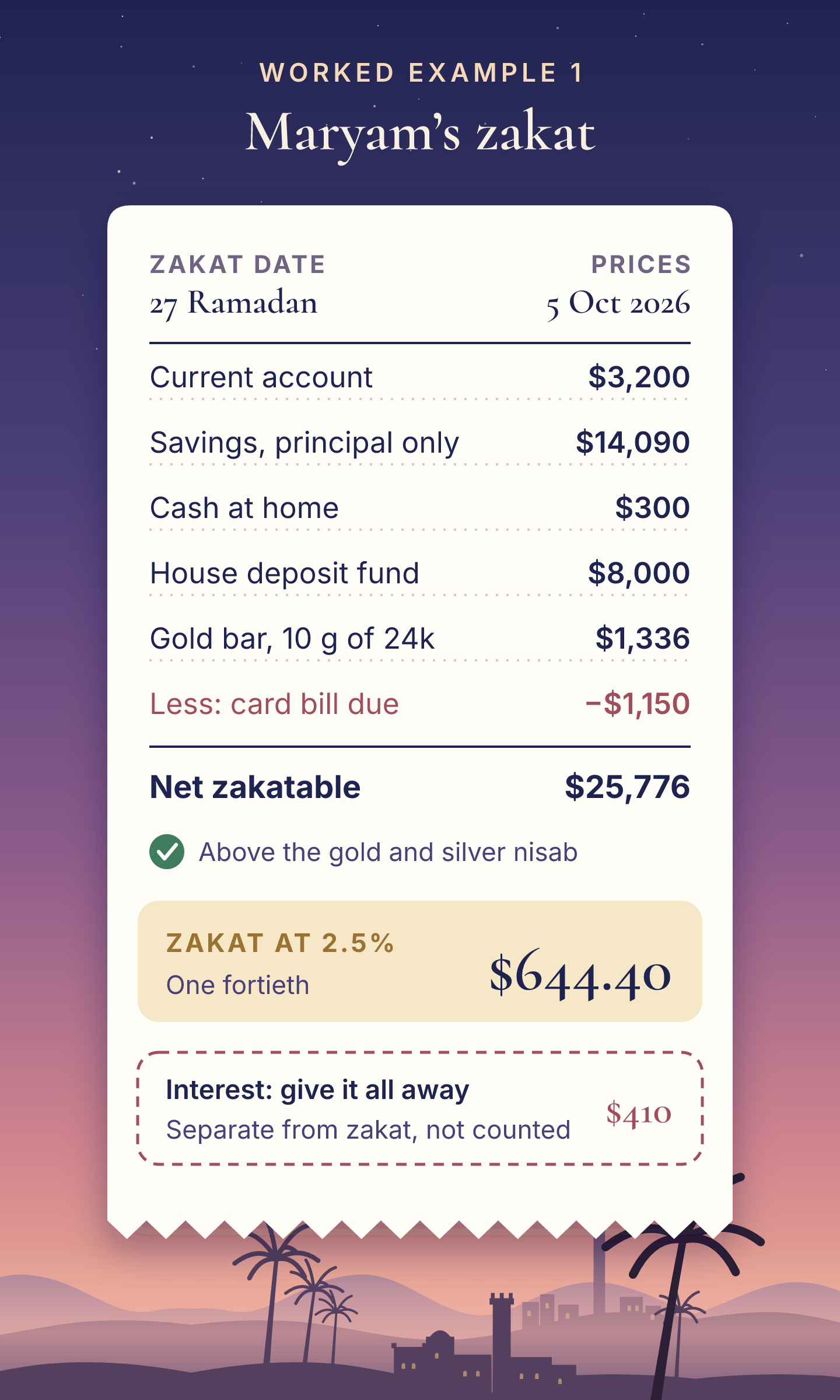
On her zakat date, 27 Ramadan, Maryam holds $3,200 in her current account and $300 in cash. Her savings account shows $14,500, including $410 of interest. She keeps $8,000 aside for a house deposit, owns a 10 g bar of 24-karat gold, and has a $1,150 card bill due next week.
| Item | Amount |
|---|---|
| Current account | $3,200 |
| Savings, principal only ($14,500 less $410 interest) | $14,090 |
| Cash at home | $300 |
| House deposit fund | $8,000 |
| Gold bar: 10 g × 0.999 × $133.73 | $1,336 |
| Less: credit card bill due | −$1,150 |
| Net zakatable wealth | $25,776 |
| Zakat at 2.5% | $644.40 |
| Interest to give away, outside zakat | $410 |
She is above both the gold and the silver nisab, so the choice of metal does not change her answer. If she follows the Shafiʿi school she does not deduct the card bill, and her zakat is $673.15.
Example 2: Imran, an investor in the UK
Imran has £6,000 in an Islamic savings account, a Stocks and Shares ISA holding £40,000 in a global index fund he means to keep for years, and £5,000 of shares he actively trades. His workplace pension is £62,000 in an equity fund he cannot reach until 57. He holds £2,400 of crypto and repays an interest-free family loan at £150 a month.
| Item | Rule | Counted |
|---|---|---|
| Islamic savings £6,000 | Cash, profit is lawful | £6,000 |
| ISA index fund £40,000 | Long-term: 25% proxy (NZF) | £10,000 |
| Trading shares £5,000 | Trade goods: full value | £5,000 |
| Pension £62,000 | Zakatable portion, 25% (NZF, FCNA method 1) | £15,500 |
| Crypto £2,400 | Market value | £2,400 |
| Loan instalments due in 12 months | Deducted (NZF) | −£1,800 |
| Net zakatable wealth | £37,100 | |
| Zakat at 2.5% | £927.50 |
That is one figure, using one clearly named method. Here is how the pension views alone move it:
| Pension view | Pension counted | Zakat |
|---|---|---|
| Not until access (IIFA for employer schemes) | £0 | £540.00 |
| Zakatable portion each year (NZF, FCNA 1) | £15,500 | £927.50 |
| Full value each year (American Fiqh Academy) | £62,000 | £2,090.00 |
The withdrawable-value view (AMJA 2010, FCNA method 2) lands near the first row, because a UK workplace pension cannot be withdrawn before the minimum age. FCNA's 30% estimate for the ISA fund would add £50.
Example 3: Fatima, who runs a shop in Dubai
Fatima's business account holds AED 85,000. Her stock would fetch AED 160,000 on the shelf; she values it at the AED 120,000 it would realistically sell for in bulk today. Reliable customers owe her AED 30,000; a customer who has stopped answering owes AED 12,000. She owes suppliers AED 45,000 now, and AED 24,000 of her AED 150,000 business loan falls due in the next twelve months. She also wears 120 g of 21-karat gold jewellery.
| Item | Amount (AED) |
|---|---|
| Business cash | 85,000 |
| Stock at realistic sale value | 120,000 |
| Receivables she expects to collect | 30,000 |
| Doubtful debt | Not counted |
| Shop fit-out, fridge, van | Not counted |
| Less: supplier invoices due | −45,000 |
| Less: loan capital due in 12 months | −24,000 |
| Net zakatable wealth | 166,000 |
| Zakat at 2.5% | 4,150 |
Two differences sit behind this figure. If Fatima follows the Shafiʿi school, no debts are deducted and her business zakat is AED 5,875. Her jewellery contains 105 g of pure gold (120 g × 0.875), worth about AED 51,568: in the Hanafi school she adds AED 1,289 of zakat on it, while in the Maliki, Shafiʿi and Hanbali schools her worn jewellery is not zakatable.
Paying your zakat
Make the intention when you pay, or when you set the money aside for zakat. Give it to those Allah named:
إِنَّمَا ٱلصَّدَقَـٰتُ لِلْفُقَرَآءِ وَٱلْمَسَـٰكِينِ وَٱلْعَـٰمِلِينَ عَلَيْهَا وَٱلْمُؤَلَّفَةِ قُلُوبُهُمْ وَفِى ٱلرِّقَابِ وَٱلْغَـٰرِمِينَ وَفِى سَبِيلِ ٱللَّهِ وَٱبْنِ ٱلسَّبِيلِ ۖ فَرِيضَةً مِّنَ ٱللَّهِ ۗ وَٱللَّهُ عَلِيمٌ حَكِيمٌ
Innama ṣ-ṣadaqātu lil-fuqarā'i wal-masākīni wal-ʿāmilīna ʿalayhā wal-mu'allafati qulūbuhum wa fi r-riqābi wal-ghārimīna wa fī sabīli llāhi wa bni s-sabīl, farīḍatan mina llāh, wa-llāhu ʿalīmun ḥakīm.
Zakat is only for the poor, the needy, those who administer it, those whose hearts are to be reconciled, freeing slaves, those in debt, the cause of Allah, and the traveller in need. It is an obligation from Allah, and Allah is All-Knowing, All-Wise.
Pay on your date rather than letting it drift: zakat is a right owed to others. Paying early, or in instalments ahead of the date, is allowed once you own the nisab. Keep a short record each year (what you counted, the prices, the method) so next year starts where this one ended.
Do it in Barakah Life. The zakat calculator uses live gold and silver prices in your currency, takes gold by weight and karat, handles shares, pensions, crypto, business stock and debts, and shows each school's figure where they differ, with the source behind every line. In the Barakah Life app, Barakah Life AI answers questions like “is zakat due on my 401(k)?” from the same cited rulings, school by school, and the app keeps your holdings and your zakat date from one year to the next. Both are a study aid built on cited rulings, not a fatwa.
Questions people ask
How much zakat do I have to pay on my savings?
2.5% of your total zakatable savings on your zakat date, after removing interest and subtracting debts that are due, provided the total reaches the nisab and you have held the nisab for a lunar year. On $10,000 of savings it is $250.
Is zakat 2.5% of everything, or only of the amount above the nisab?
Of everything. Once your net wealth reaches the nisab, zakat is 2.5% of the whole amount, not only of the part above the threshold. The nisab decides whether zakat is owed; it is not an allowance.
What is the nisab for cash today?
The value of 595 g of silver or 85 g of gold on your zakat date: on 5 October 2026, about $1,183 or $11,367. Scholars differ on which applies to cash; many recommend silver as the precaution. The Barakah Life zakat calculator shows both at today's prices.
Do I pay zakat on money I have had for less than a year?
In the Hanafi school the year is counted from when you first held the nisab, not separately for each deposit, so money that arrived recently is still counted on your zakat date. The Shafiʿi and Hanbali schools give each new sum its own year, but allow paying early, so most of their followers pay on the whole balance anyway.
Do I pay zakat on money saved for a house or a wedding?
Yes. Savings set aside for a future purchase remain zakatable cash until they are spent; the four schools agree on this.
Do I pay zakat on my pension or superannuation?
Not on a final salary or state pension. On a pot in your name there are four contemporary views: nothing until access (IIFA for employer schemes), yearly on the zakatable portion (NZF, FCNA), yearly on the withdrawable value (AMJA 2010), or yearly on the full value (American Fiqh Academy).
Can I deduct my mortgage from my zakat?
Not the whole balance. Most contemporary bodies allow, at most, the capital instalments due in the coming year (NZF) or only the payment currently due (Zakat Foundation of America), and never the interest. In the Shafiʿi school no debt is deducted.
Is the interest in my bank account zakatable?
No. Interest is riba, which is not your lawful wealth. Remove it from your zakat total and give all of it away to people in need or public benefit, separately from your zakat. Paying 2.5% of it does not purify it.
A closing word
It is easy to treat zakat as a spreadsheet and forget that it is worship. Among the qualities of the believers, the Qur'ān names this one:
وَٱلَّذِينَ فِىٓ أَمْوَٰلِهِمْ حَقٌّ مَّعْلُومٌ لِّلسَّآئِلِ وَٱلْمَحْرُومِ
Wa-lladhīna fī amwālihim ḥaqqun maʿlūm, lis-sā'ili wal-maḥrūm.
And those in whose wealth there is a known right, for the one who asks and the one who is deprived.
A known right: a measured share, not a vague intention. The calculation is how you find that right and hand it over. Do it carefully, follow the scholarship you trust where it differs, and then give it with a glad heart, knowing that what leaves your account this way is the part of your wealth you get to keep.
Sources
- Qur'ān 2:267, 2:278 to 279, 9:34, 9:60, 9:103, 70:24 to 25 (quran.com).
- Ṣaḥīḥ al-Bukhārī 1395, 1447, 1454; Sunan Ibn Mājah 1792; Sunan Abī Dāwūd 1563, 1565, 1573, 1624; Jāmiʿ al-Tirmidhī 637. Gradings as recorded by al-Albānī and others on sunnah.com.
- al-Mawsūʿa al-Fiqhiyya al-Kuwaytiyya (Kuwaiti Fiqh Encyclopedia), vol. 23, entry “Zakat”, pp. 230 to 335, and vol. 18, entry “Ḥulī” (shamela.ws).
- Yūsuf al-Qaraḍāwī, Fiqh al-Zakah, trans. Monzer Kahf, vol. 1 (PDF).
- International Islamic Fiqh Academy resolutions 1 (debts), 28 (company shares), 121 (shares held for income), 143 (restricted accounts and end-of-service benefits), and 10, 21 and 237 in the official edition.
- AAOIFI Shariʿah Standard No. 35 (Zakah), as cited by FCNA and NZF.
- National Zakat Foundation (UK): share proxy, pensions, crypto, deductible debts, interest, solar year.
- Fiqh Council of North America: Zakah on Stocks (2025) and Zakat on Retirement Accounts.
- AMJA fatwas 82475 and 21964; American Fiqh Academy, Zakat on 401(k) (2022); Zakat Foundation of America on mortgages.
- Darul Uloom Deoband, nisab fatwa 1758 (islamqa.org); DarulIftaa.us fatwa 1123; Dar al-Iftaʾ al-Miṣriyya fatwa 8426; MUIS fatwa on gold jewellery; Ibn ʿUthaymīn via IslamQA 43033; Mufti Taqi Usmani, Fiqhi Maqalat, vol. 3.
This guide summarises the positions of the schools and of contemporary bodies as recorded in the sources above. It is a study aid, not a fatwa. Where your situation is unusual, or where the views differ and it matters to you, confirm with a scholar whose knowledge you trust.