Why prayer times differ between apps, and which one to follow
Two apps, two Fajr times. The twilight angles, the Asr shadow, high-latitude rules and official timetables behind every difference, what the schools hold, and a simple way to choose for your city.
You open two prayer apps on the same morning in the same street, and one says Fajr is at 05:53 while the other says 06:13. Asr is 15:23 on one and 16:04 on the other. It feels as if one of them must be broken. Usually neither is. Each app is answering a slightly different question, and once you can see which question, you can choose with confidence instead of guessing. This guide explains every reason two timetables disagree, by how many minutes, what the Sunnah and the schools say about each, and how to settle on one set of times for your city.
In short
Prayer times are set by signs in the sky: dawn, noon, a shadow's length, sunset and nightfall. Apps turn those signs into clock times with a few choices, and the choices differ.
Fajr and Isha depend on how far below the horizon the sun is taken to be, from 12° to 20°, or a fixed interval after Maghrib. That alone moves them by 10 to 45 minutes.
Asr depends on your school: one shadow length (Maliki, Shafi'i, Hanbali) or two (Abu Hanifa), often 30 to 80 minutes apart.
Above about 48° latitude, summer nights never get fully dark, so every method needs a rule for Fajr and Isha, and the rules can differ by two hours.
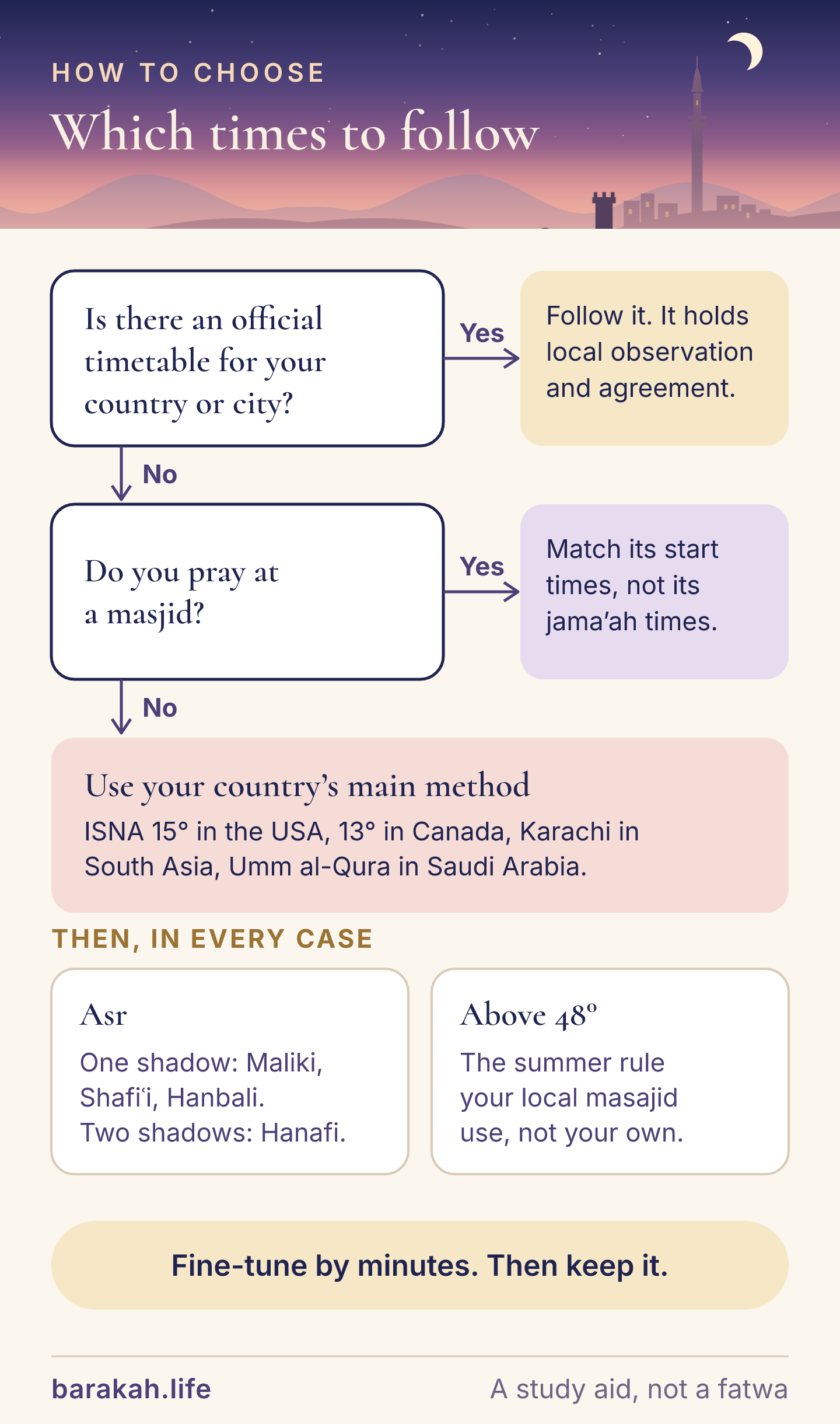
Follow your country's or city's official timetable if there is one; otherwise match your masjid's start times; otherwise use your country's main method, and keep it.
The Quran and the Sunnah do not give prayer times in hours and minutes. They give signs you can see: the sun passing its highest point, a shadow growing, the sun setting, the red glow leaving the western sky, the first thread of light spreading along the eastern horizon. The Prophet ﷺ set out the span of each prayer in one short teaching:
When you pray Fajr, its time lasts until the first edge of the sun rises. When you pray Dhuhr, its time lasts until Asr arrives. When you pray Asr, its time lasts until the sun turns yellow. When you pray Maghrib, its time lasts until the twilight has gone. When you pray Isha, its time lasts until the middle of the night.
Sahih Muslim 612, from 'Abdullah ibn 'Amr
For centuries, a muezzin looked at the sky and called the adhan. A phone cannot look, so it calculates. Three of the signs are easy for a computer: noon (the sun crossing the meridian), sunrise and sunset. Those agree between apps to within a minute or two. Three are not: the exact moment of true dawn, the moment twilight is gone, and the shadow that starts Asr. Every disagreement you will see comes from how those three are translated into numbers, plus a few practical settings layered on top.
Why the times differ
Prayers affected
Typical gap
Twilight angle (12° to 20°) or a fixed interval
Fajr, Isha
10 to 45 minutes
Asr school: one shadow or two
Asr
25 to 80 minutes
High-latitude rule in summer
Fajr, Isha
Up to two hours or more
An official or mosque timetable instead of a calculation
Mostly Fajr, Isha
A few minutes to half an hour
Safety minutes, rounding, elevation, location, time zone
Any
1 to 5 minutes
If your two apps are one or two minutes apart, it is the last row and it does not matter. If they are twenty minutes apart at Fajr, or forty at Asr, it is one of the first rows, and it is worth deciding deliberately.
Fajr and Isha: how far below the horizon?
Fajr begins at true dawn, the moment that also begins the fast:
Wa kulū wa-shrabū ḥattā yatabayyana lakumu l-khayṭu l-abyaḍu mina l-khayṭi l-aswadi mina l-fajr.
And eat and drink until the white thread of dawn becomes distinct to you from the black thread [of night].
Quran 2:187 (part of the verse)
The Prophet ﷺ distinguished this true dawn from an earlier, misleading glow. The false dawn (al-fajr al-kādhib) is a faint vertical column of light; the true dawn (al-fajr al-ṣādiq) spreads sideways along the horizon:
Lā yaghurrannakum min saḥūrikum adhānu Bilālin wa lā bayāḍu l-ufuqi l-mustaṭīlu hākadhā ḥattā yastaṭīra hākadhā.
Do not let the adhan of Bilal, nor this tall whiteness on the horizon, keep you from your suhur, until it spreads out like this.
Sahih Muslim 1094, from Samura ibn Jundub. The narrator showed it with his hands spread across.
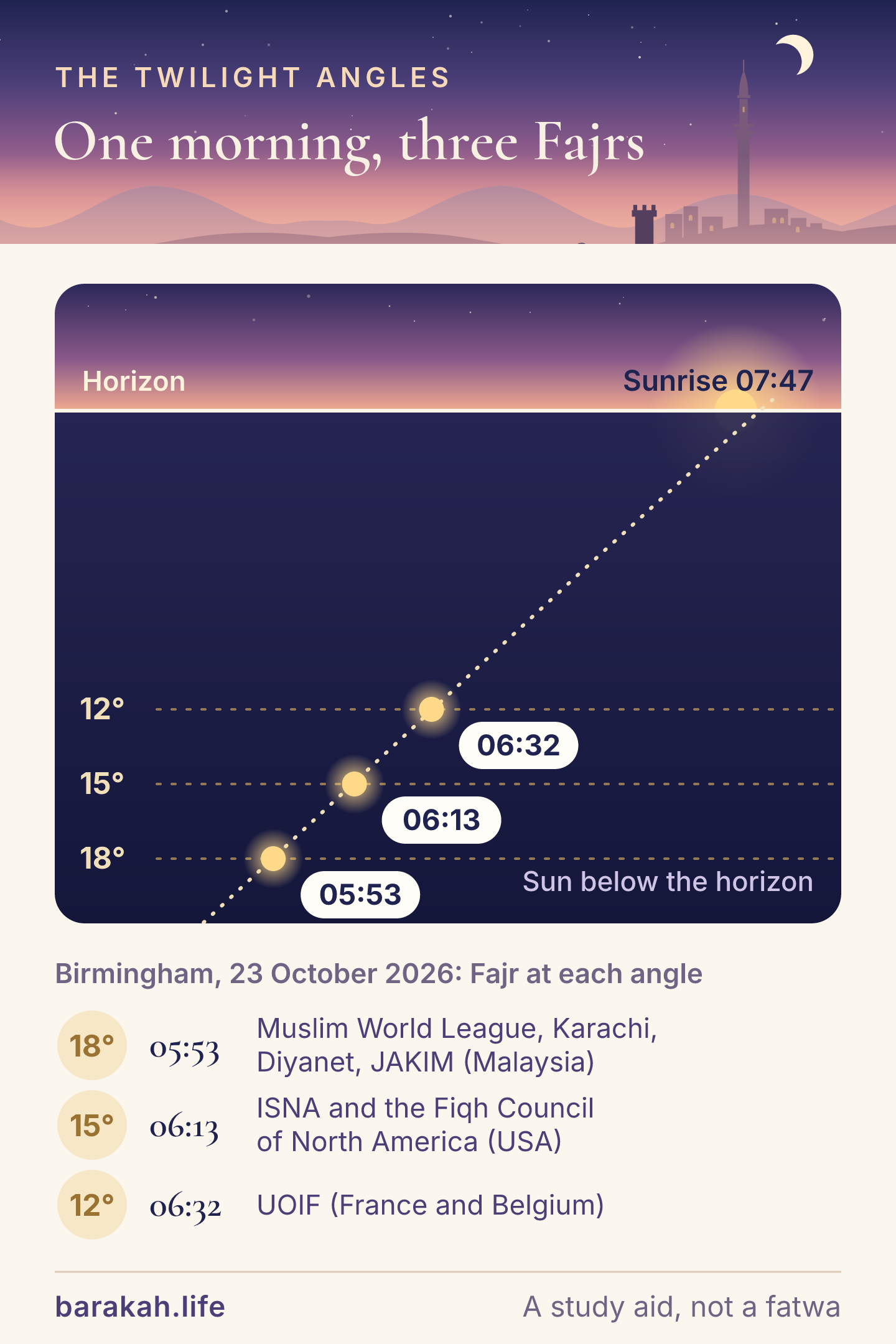
Isha begins when the twilight after sunset (al-shafaq) has disappeared. Astronomy describes both moments by one number: how many degrees the sun sits below the horizon when the light first appears in the east, or when the last of it leaves the west. At 18° below the horizon the sky is, by the astronomer's definition, fully dark. The light builds as the sun climbs from there to the horizon, and the question every method has to answer is: at which depth does the white thread actually become distinct?
Same city, same morning, three defensible answers. Each degree is about six and a half minutes here in autumn.
Different bodies have answered differently, from their own observations and from the classical astronomers who placed dawn around 18° to 19°:
Method
Fajr
Isha
Where it is common
Muslim World League
18°
17°
Europe, parts of Asia and Africa, a common default
University of Islamic Sciences, Karachi
18°
18°
Pakistan, India, Bangladesh, Afghanistan
Egyptian General Authority of Survey
19.5°
17.5°
Egypt, Sudan, parts of the Levant
Umm al-Qura, Makkah
18.5°
90 minutes after Maghrib (120 in Ramadan)
Saudi Arabia
Diyanet (Turkey)
18°
17°, with safety minutes
Turkey, and communities in Germany and Sweden
ISNA, Fiqh Council of North America
15°
15°
United States
Fiqh Council of North America, Canada
13°
13°
Canada
UOIF
12°
12°
France, Belgium
JAKIM (Malaysia)
18° since 2019 (was 20°)
18°
Malaysia
MUIS, Kemenag
20°
18°
Singapore, Indonesia
Moonsighting Committee
Varies with season and latitude
Varies
Many UK and North American mosques
How far apart that puts the times
Here is a single day, 23 October 2026, in Toronto, worked through each method. Dhuhr, Asr and Maghrib barely move. Fajr and Isha move a lot:
Method
Fajr
Isha
Egyptian (19.5° / 17.5°)
05:58
19:54
Umm al-Qura (18.5° / 90 min)
06:03
19:51
Muslim World League (18° / 17°)
06:06
19:51
Karachi (18° / 18°)
06:06
19:57
Moonsighting Committee
06:09
19:44
ISNA (15° / 15°)
06:22
19:40
Fiqh Council, Canada (13° / 13°)
06:34
19:29
UOIF (12° / 12°)
06:39
19:24
Forty-one minutes separate the earliest and latest Fajr. In the tropics the spread is smaller, because the sun drops steeply; far north it is larger, because the sun slides along the horizon. The size of a degree in minutes changes with your latitude and the season, which is why the gap between the same two apps grows in summer.
Why the bodies disagree
Not because some of them are careless. True dawn begins as a very faint light, and where people see it depends on how dark the sky is, how clear the air is, and how carefully the observers watch. Modern observation campaigns have reached different results, and some bodies have changed their figure after them:
Malaysia. After a year of dawn observations by JAKIM with several universities, the national Muzakarah committee decided on 20 to 21 November 2019 that Subuh begins at 18° rather than 20°, about eight minutes later. States adopted it in turn; Selangor announced its change in 2023.
Indonesia. Muhammadiyah's Majelis Tarjih moved from 20° to 18° (decided in 2020, implemented in 2021), while the Ministry of Religious Affairs kept 20°, citing its own observations. Two serious bodies in one country, both observing, still differ.
North America. The Fiqh Council of North America, in 2017, recommended 15° for the United States and 13° for Canada, year round, describing them as approximations that spare people from observing the sky every day.
London. The London Unified Prayer Timetable, adopted by a group of London mosques from 1 Ramadan 1432 (1 August 2011), uses a model by Khalid Shaukat of moonsighting.com that is guided by observation data from northern latitudes rather than a single fixed angle.
This is a question of ijtihad about a physical sign, not a disagreement about what the sign is. Everyone agrees Fajr begins at true dawn. They differ on where to draw the line in a sky that brightens gradually.
Isha: which twilight?
There is also a classical difference over the shafaq itself. After sunset the western sky first glows red, then a paler white glow lingers after the red has gone. The Maliki, Shafi'i and Hanbali schools, and Abu Hanifa's two principal students Abu Yusuf and Muhammad al-Shaybani, held that Isha begins when the red twilight disappears. Abu Hanifa held that it begins when the white twilight has also gone, which is later. Hanafi texts differ on which view carries the fatwa. Most calculation methods put Isha at 15° to 18°, which is near or past the end of the white glow, so in practice both views are usually satisfied. The Moonsighting Committee method lets you choose between the two twilights for Isha.
The fixed-interval methods
Umm al-Qura, used across Saudi Arabia, does not use an angle for Isha at all. It sets Isha 90 minutes after Maghrib, and 120 minutes in Ramadan. Near the tropics in most seasons that lands close to the 17° to 18° time. Far from the tropics it does not: in Birmingham on 23 October it gives 19:26, while 18° gives 19:50. A fixed interval is a sensible approximation for the latitude it was designed for, and a poor one elsewhere.
Asr: one shadow or two
Asr is the prayer where the schools differ most visibly, and the difference is old and well documented. The evidence is the narration of the two days on which the angel Jibril led the Prophet ﷺ in the five prayers, to show him the start and end of each time:
Jibril, peace be upon him, led me in prayer at the House twice … He prayed Asr with me when the shadow of a thing was equal to it … On the next day he prayed Dhuhr with me when its shadow was equal to it, and prayed Asr with me when its shadow was twice its length … And the time is between these two times.
Sunan Abi Dawud 393, from Ibn 'Abbas (excerpt). Graded hasan sahih by al-Albani and hasan by al-Arna'ut; also Jami' at-Tirmidhi 149
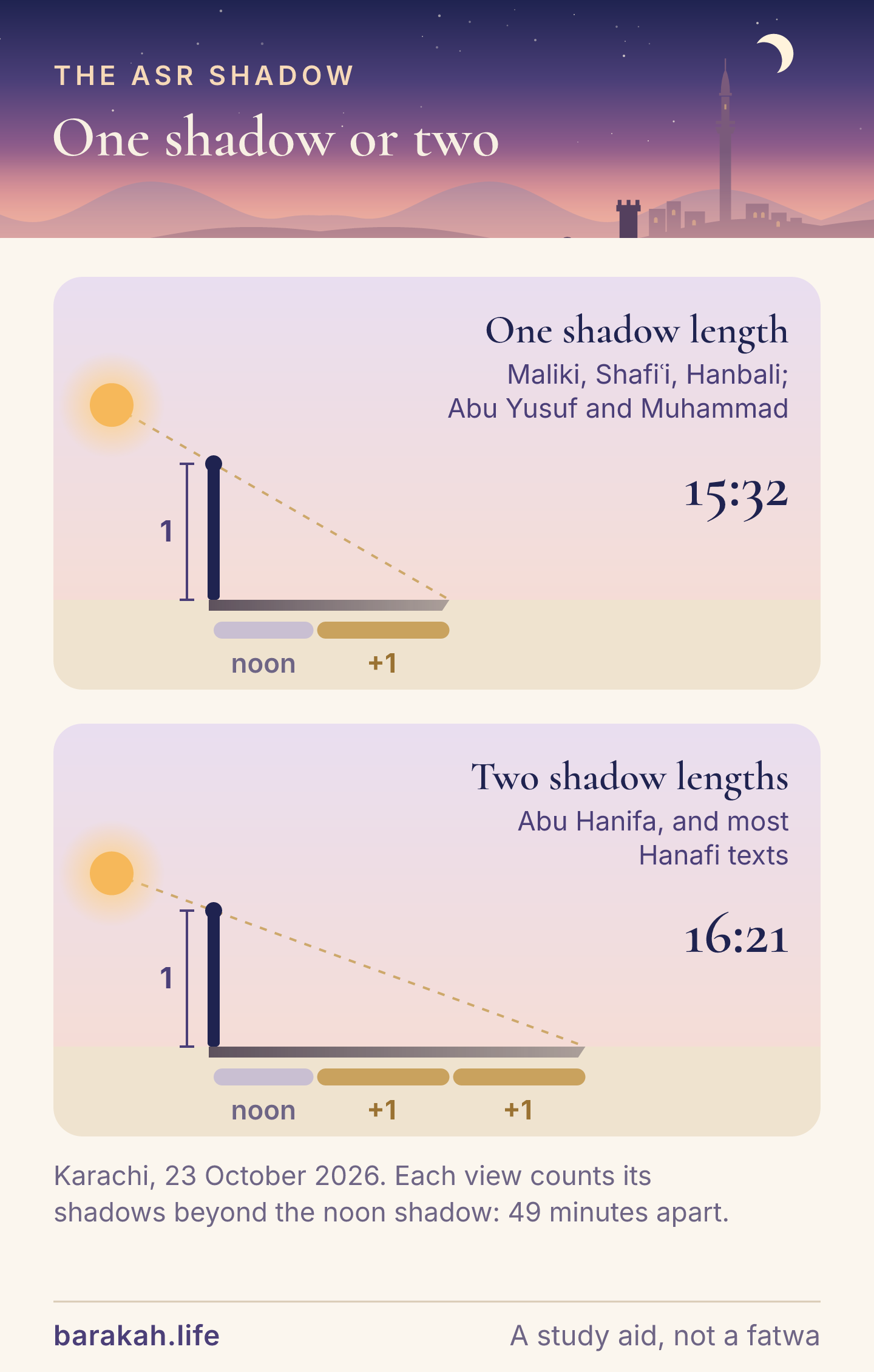
Read on the first day, Asr starts when an object's shadow equals its height. Read on the second, Dhuhr is still being prayed at that moment and Asr follows at twice the height. The schools resolved this differently:
One shadow length (mithl). The Maliki, Shafi'i and Hanbali schools, and among the Hanafis, Abu Yusuf and Muhammad al-Shaybani. Asr enters when the shadow of an object equals its height.
Two shadow lengths (mithlayn). Abu Hanifa, and the position most Hanafi texts adopt. Asr enters when the shadow equals twice the height. Some major Hanafi works chose the students' view, and many Hanafi scholars advise praying Dhuhr before one shadow and Asr after two, so the prayer is sound on both views.
Both measure the shadow from the shadow the object already casts at noon (fay' al-zawāl). In winter, or far from the equator, the sun is low even at midday, so that noon shadow can be longer than the object itself, and both Asr times move earlier in the day. Both views also agree that Asr should not be delayed until the sun turns pale and yellow.
The noon shadow is part of both measurements. Here the two views are 49 minutes apart.
Every app has a setting for this, usually called “Asr method” or “juristic method”, with two options: Standard (or Shafi'i, Maliki, Hanbali) and Hanafi. If one of your apps is on each, Asr will differ by much more than anything else on the screen:
City
21 June
23 October
21 December
Karachi
15:55 17:17
15:32 16:21
15:28 16:12
Dubai
15:43 17:04
15:19 16:08
15:14 15:58
Kuala Lumpur
16:42 17:41
16:16 17:17
16:35 17:30
New York
16:58 18:12
15:37 16:21
14:14 14:51
Birmingham
17:34 18:49
15:23 16:04
13:40 14:09
In each cell, the first time is one shadow and the second is two, in local time and before any official safety minutes. The gap runs from under half an hour in a northern winter to well over an hour in summer. Neither is the “right” Asr for everyone: choose the one your school follows, and if you follow no particular school, the one your masjid uses.
High latitudes: when the night never gets dark
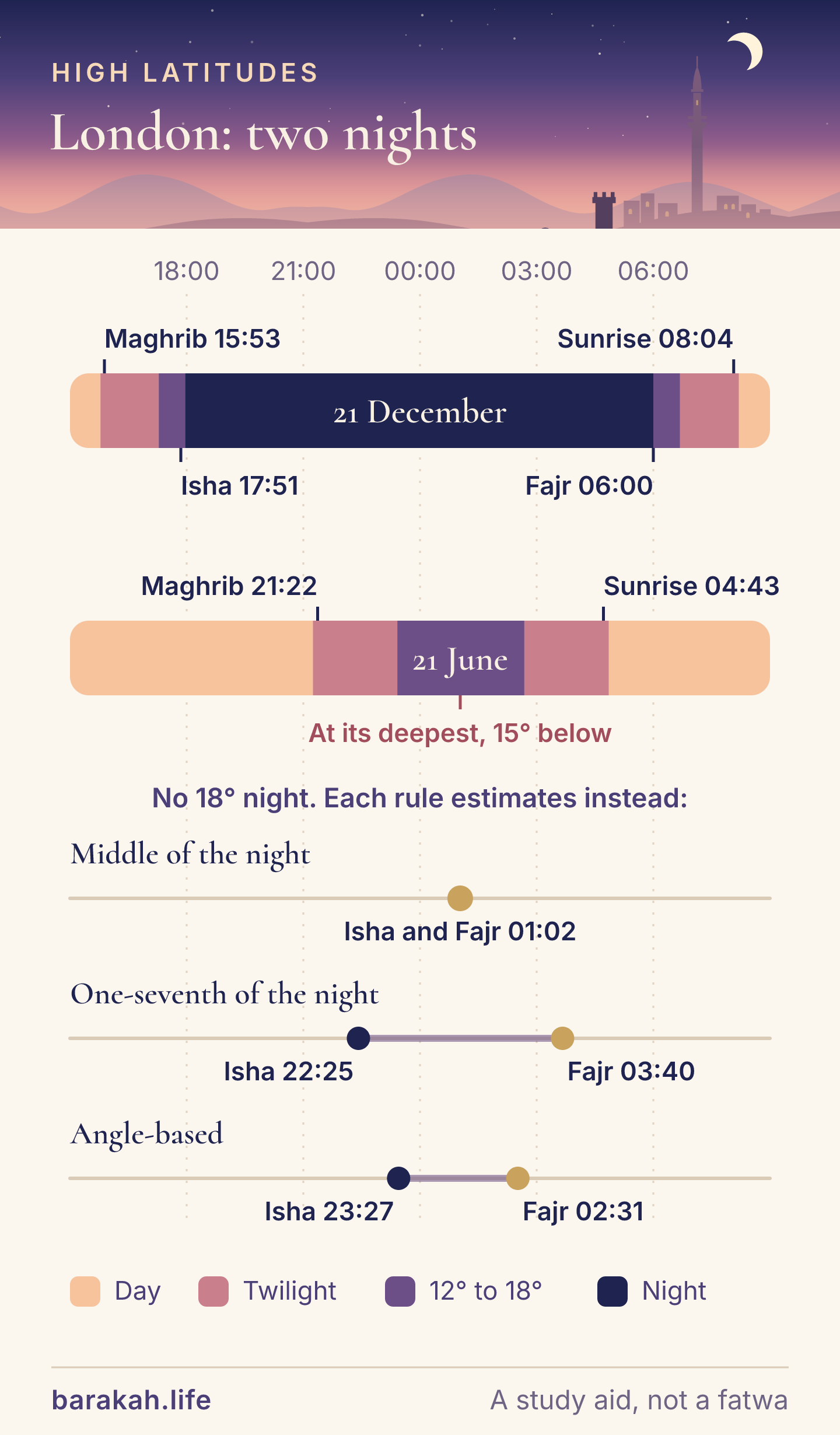
Every angle-based method assumes that the sun goes far enough below the horizon for twilight to end. In much of Europe and Canada, in summer, it does not. In London the sun gets no deeper than about 15° below the horizon at midsummer, so an 18° Fajr simply never arrives from about the last week of May to the third week of July. In Birmingham, even 15° is not reached from early June to early July. In Glasgow, even 12° fails for almost six weeks. In Stockholm and Oslo, 18° fails for nearly four months.
In midsummer the sky over London never reaches the 18° darkness that most methods wait for. The rule an app applies decides the times.
The prayers are not dropped because a sign is missing. The Prophet ﷺ was asked about the long days of the Dajjal, one of which will last a year:
We said: Messenger of Allah, on that day which is like a year, will one day's prayers be enough for us? He said: No. Estimate its measure.
Sahih Muslim 2937, from an-Nawwas ibn Sam'an (excerpt)
Scholars took from this that when the signs do not appear, the times are estimated (taqdīr), not abandoned. The Islamic Fiqh Council of the Muslim World League, at its ninth session in Makkah in Rajab 1406 (1986), divided the high latitudes into bands: between about 45° and 48° the signs appear and the ordinary times apply; between 48° and 66°, where twilight can last all night, Fajr and Isha are estimated by analogy with the nearest region where they are clearly marked; beyond 66°, all the times are estimated from latitude 45°. How to estimate is where the rules in your app come from:
Rule
How it works
London, 21 June 2026
Middle of the night
Fajr and Isha may not pass the midpoint between sunset and sunrise
Isha 01:02, Fajr 01:02
One-seventh of the night
Isha one seventh of the night after sunset; Fajr one seventh before sunrise
Isha 22:25, Fajr 03:40
Angle-based
The angle sets a share of the night (18° becomes 18/60 of it)
Isha 23:27, Fajr 02:31
Moonsighting Committee
Seasonal curves built from observations; one-seventh above 55°
Isha 22:42, Fajr 02:43
Nearest latitude or nearest day
Borrow the times of the nearest place, or the last date, where the signs still appeared
Depends on the body applying it
Those rows are all the same city on the same night. Fajr ranges across two and a half hours, and because Fajr also ends suhur, so does the start of the fast. This is the one area where you should not pick a rule yourself. Ask what the masajid in your city use and follow them: in London most major mosques follow the unified timetable; the Diyanet-affiliated communities in Germany and Sweden follow Diyanet's published tables, which handle the white nights in their own way; many other UK mosques use the one-seventh rule in summer.
Official and mosque timetables
A calculation method is a stand-in for something better: an authority that has already decided the times for your place. Many countries and some cities publish one:
National tables: Diyanet in Turkey, JAKIM in Malaysia (zone by zone), the Ministry of Religious Affairs (Kemenag) in Indonesia, MUIS in Singapore, the official Awqaf times in the UAE, Umm al-Qura in Saudi Arabia, and the Ministry of Habous in Morocco.
City tables: the London Unified Prayer Timetable, published through the East London Mosque and used by London Central Mosque and many others.
Your own masjid: almost every mosque prints a monthly timetable with its start times.
Where one of these exists, it is usually the best answer, because it carries local observation, local scholarly agreement and local safety margins that no general method reproduces. On 23 October 2026 in London, an 18° calculation gives Fajr at 05:46 and Isha at 19:36. The unified timetable gives 06:00 and 19:19. The difference is not an error in either; it is the difference between a general rule and a local decision.
Start times are not jama'ah times
The most common reason a mosque timetable “disagrees” with an app has nothing to do with angles. A mosque timetable usually has two columns: the start of each prayer (sometimes labelled “begins” or “adhan”) and the jama'ah or iqamah, when the congregation stands to pray. An app shows the start. On that same London day, Fajr begins at 06:00 and the East London Mosque congregation prays at 06:20; Isha begins at 19:19 and the congregation prays at 19:45. Compare an app with the start column, not the jama'ah column.
The last few minutes
When two apps use the same method and still differ by a minute or two, the cause is one of these:
Safety minutes (iḥtiyāṭ, or temkin in Turkey). Many authorities add a few minutes so that no one prays a moment early: Diyanet adds minutes to Dhuhr, Asr and Maghrib and takes them from sunrise; several Gulf and North African tables add three to five minutes to Dhuhr and Maghrib.
Dhuhr after noon. Dhuhr starts once the sun has passed its highest point (zawāl). Most apps add one to five minutes to true noon to be sure it has.
Rounding. Rounding to the nearest minute, or always up, moves half the times by one minute.
Location and elevation. A phone that only knows your city centre, or a high-rise or hill town where the sun sets later, shifts sunrise and Maghrib by a minute or two.
Time zone and daylight saving. A wrong zone on the day clocks change can move every time by an hour. If one app is exactly sixty minutes out, check this first.
How to choose: a short decision path
Four questions settle it for almost everyone. Once chosen, keep it.
Is there an official timetable for your place? Use it. If your app supports it directly, choose that; if not, pick the matching method and adjust it by minutes to agree with the table.
Do you pray at a masjid? Match its start times. Ask the imam or committee which method they use. It is good for a community to stand together for Fajr and break the fast together in Ramadan.
Otherwise, use your country's main method from the table below.
Set Asr to your school: Standard (Maliki, Shafi'i, Hanbali) or Hanafi.
Above about 48°, use the summer rule your local masajid use. Do not choose one for convenience.
Fine-tune with minute adjustments, not by switching methods. If your masjid is consistently two minutes later at Maghrib, adjust Maghrib by two minutes and leave the method alone.
Where you live
What most people follow
City pages
United Kingdom
London: the London Unified Prayer Timetable. Elsewhere: your masjid's printed table; many use the Moonsighting Committee method or an 18° table with a summer rule
Every one of the city prayer-time pages names the method it uses and shows both Asr times, so you can compare it with your masjid before you change anything.
If you have been using a different method
Discovering that your app was set differently from your masjid is not a reason for anxiety. Each of these methods is an effort by qualified people to apply the signs Allah set, and a prayer offered in good faith on a recognised timetable is not something you need to repeat. When Malaysia moved Subuh eight minutes later in 2019, the Federal Territory Mufti's office stated that prayers prayed on the earlier timetable did not need to be made up. What matters is that, from now on, you pray within a time you have good reason to trust.
The one situation that does deserve care is Fajr at the very start of its time, because praying before the time has begun does not count, while eating a few minutes into it would break the fast. The Fiqh Council of North America advises those who can to delay the Fajr prayer by a few minutes after the calculated start, and to stop eating a few minutes before it. That small habit makes your Fajr and your fast sound on almost every method.
What Barakah Life does
The Barakah Life app was built to make these choices visible rather than hide them:
The method your country uses, by default. When you set your location, the app picks the method most masajid in your country follow: ISNA in the United States, the Fiqh Council's 13° in Canada, Karachi in South Asia, Umm al-Qura in Saudi Arabia, Diyanet in Turkey and for Germany and Sweden, UOIF in France, and so on. You can change it in Settings at any time.
Official timetables where we have them. In Greater London the app uses the London Unified Prayer Timetable itself, on every screen, in widgets and for the adhan, and shows the East London Mosque jama'ah times beneath the start times. In Malaysia and Indonesia, the prayer tab shows the official JAKIM and Kemenag times for your zone.
Your Asr school. Standard or Hanafi, chosen once, and never hidden.
A high-latitude rule that matches your method. Automatic by default, with middle of the night, one-seventh and angle-based available if your masjid uses one of them.
Minute adjustments for each prayer, so you can match your masjid exactly without changing method.
Adhan alarms on the times you have chosen, with a salah tracker alongside.
Set it once, then stop worrying about it. Find your city on the prayer times page and compare it with your masjid's timetable. Then set the same method, Asr school and adjustments in the Barakah Life app and let the adhan come to you. If you are still learning the prayer itself, how to pray walks through every position, and our guide to praying salah step by step starts from the very first takbir.
Questions people ask
Why are prayer times different on different apps?
Because they use different calculation settings. Fajr and Isha depend on the twilight angle (from 12° to 20° below the horizon, or a fixed interval after Maghrib), Asr depends on whether the app uses one shadow length or two (the Hanafi view), and far from the equator the summer rule for Fajr and Isha changes the times too. Small one or two minute differences come from rounding, safety minutes and location.
Is Fajr at 18 degrees or 15 degrees correct?
Both are used by recognised bodies. 18° is the classical astronomical figure and is used by the Muslim World League, Karachi, Diyanet and, since 2019, Malaysia; 15° is the Fiqh Council of North America's figure for the United States. Follow the one your country's main body or your masjid uses. If you are unsure, pray Fajr a few minutes after the later time and stop eating before the earlier one.
Why is the Hanafi Asr time later?
Abu Hanifa held that Asr begins when an object's shadow is twice its height, beyond its noon shadow. The Maliki, Shafi'i and Hanbali schools, and Abu Hanifa's students Abu Yusuf and Muhammad, held that it begins at one height. The gap is usually 30 to 80 minutes depending on place and season.
Which prayer time calculation method is best?
There is no single best method for the whole world. The best one for you is your country's or city's official timetable if one exists, then your masjid's timetable, then the method your country's main Islamic body uses.
Which calculation method is used in the UK?
There is no single national method. Most major London mosques follow the London Unified Prayer Timetable. Elsewhere, mosques print their own tables, often using the Moonsighting Committee method or an 18° table with the one-seventh rule in summer. Match the masjid you attend.
Which method is used in India and Pakistan?
Most mosques and apps use the University of Islamic Sciences, Karachi method, with Fajr and Isha at 18°, and many follow the Hanafi Asr.
What should I do when Isha is very late in summer?
Above about 48° latitude the sky may never get fully dark in midsummer, so Isha and Fajr are estimated using a high-latitude rule. Use the rule your local masajid use rather than choosing one yourself, since the options can differ by two hours.
Why is my mosque's time later than my app?
Usually because you are comparing the app with the jama'ah (congregation) time. Mosque timetables show both the start of the prayer and the time the congregation prays; apps show the start. If the start times differ too, the mosque is using a different method or an official table.
A closing word
It is easy to treat all of this as a technical problem and forget what it is for. Allah tied our prayers to the movement of His sun and the turning of His night:
Establish the prayer from the decline of the sun until the darkness of the night, and the recitation at dawn. Indeed, the recitation at dawn is ever witnessed.
Quran 17:78
The scholars who argue over 15° and 18° are trying to honour that sign as precisely as they can. Your part is simpler: choose a timetable you have good reason to trust, keep to it, and let the time of each prayer become the shape of your day. And now and then, step outside before Fajr and watch the white thread spread along the horizon for yourself.
Islamic Fiqh Council of the Muslim World League, ninth session, Makkah, Rajab 1406, on prayer and fasting at high latitudes, as reproduced in Praying and Fasting at High Latitudes (IslamOnline), with the European Council for Fatwa and Research's endorsement.
Method parameters as published by the adhan open-source library, METHODS.md. All worked times in this guide were calculated for 2026 with the same library the Barakah Life app uses.
This guide summarises the positions of the schools and of contemporary bodies as recorded in the sources above. It is a study aid, not a fatwa. Where your situation is unusual, follow the masajid and scholars of your own city.