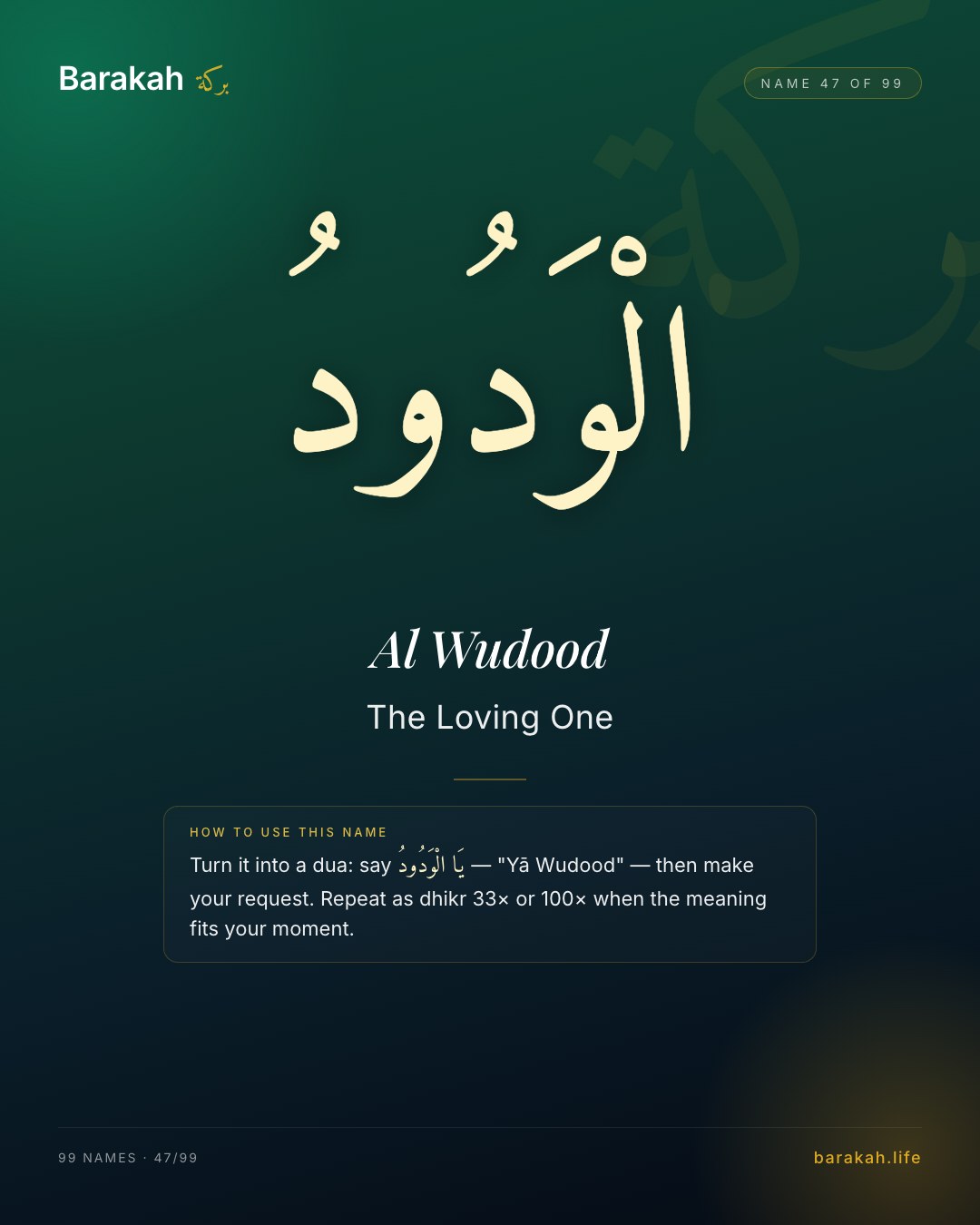
Al Wudood
The Most Loving
The Loving, whose affection for His servants is expressed, not theoretical.
Al-Wadood loves and is loved. His love descends as guidance sent, mercy written, repentance accepted, and care threaded through ordinary days; and every heart that turns to Him finds Him more worthy of love than everything it loved before.
Mentions of Al Wudood
From the Quran & Hadith
From the root waw-dal-dal (و د د), which carries the classical Arabic connotations of loving with affection, longing for, desiring good for, and showing constant, expressed love. Wudd is not hidden goodwill; it is love that shows itself in acts. Al-Wadood both loves His servants and makes His love felt, and He is also the One truly worthy of all love.
Between forgiveness and the Throne
Surah al-Buruj places this Name in company that interprets it: 'And He is the Forgiving, the Loving (al-Ghafūru-l-Wadūd), Owner of the Throne, the Glorious' (Quran 85:14-15). Love beside forgiveness: He loves those He pardons, pardons those He loves; the past does not disqualify you from His wudd. And love beside the Throne: this affection comes from the height of all majesty, not from need or weakness, which makes it the securest love in existence.
Love made public
The Prophet ﷺ revealed the mechanics of His love: 'When Allah loves a servant, He calls Jibril and says: Indeed I love so-and-so, so love him. Then Jibril loves him and announces to the inhabitants of heaven: Allah loves so-and-so, so love him. Then the inhabitants of heaven love him, and acceptance is placed for him on the earth' (Sahih al-Bukhari 3209). And for the believers who repent and do right, He goes further: 'the Most Merciful will appoint for them affection' (Quran 19:96), love planted in hearts on their behalf.
Wa huwa-l-Ghafūru-l-Wadūd.
“And He is the Forgiving, the Loving.”
Wa-staghfirū rabbakum thumma tūbū ilayh. Inna rabbī Raḥīmun Wadūd.
“And ask forgiveness of your Lord and then repent to Him. Indeed, my Lord is Merciful and Loving.”
Inna-lladhīna āmanū wa ʿamilu-ṣ-ṣāliḥāti sa-yajʿalu lahumu-r-Raḥmānu wuddā.
“Indeed, those who have believed and done righteous deeds, the Most Merciful will appoint for them affection.”
Abu Hurairah (may Allah be pleased with him) reported the Prophet ﷺ said: 'When Allah loves a servant, He calls Jibril and says: Indeed I love so-and-so, so love him. Then Jibril loves him and announces it to the inhabitants of heaven, and they love him, and then acceptance is placed for him on the earth.'
Many carry an image of Allah built only from fear, and their worship limps because hearts do not run toward what they only dread. Al-Wadood repairs the image. The One you pray to called Himself the Loving, tied His love to His forgiving, and broadcasts His love for a servant through the heavens. You are allowed, meant, to love Him back with the strongest love: 'those who believe are stronger in love for Allah' (Quran 2:165). And wudd, love expressed, is the family trait of His servants. Say the love aloud in your homes, show it in service, let affection leave the heart and reach hands and words. The dry heart asks: how do I begin? Begin where He said: istighfar and returning (11:90); the road back to Al-Wadood is itself paved with His love.
Allāhumma innī as'aluka ḥubbaka wa ḥubba man yuḥibbuka wa ḥubba ʿamalin yuqarribunī ilā ḥubbik
O Allah, I ask You for Your love, the love of those who love You, and the love of deeds that bring me closer to Your love.
- Sahih al-Bukhari 3209
- Quran 85:14
- Quran 2:165
Count "Al Wudood", The Loving One
Saved as a custom preset in your tasbih. Tap-to-count, hit 33 or 100, and the lifetime total stays with your account.