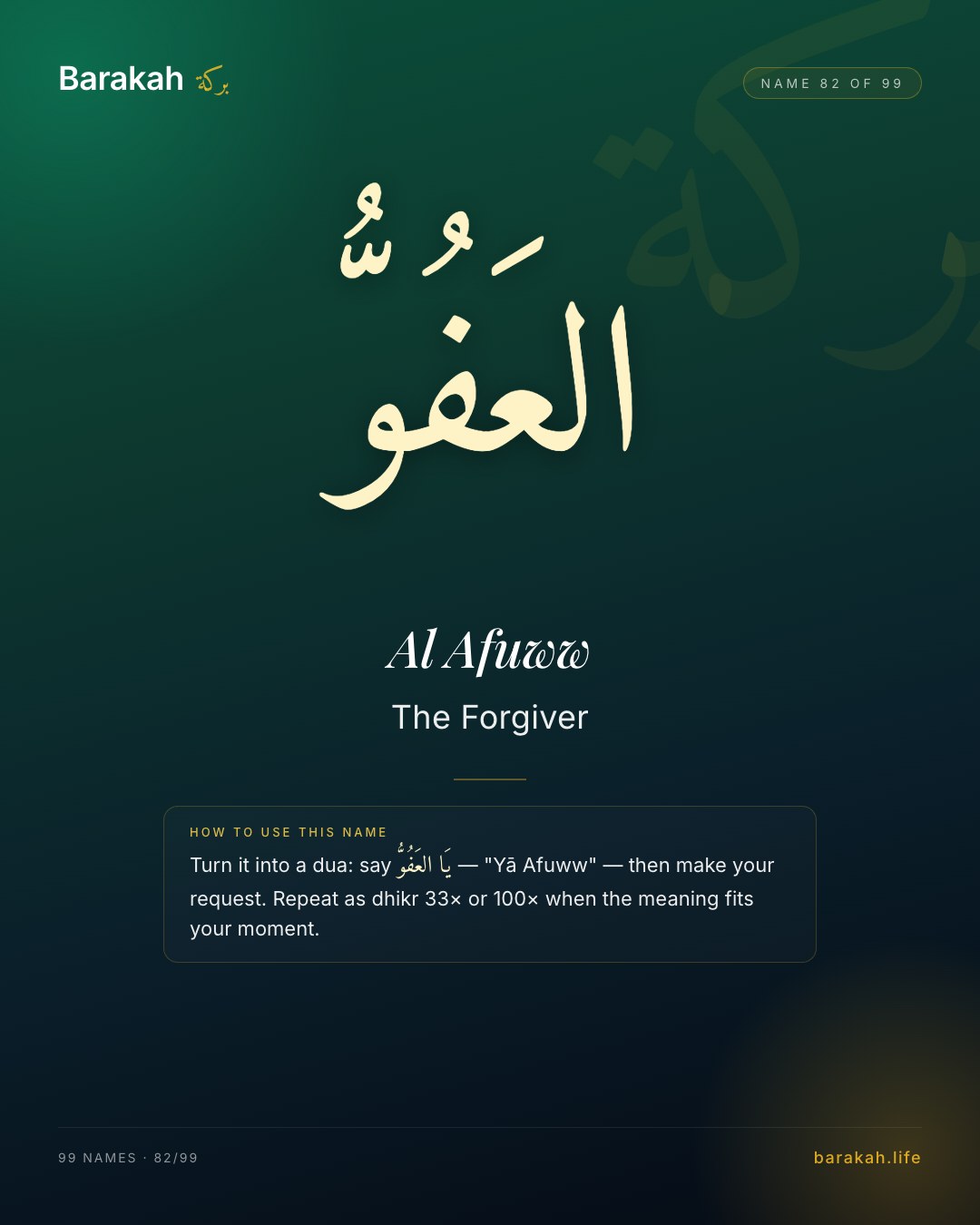
Al Afuww
The Supreme Pardoner
The Pardoner, who does not merely cover the sin but erases it.
Al-Afuww takes the wrong out of existence: no residue, no reproach, no archived copy brought up later. The scholars rank ʿafw above forgiveness for exactly this reason, and the Quran attaches it to His power: He pardons while fully able to punish, which is the only pardon that means everything.
Mentions of Al Afuww
From the Quran & Hadith
From the root ʿayn-fa-waw (ع ف و), which carries the classical Arabic connotations of pardoning by effacing, obliterating all trace, as wind effaces footprints in sand. Here it exceeds even maghfirah: forgiveness covers the sin, but ʿafw erases it, from the record, from the account, as if it never was. Al-Afuww is the Pardoner who deletes.
The dua of the greatest night
When Aishah (may Allah be pleased with her) asked the Prophet ﷺ what to say if she found Laylatul-Qadr, he gave her this Name twice in one line: 'Say: O Allah, You are Pardoning and You love pardon, so pardon me' (Jami at-Tirmidhi 3513). Of everything one could request on the best night of the year, the Prophet ﷺ chose ʿafw: total erasure. And inside the dua sits the astonishing clause: He loves to pardon. Deleting your record is not His concession; it is His pleasure.
Pardon joined to power
'If you show a good deed or conceal it or pardon an offense, indeed, Allah is ever Pardoning and Competent' (Quran 4:149). ʿAfuwwan Qadīrā: the pairing teaches that His pardon is never the amnesty of the helpless. Every offense against Him occurs within His full ability to respond instantly, and He pardons anyway, and loves it. That is the standard the verse quietly hands to us in the same breath: pardon others while able.
In tubdū khayran aw tukhfūhu aw taʿfū ʿan sū'in fa-inna-llāha kāna ʿAfuwwan Qadīrā.
“If you show a good deed or conceal it or pardon an offense, indeed, Allah is ever Pardoning and Competent.”
Inna-llāha la-ʿAfuwwun Ghafūr.
“Indeed, Allah is Pardoning and Forgiving.”
Aishah (may Allah be pleased with her) asked: O Messenger of Allah, if I know which night is Laylatul-Qadr, what should I say in it? He said: 'Say: Allāhumma innaka ʿafuwwun tuḥibbu-l-ʿafwa fa-ʿfu ʿannī, O Allah, You are Pardoning and You love pardon, so pardon me.'
Some believers carry old sins like a limp: technically forgiven, privately still flinching at the memory. Al-Afuww's erasure is the cure for the flinch. What He effaces is gone; digging it back up to re-grieve it is honoring a record He shredded. Repent fully once, then walk like a person whose file is clean, because it is. And practice deletion on others. Forgiving-but-remembering, the pardon that keeps receipts for future arguments, is not ʿafw. Once you pardon, delete: no archives, no callbacks. It is the hardest generosity there is, and the verse dangles the exchange openly: pardon while able, for the One who pardons you while Able loves the family resemblance.
Allāhumma innaka ʿafuwwun tuḥibbu-l-ʿafwa fa-ʿfu ʿannī
O Allah, You are Pardoning and You love pardon, so pardon me.
- Jami at-Tirmidhi 3513
- Quran 4:149
Count "Al Afuww", The Forgiver
Saved as a custom preset in your tasbih. Tap-to-count, hit 33 or 100, and the lifetime total stays with your account.