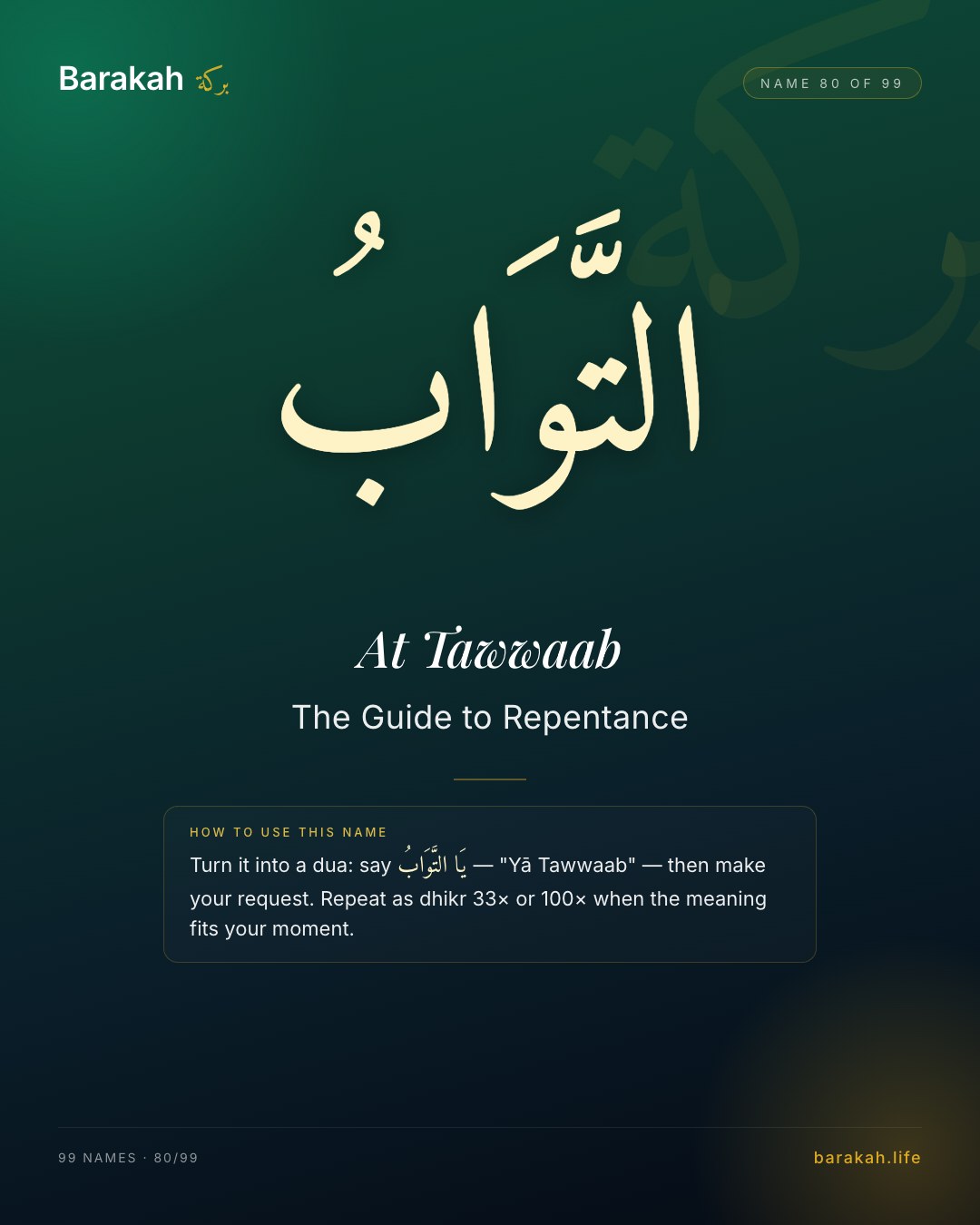
At Tawwaab
The Ever-Returning, Acceptor of Repentance
The Ever-Returning, who turns to His servant so the servant can turn to Him.
At-Tawwaab runs both halves of every repentance: He plants the regret, opens the road back, receives the returner without archives of resentment, and does it all again next time. In the Quran's precise wording, He turned to them so that they would turn: the door opens from His side first.
Mentions of At Tawwaab
From the Quran & Hadith
From the root ta-waw-ba (ت و ب), which carries the classical Arabic connotations of returning and turning back. Tawbah is the servant's return to Allah; and At-Tawwaab, in the intensive form, is the One who returns to His servant, before the repentance, by inspiring it, and after it, by accepting it, endlessly, however many times the cycle repeats.
The first tawbah in history
When Adam (peace be upon him) fell, the words of return themselves were a gift: 'Then Adam received from his Lord some words, and He accepted his repentance. Indeed, it is He who is at-Tawwaab, ar-Raheem' (Quran 2:37). Note the sequence the scholars love: the Lord supplied the words of apology to the one who owed the apology. Every repentance since follows that template: your tawbah was His idea before it was yours.
He loves those who keep returning
'Indeed, Allah loves those who are constantly repentant and loves those who purify themselves' (Quran 2:222). Not tolerates: loves. The Prophet ﷺ pushed the portrait further: Allah rejoices more over the repentance of His servant than a man who despaired in the desert and then found his lost camel carrying all his provisions (Sahih Muslim 2747). Rejoicing, at the return of someone who had wandered from Him. No other theology dares describe God this way.
Fa-talaqqā Ādamu min rabbihi kalimātin fa-tāba ʿalayh. Innahu huwa-t-Tawwābu-r-Raḥīm.
“Then Adam received from his Lord some words, and He accepted his repentance. Indeed, it is He who is the Accepting of repentance, the Merciful.”
Inna-llāha yuḥibbu-t-tawwābīna wa yuḥibbu-l-mutaṭahhirīn.
“Indeed, Allah loves those who are constantly repentant and loves those who purify themselves.”
Fa-sabbiḥ bi-ḥamdi rabbika wa-staghfirh. Innahu kāna tawwābā.
“Then exalt Him with praise of your Lord and ask forgiveness of Him. Indeed, He is ever Accepting of repentance.”
The Prophet ﷺ said: 'Allah rejoices more over the repentance of His servant when he turns to Him than one of you would rejoice over his riding camel, lost in a barren land with his food and drink upon it, after he had despaired of it and then suddenly found it standing before him.'
Anas (may Allah be pleased with him) reported the Prophet ﷺ said: 'Every son of Adam commits sin, and the best of those who sin are those who repent.'
Shame tells the relapsed believer to stay away until he is 'better'; At-Tawwaab's Name is the refutation. The intensive form exists precisely for the repeat offender: He is not the acceptor of one repentance but the Ever-Accepting of the seventieth, from the servant sincere each time and defeated each time. The best of sinners, said the Prophet ﷺ, is not the one who stopped needing tawbah, but the one who keeps performing it. And notice whom the Quran pairs with His love for the oft-returning: those who purify themselves. Repentance is the believer's hygiene, not his emergency room. Build it into the day like washing: the Prophet ﷺ, sinless, sought forgiveness dozens of times daily. The door is open; live near it.
Rabbanā wa tub ʿalaynā innaka anta-t-Tawwābu-r-Raḥīm
Our Lord, accept our repentance. Indeed, You are the Accepting of repentance, the Merciful.
- Sahih Muslim 2747
- Quran 2:222
Count "At Tawwaab", The Guide to Repentance
Saved as a custom preset in your tasbih. Tap-to-count, hit 33 or 100, and the lifetime total stays with your account.