The qibla follows the curve of the earth, not a flat map. Here is how to find it with a phone you can trust, with your shadow and a clock face, on the four days the sun points the way, with a map or the stars, on the road and in the air, and how exact you need to be.
Five times a day, a Muslim turns towards one small building in Makkah. At home you learn the direction once and forget about it. Then you travel, or the compass on your phone swings thirty degrees while you stand still, and the question comes back: which way is the qibla? This guide answers it with a phone and without one: why the qibla from America is north-east, how to make a phone compass tell the truth, how to read the qibla from a shadow, the four moments a year when the sun points the way, what to do on the road, and how much leeway the scholars allow.
In short
The qibla is the shortest path over the earth to the Kaaba, given in degrees clockwise from true north: New York 58°, London 119°, Karachi 268°, Jakarta 295°.
With a phone: take off any magnetic case, step away from metal, hold it flat, calibrate with a slow figure-8, and use an app that corrects to true north.
Without a phone: mark a stick's shadow tip twice, fifteen minutes apart. With the first mark on your left you face north; then turn by your number.
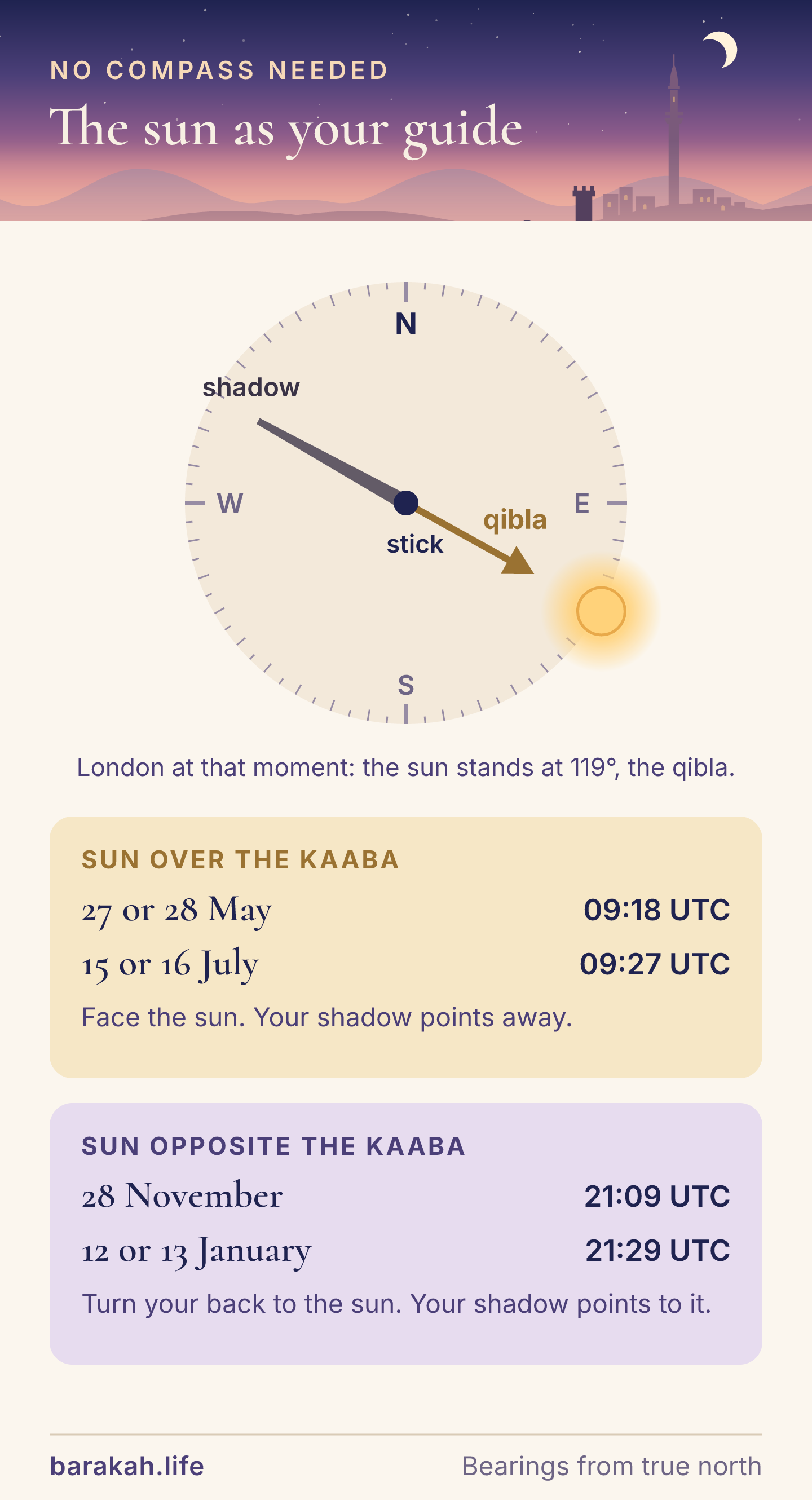
On 27 or 28 May and 15 or 16 July the sun stands over the Kaaba, at 09:18 and 09:27 UTC, so facing the sun is facing the qibla.
In a mosque, follow the mihrab. When you cannot know, make your best effort and pray; every school accepts an honest effort.
For about sixteen or seventeen months after the Hijrah, the Prophet ﷺ and the believers in Madinah prayed towards Jerusalem, and he would look up at the sky hoping for a change (Sahih al-Bukhari 399). Then this was revealed:
Qad narā taqalluba wajhika fi s-samā', fa-la-nuwalliyannaka qiblatan tarḍāhā. Fa-walli wajhaka shaṭra l-masjidi l-ḥarām, wa ḥaythu mā kuntum fa-wallū wujūhakum shaṭrah.
We have seen you turning your face towards the heavens, and We will surely turn you towards a qibla that will please you. So turn your face towards the Sacred Mosque, and wherever you are, turn your faces towards it.
Quran 2:144 (part of the verse)
The word the verse uses is shaṭr: towards, in the direction of. The news reached the mosque of Quba while its people were already bowing in the dawn prayer, facing Jerusalem. They did not stop and start again. They turned around, in the middle of the prayer, to face the Kaaba (Sahih al-Bukhari 403, Sahih Muslim 526). Keep that picture in mind. It is the whole spirit of this subject: you face the best direction you know, and when you learn better, you turn.
Facing the qibla is a condition of the obligatory prayer. When the Prophet ﷺ taught a man who had prayed carelessly, the instruction was to make wudu properly, face the qibla, then say the takbir (Sahih al-Bukhari 6251). It is worth getting right, and easier than most people think.
Why the qibla is not simply east
Ask a child in Chicago which way Makkah is, and they will point east, maybe a little south, because that is where Arabia sits on the classroom map. The real answer is north-east, at about 49°. The map is what is wrong.
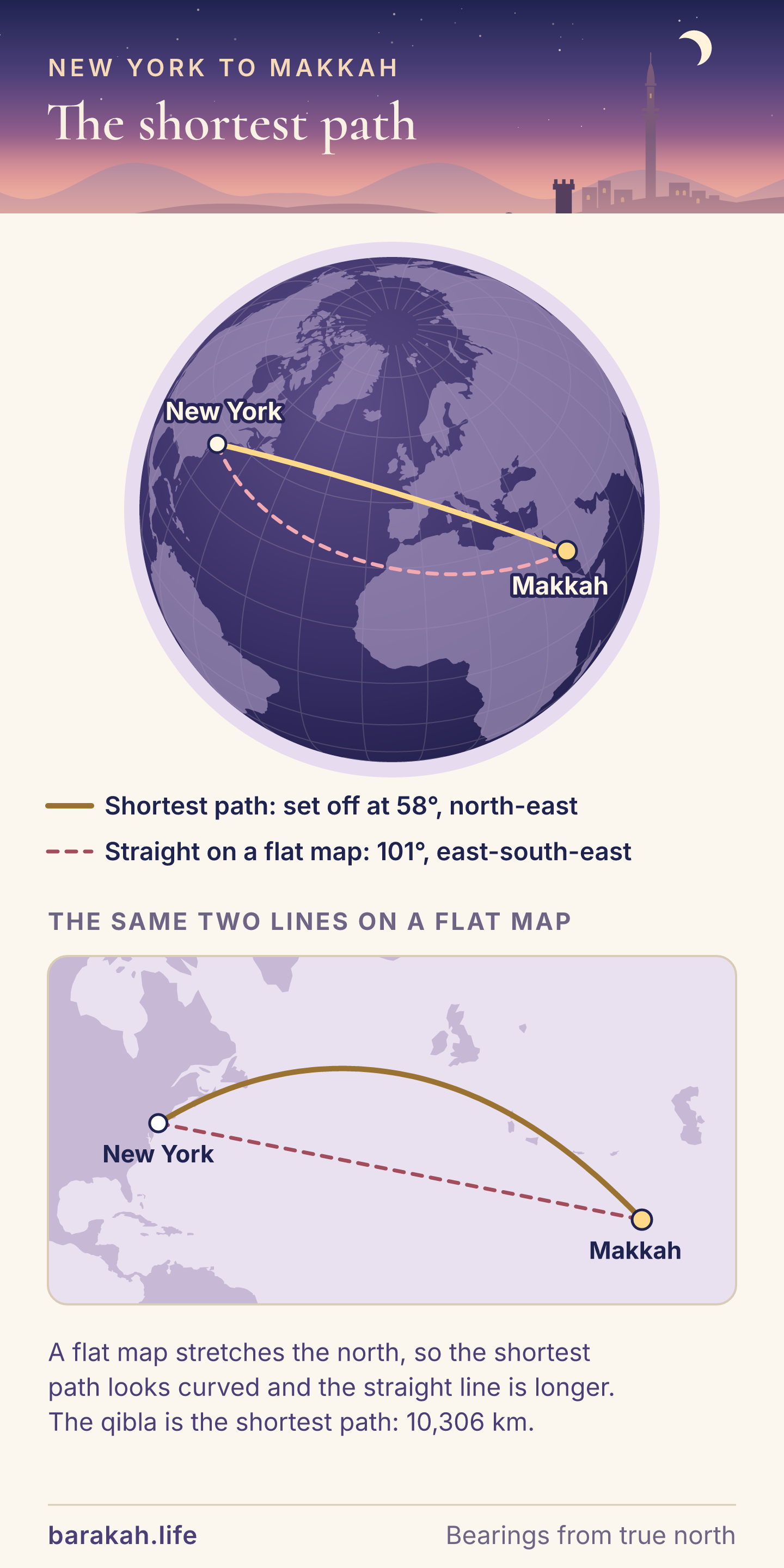
A flat map stretches the round earth, and the common kind (the Mercator projection) stretches the far north and south the most. A straight line on it keeps the same compass bearing the whole way; sailors call it a rhumb line. It is a fine way to steer a ship, but it is not the shortest way, and not the direction in which a distant place actually lies. The shortest path over a sphere is a great circle, the line a taut string makes when stretched over a globe between two cities. It is the direction you would look if you could see the Kaaba through the curve of the earth, and it is the qibla.
The same two cities, the same two lines. On the globe the qibla is the straight one; on the flat map it is the curve.
From New York, the great circle sets off at 58°, north-east, and crosses the Atlantic, southern France, the toe of Italy and Egypt on its way to Makkah. The straight line on a flat map would send you at 101°, a little south of east. That is 43° of difference, which is why so many people in North America are surprised by their first qibla app. Close to Makkah the two lines nearly agree.
In the 1990s a small group in North America argued, notably in a 1993 book by Riad Nachef and Samir Kadi, that the qibla there is south-east, following the flat map. Scholars and astronomers answered it at length (S. Kamal Abdali's paper The Correct Qibla is the best known reply), and the great majority of scholars and mosques in North America face north-east. The classical Muslim astronomers' method of finding the qibla from the sun, described below, gives exactly the great-circle direction.
For the curious: the formula. With your latitude φ and longitude λ, and the Kaaba at latitude φₖ = 21.4225° N and longitude λₖ = 39.8262° E, the qibla bearing from true north is atan2( sin(λₖ − λ), cos φ · tan φₖ − sin φ · cos(λₖ − λ) ). Every bearing in this guide was worked out this way, the same calculation our qibla finder and city pages use.
The qibla from major cities
Qibla in degrees clockwise from true north. The magnetic column is what a plain compass should read, corrected for this year's magnetic north, and the clock column (the minute hand) is explained in the no-phone section. Each city links to its own page with a live compass.
Not listed? The Barakah Life qibla finder works out the bearing for exactly where you are, and hundreds of cities have their own page, alongside their prayer times (for example prayer times in London).
With a phone: getting a compass you can trust
A qibla app needs two things. Where you are comes from GPS, and from that the bearing is simple arithmetic. Which way the phone points comes from a tiny magnetometer that feels the earth's magnetic field, and that field is weak. A fridge door, a steel desk, a car, a speaker or the magnet in a phone case is much closer and can drag the reading ten, thirty or even ninety degrees off. Almost every "my qibla app is wrong" story is this, not the maths.
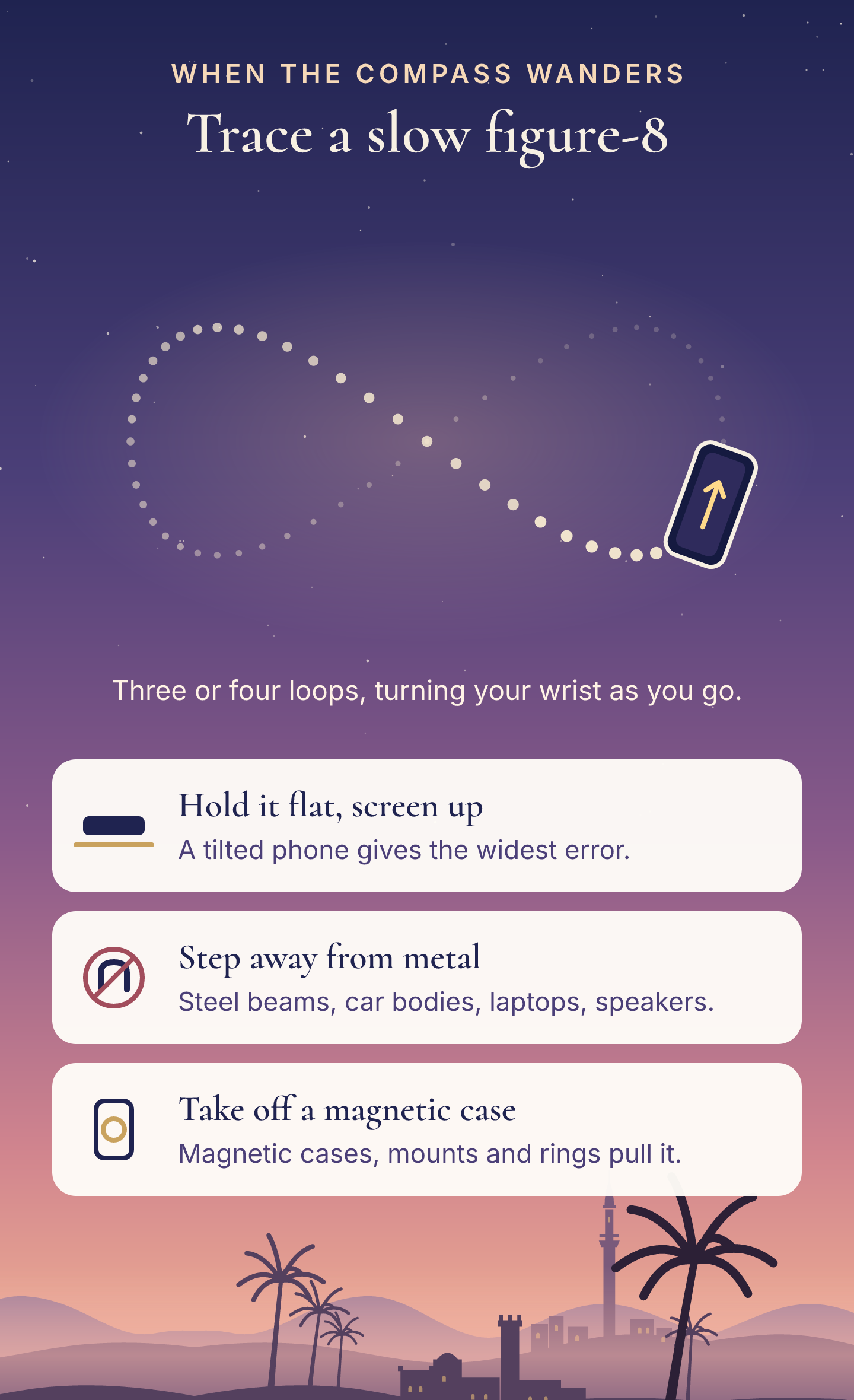
Take off anything magnetic. Magnetic cases, wallet clasps, car mounts and magnetic rings all bend the reading.
Step away from metal. Move a pace or two from steel furniture, radiators, cars, speakers and laptops. The middle of a room is better than against a wall, which may hide steel.
Hold it flat, screen up, at waist height. A tilted phone gives the widest error.
Calibrate it. Trace a slow figure-8 in the air three or four times, turning your wrist so the phone rolls through every angle. This lets the phone measure its own magnetic quirks and subtract them.
Wait, then read. Let the needle settle for a few seconds, turn your body until you face the qibla, and note something in the room that lines up with it.
Calibration takes ten seconds. Do it whenever the needle drifts, and always in a new place.
True north and magnetic north
A compass needle points to magnetic north, which is not where the meridians meet. The gap, called magnetic declination, depends on where you are and drifts a little each year. In London it is about 1°, so it hardly matters. In New York it is about 12.5° west, in Seattle and Vancouver about 15° east, in Auckland about 20° east and in Cape Town about 27° west. Qibla bearings are always given from true north, so a phone or a hand compass that shows magnetic north will be off by that much unless it corrects for it. That is the "on a magnetic compass" column in the table above: from Cape Town, a plain compass must read 50°, not 23°.
Good qibla apps apply the correction for you, using the World Magnetic Model. On an iPhone, the built-in Compass app has a Use True North setting (in Settings, under Compass), and Location Services must be on for it to work; leaving Compass Calibration switched on under Location Services, System Services, helps too. On Android, Google Maps shows a beam from the blue dot: if it is wide, tap the dot and choose Calibrate.
When the compass will not behave
The needle keeps spinning or jumping. You are near metal or a magnet. Move, take the case off, calibrate again.
Two phones disagree by twenty degrees or more. At least one is uncalibrated or near something magnetic. Calibrate both, away from each other. If they still disagree, use a method below that does not need a magnetometer.
Inside a car, train or plane. The steel body and motors make any magnetometer unreliable. Use the sun, a map, or the vehicle's heading instead (see travel, below).
The app shows the wrong city. Check location permission. Across the United States the qibla changes by more than thirty degrees.
The best habit is a second opinion that uses no magnets: in a new home or hotel, check the phone once against the sun or a map line, then trust your landmark.
Without a phone: the sun and a clock face
The sun is the oldest qibla finder there is, and no phone case can fool it. You need a way to find north, and your qibla number, written down before you travel.
Find north from a shadow
Stand a stick upright on level ground in the sun. A pen standing on a sunny windowsill works too.
Mark the tip of its shadow with a stone or a pencil dot.
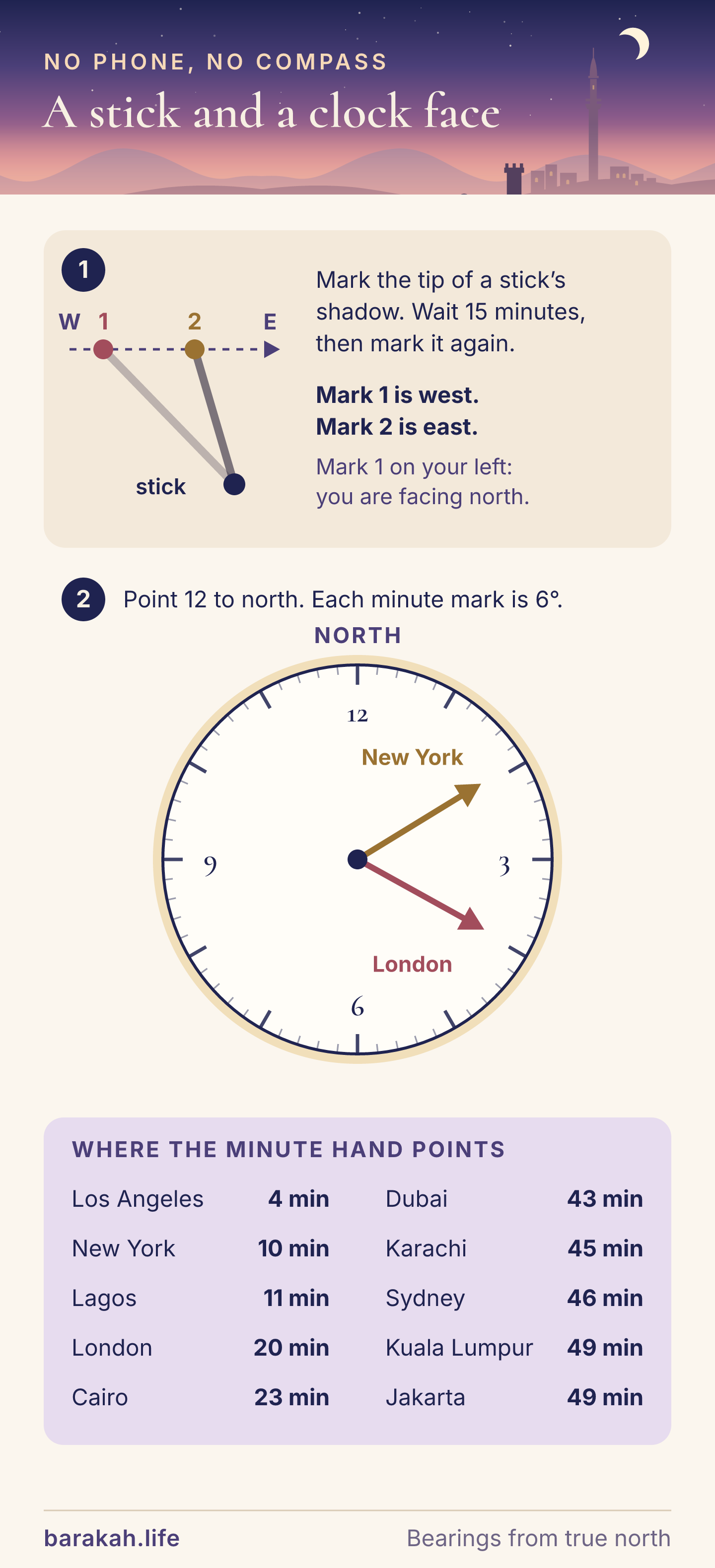
Wait about fifteen minutes and mark the tip again. The sun moves west across the sky, so the shadow tip creeps east.
The line from the first mark to the second runs west to east. Stand with the first mark on your left and the second on your right, and you are facing north. This works in both hemispheres.
There is a quicker version tied to the prayer itself. Dhuhr begins once the sun has passed its highest point (the zawal), and at that highest moment every shadow lies exactly along the north-south line. A minute or two before the Dhuhr time on your timetable, the shortest shadow of the day points north if you live well north of the tropics and south if you live well south of them. (Our guide to why prayer times differ between apps explains how that time is set.)
Turn by your number with a clock face
Now picture a clock lying flat with 12 pointing north. The minute hand works like a compass: quarter past is east, half past is south, quarter to is west, and each minute mark is 6°. Divide your qibla number by six and you have the minute. New York's 58° is ten minutes past; London's 119° is twenty past; Karachi's 268° is a quarter to.
A stick, fifteen minutes and a clock face: north first, then your minute.
Done carefully, this lands within a few degrees, closer than an uncalibrated phone.
The four moments a year the sun points the way
Twice a year the sun passes directly over the Kaaba at its noon. At that moment, everywhere the sun is up, the sun stands exactly in the direction of the qibla, and every upright thing casts its shadow directly away from Makkah. Face the sun and you face the Kaaba, with no calculation at all. The classical astronomers used exactly this: Nasir al-Din al-Tusi in the thirteenth century described observing the shadow on these two days, adjusting the hour for the difference in longitude from Makkah.
On these four days, a shadow is a qibla compass for half the world.
Where you are
27 or 28 May
15 or 16 July
Makkah, Istanbul, Nairobi
12:18
12:27
London, Lagos
10:18
10:27
Paris, Berlin, Johannesburg
11:18
11:27
Dubai
13:18
13:27
Karachi
14:18
14:27
Delhi
14:48
14:57
Dhaka
15:18
15:27
Jakarta
16:18
16:27
Kuala Lumpur, Singapore
17:18
17:27
Local clock times, with summer time where it applies; either day of each pair, and a few minutes either side, is still very close. It works wherever the sun is up then: Europe, Africa, the Middle East and most of Asia, but not the Americas or eastern Australia. Near Makkah the sun is almost overhead and shadows are short, so use a tall straight edge such as a door frame.
The Americas get their own two moments. Around 28 November at 21:09 UTC and 12 or 13 January at 21:29 UTC, the sun stands over the point on the far side of the earth from the Kaaba. Now the shadow points to the qibla: turn your back to the sun and face along it.
Where you are
28 November
12 or 13 January
Los Angeles, Vancouver, Seattle
13:09
13:29
Denver, Calgary
14:09
14:29
Chicago, Houston, Mexico City
15:09
15:29
Honolulu
11:09
11:29
Sydney, Melbourne (next day)
08:09
08:29
Auckland (next day)
10:09
10:29
On the east coast of North America the sun is then too low to use (16:09 in New York); Chicago and everywhere west of it do well.
Sunrise and sunset are only rough guides
The sun rises due east and sets due west only around the equinoxes, about 20 March and 22 September. In London it rises at about 49° in June and 128° in December, nearly eighty degrees apart. Use sunrise for a rough sense of east, nothing finer. One curiosity for New Yorkers: in the days around 21 June the sun rises at about 58°, almost exactly on the qibla.
At night: the stars
Allah reminds us that He placed signs on the land and in the sky for those who travel:
وَعَلَٰمَٰتٍ ۚ وَبِٱلنَّجْمِ هُمْ يَهْتَدُونَ
Wa ʿalāmāt, wa bi n-najmi hum yahtadūn.
And landmarks; and by the stars they find their way.
Quran 16:16
In the northern hemisphere, follow the two front stars of the Plough (the Big Dipper) upwards about five times the gap between them to the Pole Star, which sits less than a degree from true north. In the southern hemisphere, extend the long bar of the Southern Cross about four and a half times its length, then drop straight down to the horizon for south. Then use your clock-face minute.
With a map: draw the real line
A map uses no magnet, so it can be the most reliable method of all, as long as you draw the shortest path rather than a straight line across a flat map. In Google Maps on a computer, right-click your location, choose Measure distance and click on Makkah: the line follows the great circle, which is why it curves. Google Earth's ruler does the same on a globe. Zoom back in and see which building or landmark near you sits on that line, and face it. This is the answer inside steel-framed buildings, where phone compasses struggle. The Barakah Life app's map view draws the same line across your own streets.
In a hotel, on a train, on a plane
Hotels
In many Muslim-majority countries, hotels mark the qibla with a small arrow on the ceiling, a desk or inside a drawer. Elsewhere, ask reception. Check it once with a method above, then use a landmark in the room for the rest of your stay. Note the city's bearing before you leave home, in case you have no data on arrival.
Trains, buses and cars
The Prophet ﷺ prayed voluntary prayers on his mount facing wherever it was heading, and when he wanted to pray an obligatory prayer he dismounted and faced the qibla (Sahih al-Bukhari 400). Ibn ʿUmar said that it was about voluntary prayer on a journey that this verse was revealed (Sahih Muslim 700c):
Wa lillāhi l-mashriqu wa l-maghrib, fa-aynamā tuwallū fa-thamma wajhu llāh, inna llāha wāsiʿun ʿalīm.
To Allah belong the east and the west. Wherever you turn, there is the Face of Allah. Allah is All-Encompassing, All-Knowing.
Quran 2:115
So voluntary prayers may be prayed in your seat, facing the direction of travel. For an obligatory prayer, plan to stop or pray at a station or service area within its time, facing the qibla. Most scholars allow a traveller to join Dhuhr with Asr and Maghrib with Isha, which makes this easier; the Hanafi school allows joining only at Arafah and Muzdalifah. Our guide to the prayer covers the travel prayer.
Planes
If you can pray before boarding or after landing within the prayer's time (joining prayers where your school allows), do. If not, pray on board: ask the crew for a space by the galley where you can stand, face the qibla, bow and prostrate. Many will help. For the direction, compare the plane's heading on the seatback map with the qibla bearing for its current position (it changes as you fly, and phone GPS often works by the window in flight mode). Your seat faces the direction of travel, so the difference between the two numbers is how far to turn. The phone's compass is not reliable inside the aircraft.
If you truly cannot stand or turn, pray seated, facing the qibla as best you can, at least at the start. Scholars differ on repeating such a prayer after landing. AMJA (the Assembly of Muslim Jurists of America) has ruled that a seated prayer on a plane, where standing is not possible, need not be repeated. Hanafi scholars such as the Darul Iftaa of Chicago hold that a prayer that could not face the qibla because of a human obstacle is repeated once you can pray it properly. Follow the scholars you trust; repeating it is the cautious course.
In a mosque: follow the mihrab
The mihrab, the niche in the front wall, shows the qibla the mosque was built to face. Every school counts the mihrab of an established mosque as strong evidence of the qibla. The Hanafi and Hanbali schools list it first among the ways of finding the direction, and for a visitor it is a safer guide than a guess. Pray with the rows. Some older mosques were laid out by a traditional direction rather than a calculated one and are a few degrees off; that sits inside the leeway described next, and the unity of the rows matters. If you believe a mosque is far out, raise it gently with its committee rather than praying at an angle on your own.
How exact do you need to be?
Exact enough to have honestly faced the Kaaba, and no more than you are able. Consider the scale: from London, the Kaaba, about twelve metres wide, takes up less than two ten-thousandths of a degree of your view. Nobody on earth aims at that, which is why the scholars distinguish between two kinds of facing:
Anyone who can see the Kaaba must face the building itself. This is agreed.
Anyone far away faces its direction. Here the schools differ in how they put it.
School
For a person far from Makkah
Hanafi
The direction (jihah) is enough. Contemporary Hanafi scholars commonly give the leeway as up to 45° either side of the exact bearing, citing Ibn ʿĀbidīn's Radd al-Muḥtār; deliberately facing away from a known exact direction within that range is disliked but the prayer stands.
Maliki
The direction is enough, so long as part of the face is turned towards it.
Hanbali
The direction is enough, so long as part of the face is turned towards it.
Shafiʿi
The relied-upon view is to aim at the Kaaba itself (ʿayn al-Kaʿbah) by your best judgement. A second view in the school, transmitted by al-Muzanī from al-Shāfiʿī, accepts the direction.
Those who accept the direction cite this hadith:
مَا بَيْنَ الْمَشْرِقِ وَالْمَغْرِبِ قِبْلَةٌ
Mā bayna l-mashriqi wa l-maghribi qiblah.
What is between the east and the west is a qibla.
Jami' at-Tirmidhi 342 and Sunan Ibn Majah 1011, from Abu Hurayrah, graded sahih by al-Albani
It was said in Madinah, where Makkah lies to the south, and the scholars who cite it take from it that the one who cannot see the Kaaba is not asked to hit it to the degree. In practice, the schools meet in the middle: make a sincere effort to face the Kaaba as closely as your means allow. A calibrated phone or a careful shadow puts you within a few degrees, which is what every school asks of you. Do not let a needle's small wobble disturb your prayer.
Praying when you are unsure
Sometimes there is no sun, no signal and nobody to ask. Every school gives the same answer: make a real effort (taḥarrī) with what you have, and pray in the direction you judge most likely.
فَٱتَّقُوا۟ ٱللَّهَ مَا ٱسْتَطَعْتُمْ
Fa-ttaqu llāha ma staṭaʿtum.
So be mindful of Allah as much as you are able.
Quran 64:16 (part of the verse)
ʿĀmir ibn Rabīʿah reported that on a dark night on a journey with the Prophet ﷺ, the Companions could not tell the qibla, so each man prayed the way he judged; in the morning they told him, and "Wherever you turn, there is the Face of Allah" was revealed (Jami' at-Tirmidhi 345). Al-Tirmidhi said its chain is not strong, and Bashshar ʿAwwad Maʿruf graded it weak, while al-Albani and Ahmad Shakir graded it hasan. Al-Tirmidhi added that most scholars act on it: whoever prays under cloud in the wrong direction and learns of it afterwards has a valid prayer, the view of Sufyan al-Thawri, Ibn al-Mubarak, Ahmad and Ishaq.
What if you later find you were clearly wrong? The schools differ:
Situation
Hanafi
Maliki
Shafiʿi
Hanbali
You made an effort, and learn during the prayer that you are facing wrongly
Turn and carry on
Turn and carry on; start again if the error was large
Start again, once certain of the error
Turn and carry on
You made an effort, and learn after the prayer
Prayer valid
Valid; better to repeat it within its time
Repeat it, once certain of the error (the school's stronger view)
Prayer valid
You prayed without making any effort
Repeat, unless it turns out you were facing the qibla
Repeat
Repeat
Repeat
These rules are about being clearly wrong, not a few degrees out. The people of Quba, turning mid-prayer when the news reached them, are the model: face your best judgement, and turn when you know better.
How Barakah Life keeps its compass honest
We built the qibla compass in Barakah Life around one rule: never show a confident needle that the phone cannot back up.
True north, always. The app corrects the magnetic reading to true north for the spot you are standing on, so a phone in New York, Seattle or Cape Town is not twelve to twenty-seven degrees out.
A steadier heading. On Android it fuses the gyroscope with the magnetometer; on iPhone it uses the system's fused heading.
It tells you when it is unsure. When calibration is poor, the qibla path fades and the app asks you to calibrate. It cross-checks two sensor readings and will not tell you that you are aligned while they disagree or the calibration is weak.
Your real position. The live compass uses where the phone actually is; a city set by hand gets its bearing as a number, not a needle.
A map view draws the qibla line across your own streets, for buildings where no magnetometer can be trusted.
Check with the sun. Under the compass, the app works out where the sun is for your exact place and minute, puts a small sun on the dial, and tells you in plain words how to turn from it: face the sun and turn 14° to the right, or, when that is the long way round, stand with the sun at your back and turn the other way. No magnetometer is involved, so you can confirm the needle against the sky itself. When the sun is down it tells you when it rises, and when it is almost overhead, where its direction is hard to judge, it says so and when the check will work again. It also shows the next day the sun stands over the Kaaba, worked out for each year rather than copied from a list. With a city set by hand, you get the same instruction on that city's clock.
Even so, the sun has the final word: in a new place, check once with the app's sun check, a shadow or the map. The qibla finder works in your phone's browser, and the Barakah Life app adds prayer times with the adhan, the compass and map, and reminders that follow you when you travel. Setting out on a journey? Keep the travel du'as close.
Questions people ask
How do I find the qibla direction without a compass?
Find north from the sun, then turn by your qibla bearing. Mark the tip of a stick's shadow, wait fifteen minutes and mark it again; with the first mark on your left you face north. Picture a clock with 12 at north and turn to your minute (bearing divided by six): ten past from New York, twenty past from London, a quarter to from Karachi. At night, the Pole Star marks north.
Why is the qibla north-east in America?
The qibla follows the shortest path over the round earth, a great circle, not a straight line on a flat map. From New York that path sets off at 58°, north-east. A flat map's straight line points east-south-east, but it is longer and is not the direction Makkah lies in.
Why does my phone's qibla compass point the wrong way?
Almost always magnetic interference: a magnetic case, a car mount, nearby steel, a laptop or speaker, or a compass that needs calibrating. Take the case off, step away from metal, hold the phone flat and trace a slow figure-8. Make sure the app corrects to true north and has your location.
How do I find the qibla with an iPhone compass?
Look up your qibla bearing (for example on the Barakah Life qibla page for your city), open the Compass app with Use True North switched on in Settings, hold the phone flat away from metal, and turn until the heading matches your bearing. If the reading jumps, take off any magnetic case and calibrate.
On which days is the sun directly over the Kaaba?
On 27 or 28 May at 09:18 UTC (12:18 in Makkah) and on 15 or 16 July at 09:27 UTC (12:27 in Makkah). Wherever the sun is up then, it stands in the direction of the qibla. On 28 November at 21:09 UTC and 12 or 13 January at 21:29 UTC it is over the opposite side of the earth, and shadows point to the qibla, which helps in the Americas.
Do I have to repeat prayers if I discover I prayed in the wrong direction?
If you made an effort and only learned after praying that you were clearly wrong, the Hanafi and Hanbali schools say the prayer is valid, the Maliki school recommends repeating it within its time, and the Shafiʿi school's stronger view is to repeat it. If you made no effort at all, all four schools say to repeat it. If you have prayers to make up, our guide to making up missed prayers sets out a plan.
A closing word
The same act of turning, in a hotel room in Toronto, a train in Malaysia and a field in Nigeria, lines up more than a billion people on one house. Learn your number, check it once with the sun, and then let it go: the direction is how the prayer begins, not what it is about. Turn your face towards the Sacred Mosque, and give the rest of yourself to the One who told you to.
Sources
Quran 2:115, 2:144, 16:16, 64:16 (quran.com). Arabic in the Uthmani script.
Sahih al-Bukhari 399, 400, 403, 6251; Sahih Muslim 526, 700c; Jami' at-Tirmidhi 342, 344, 345; Sunan Ibn Majah 1011. Gradings as recorded by al-Albani and others on sunnah.com and in the hadith data Barakah Life uses.
Wahbah al-Zuḥaylī, al-Fiqh al-Islāmī wa Adillatuh (Dar al-Fikr), on facing the qibla, the stages of searching for it, and errors, as summarised by Mohamed Nabeel Tarabishy, Jurisprudence of Qibla (2014).
S. Kamal Abdali, The Correct Qibla (1997), including al-Tusi's solar method; Riad Nachef and Samir Kadi (1993), the south-east view it answers.
Bearings and distances computed with the great-circle formula above (Kaaba at 21.4225° N, 39.8262° E), as on the Barakah Life qibla pages. Solar positions from the NOAA solar equations. Magnetic declination from the World Magnetic Model 2025 for 28 October 2026. Coastlines from Natural Earth.
This guide summarises the positions of the schools and of contemporary scholars as recorded in the sources above. It is a study aid, not a fatwa. Where your situation is unusual, or the views differ and it matters to you, ask a scholar whose knowledge you trust.
Tagsqiblaqibla directionkaabatravelcompass
Pass it on
Know someone who needs this today? Send it to them.
“Whoever guides someone to good has a reward like the one who does it.” Sahih Muslim 1893