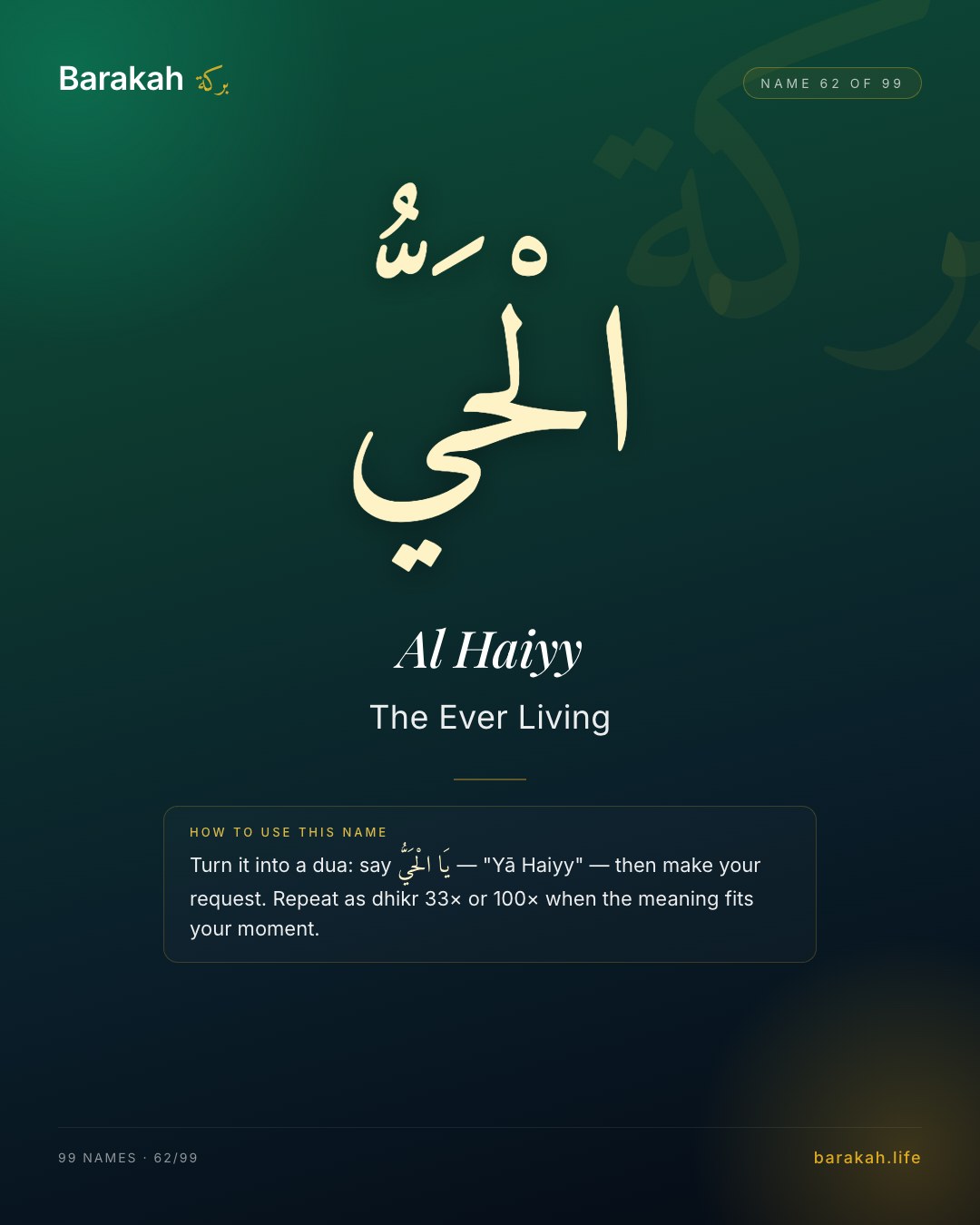
Al Haiyy
The Ever-Living
The Ever-Living, whose life has no beginning, no end, and no flaw.
Al-Haiyy is alive with the fullness every attribute requires: His knowledge is living knowledge, His power living power, His mercy living mercy. Every heartbeat in creation is sustained from a Life that never had a first beat and will never have a last.
Mentions of Al Haiyy
From the Quran & Hadith
From the root ha-ya-ya (ح ي ي), shared with Al-Muhiy, the Giver of Life. Al-Haiyy is life itself in its perfection: a life with no birth behind it, no death ahead of it, no sleep interrupting it, and no weakness inside it. All other life is a temporary flame lit from this eternal one.
The opening of the greatest verse
Ayat al-Kursi begins: 'Allah, there is no deity except Him, the Ever-Living, the Sustainer of existence. Neither drowsiness overtakes Him nor sleep' (Quran 2:255). Al-Haiyy and Al-Qayyoom together open the greatest verse, and scholars across the centuries held that these two comprise the ismu-llāhi-l-aʿdham, the greatest Name, because all other perfections unfold from perfect life and perfect self-subsistence.
Trust that cannot be orphaned
The Quran gives one instruction built directly on this Name: 'And rely upon the Ever-Living who does not die, and exalt Him with His praise' (Quran 25:58). Every other support you lean on is mortal: parents age, mentors pass, institutions dissolve. Reliance placed on the Living who does not die is the only trust in existence that can never be bereaved.
Allāhu lā ilāha illā huwa-l-Ḥayyu-l-Qayyūm. Lā ta'khudhuhu sinatun wa lā nawm.
“Allah, there is no deity except Him, the Ever-Living, the Sustainer of existence. Neither drowsiness overtakes Him nor sleep.”
Wa tawakkal ʿala-l-Ḥayyi-lladhī lā yamūtu wa sabbiḥ bi-ḥamdih.
“And rely upon the Ever-Living who does not die, and exalt Him with His praise.”
Huwa-l-Ḥayyu lā ilāha illā huwa fa-dʿūhu mukhliṣīna lahu-d-dīn.
“He is the Ever-Living; there is no deity except Him, so call upon Him, being sincere to Him in religion.”
Anas (may Allah be pleased with him) reported that when a matter distressed the Prophet ﷺ he would say: 'Yā Ḥayyu yā Qayyūm, bi-raḥmatika astaghīth', O Ever-Living, O Sustainer, by Your mercy I seek relief.
Grief and fear are, at bottom, encounters with mortality: everything we love here can die, and so can we. Al-Haiyy is the one relationship exempt from that shadow. Love poured toward the Ever-Living is the only love guaranteed never to attend a funeral, and hearts anchored there survive every other loss still standing. When distress squeezes you, use the Prophet's ﷺ own emergency call: Yā Ḥayyu yā Qayyūm, bi-raḥmatika astaghīth. You are dialing the two Names that open the greatest verse, the Life that never sleeps and the Sustainer who never lets go, and no hour of night finds that line closed.
Yā Ḥayyu yā Qayyūm, bi-raḥmatika astaghīth
O Ever-Living, O Sustainer, by Your mercy I seek relief.
- Jami at-Tirmidhi 3524
- Quran 25:58
Count "Al Haiyy", The Ever Living
Saved as a custom preset in your tasbih. Tap-to-count, hit 33 or 100, and the lifetime total stays with your account.