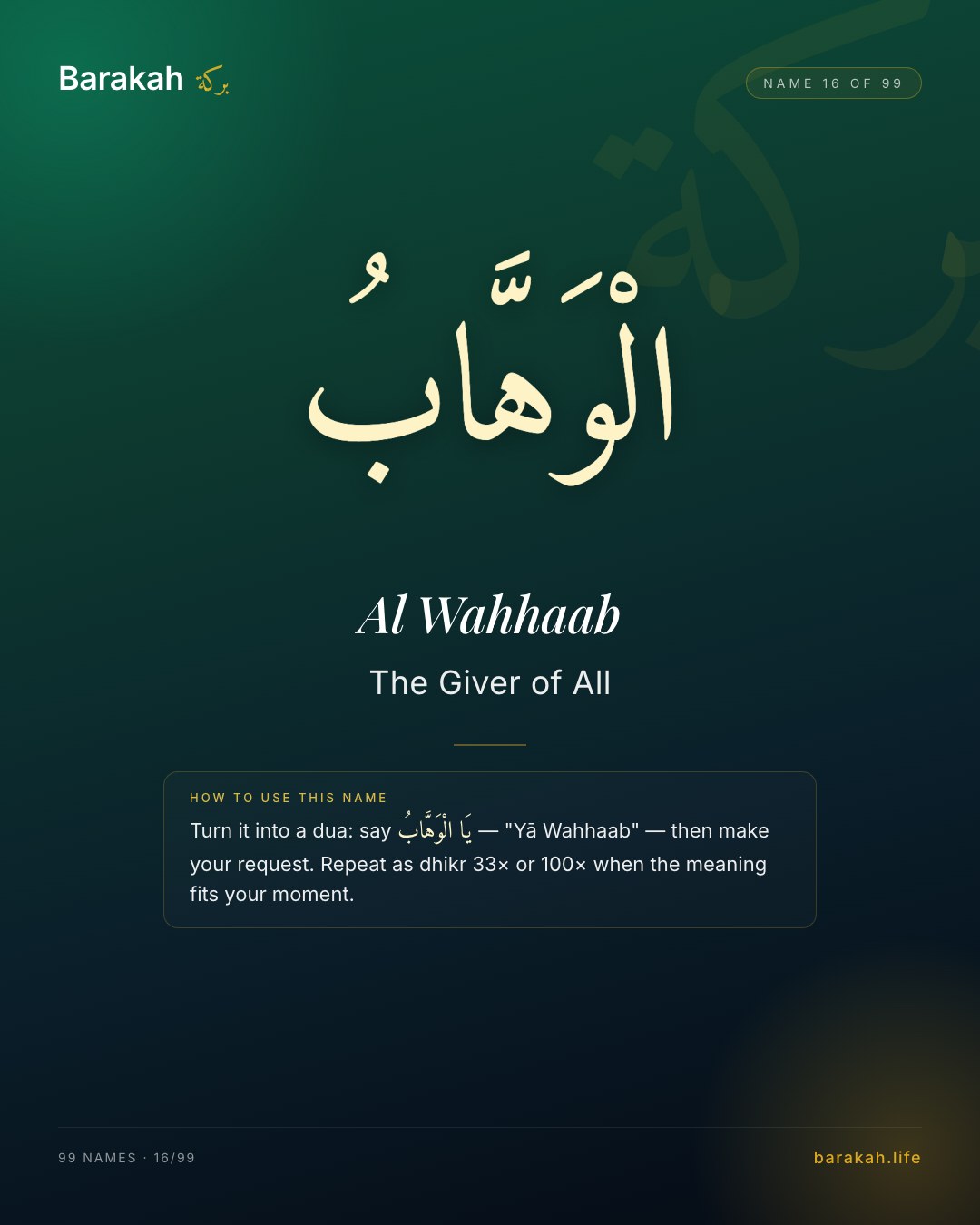
Al Wahhaab
The Supreme Bestower
The One who is abundantly generous in giving without ever needing to calculate.
Al-Wahhaab is the great giver whose blessings are freely and perpetually given. He gives with no ulterior purpose and expects nothing in return, to the deserving and the undeserving, to the good and the evil. He loves His creation intimately and gives without recompense or interest.
Mentions of Al Wahhaab
From the Quran & Hadith
From the root waw-ha-ba (و ه ب), which carries the classical Arabic connotations of giving for no compensation, giving as a gift, donating, offering as a present, bestowing, and giving liberally and freely. From the same root comes hibah, a gift detached from conditions or prior cause: given without recompense and without expectation of return.
A gift with no strings
The Name appears three times in the Quran, and its shade of meaning is precise: hibah is giving detached from any condition. Human generosity almost always carries an unspoken social contract; an invitation obliges an invitation, a favour expects acknowledgement. Al-Wahhaab is free of all of it. He just gives, and gives without any limits. 'And if you should count the favors of Allah, you could not enumerate them' (Quran 14:34).
The pairing with Al-Azeez
When Al-Wahhaab is paired in the Quran, it is with Al-Azeez, the Exalted in Might: 'Or do they have the depositories of the mercy of your Lord, the Exalted in Might, the Bestower?' (Quran 38:9). The pairing signals the purity of the gift. The All-Mighty needs nothing from anyone, so when He gives, He gives freely: no ulterior motive, no seeking favour, nothing wanted back. Poverty and hunger persist in the world not because His bounties ran out, but because of what people do with them; nothing can prevent Him from giving to whom He wills.
He even gives to those who might not be deserving; perhaps the gift itself is the invitation, a reminder of His love, so that the receiver would realize their Lord is showering them with blessings and turn back to Him. To be given so you would come to know the Giver: that is a gift within a gift.
Rabbanā lā tuzigh qulūbanā baʿda idh hadaytanā wa hab lanā min ladunka raḥmah, innaka anta-l-Wahhāb.
“Our Lord, let not our hearts deviate after You have guided us and grant us from Yourself mercy. Indeed, You are the Bestower.”
Qāla rabbi-ghfir lī wa hab lī mulkan lā yanbaghī li-aḥadin min baʿdī, innaka anta-l-Wahhāb.
“He said, My Lord, forgive me and grant me a kingdom such as will not belong to anyone after me. Indeed, You are the Bestower.”
Am ʿindahum khazā'inu raḥmati rabbika-l-ʿAzīzi-l-Wahhāb.
“Or do they have the depositories of the mercy of your Lord, the Exalted in Might, the Bestower?”
Uqba (may Allah be pleased with him) narrated that the Prophet ﷺ, after leading the Asr prayer, hurried to one of his houses and returned to find the people surprised at his haste. He said: 'I remembered a piece of gold lying in my house, and I did not like it to divert my attention from Allah's worship, so I ordered it to be distributed.'
Abu Hurairah (may Allah be pleased with him) reported that the Prophet ﷺ said: 'Give gifts and you will love one another.'
The Prophet ﷺ said: 'O Muslim women, none of you should consider insignificant a gift to give to her neighbour, even if it is the trotters of a sheep.'
This Name should reframe where success comes from. Whatever good you do, who inspired that impulse within you? Who records and rewards it? It is all from Allah. Upon further reflection, even the skills and qualities we call our own are gifts we did nothing to deserve. He gives, period. No questions asked, no signing on the dotted line, and then He leaves us with the choice to take the gift for granted or to be grateful. It is on us to see His kindness and His mercy. And a gift tells you how to give. If you gave a friend a present and saw it misused, or worse, used against you, it would hurt. Allah has given us knowledge, wealth, faculties, and time; using His gifts in ways that would insult the Giver is the ingratitude to avoid. Use your gifts to spread goodness, to uplift, to benefit others, and, like the Prophet ﷺ who accepted gifts and gave in return, let giving become your habit too.
Rabbanā lā tuzigh qulūbanā baʿda idh hadaytanā wa hab lanā min ladunka raḥmah, innaka anta-l-Wahhāb
Our Lord, let not our hearts deviate after You have guided us and grant us from Yourself mercy. Indeed, You are the Bestower.
- Sahih al-Bukhari 851
- Al-Adab al-Mufrad 594
- Sahih al-Bukhari 2566
Count "Al Wahhaab", The Giver of All
Saved as a custom preset in your tasbih. Tap-to-count, hit 33 or 100, and the lifetime total stays with your account.