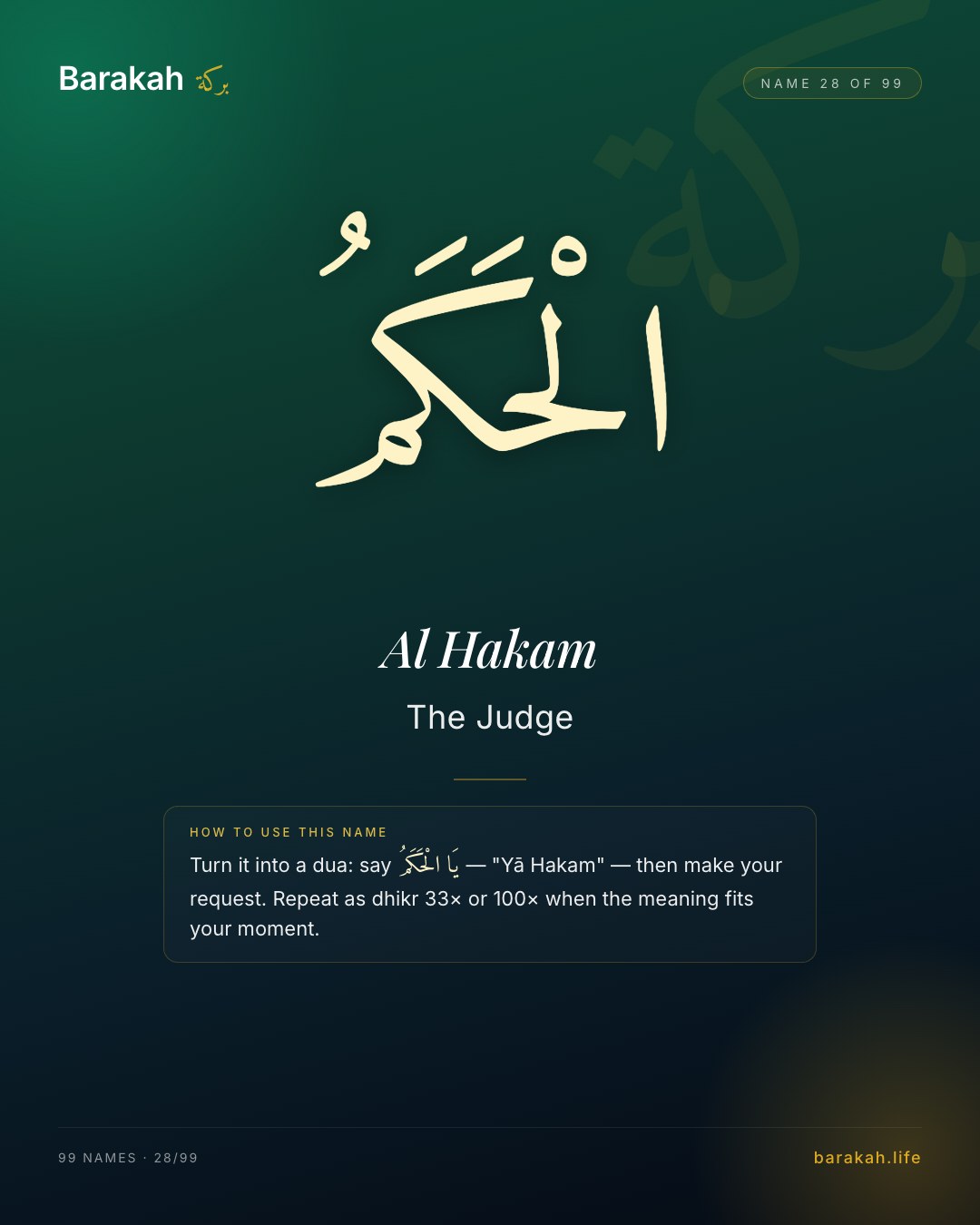
Al Hakam
The Impartial Judge
The Arbitrator, the Judge, the Giver of Justice.
Allah is Al-Hakam, the Giver of Justice, whose judgment, once rendered, cannot be thwarted. He always delivers justly in every situation and never makes a mistake. He is the best of judges. Imam al-Ghazali writes that He is the arbitrating magistrate and the avenging judge, whose ruling no one overturns and whose decree no one corrects.
Mentions of Al Hakam
From the Quran & Hadith
From the root ha-kaf-mim (ح ك م), which carries the classical Arabic connotations of being wise and knowing the true nature of things; passing judgment, deciding, and passing a verdict; judging and passing sentence; and preventing or restraining from wrongdoing or corruption, turning someone back from wrongdoing or ignorance. The same root gives Al-Hakeem, the All-Wise, and hikmah itself: the essence of things as they are. To be the best of judges, one must be all-wise.
The best of judges
'Then is it the judgement of the time of ignorance they desire? But who is better than Allah in judgement for a people who are certain in faith?' (Quran 5:50). Human courts work from partial evidence, fallible witnesses, and imperfect judges. Al-Hakam works from complete knowledge: 'Allah will judge between you on the Day of Resurrection concerning that over which you used to differ' (Quran 22:69). Every unresolved dispute, every wrong that never reached a courtroom, has a hearing date.
Under the lens of His decree
An essential aspect of this Name is trusting the decree of the wisest of judges. The Prophet's ﷺ counsel teaches us to recognize Allah in ease and adversity, and that 'what has passed you by was not going to befall you, and what has befallen you was not going to pass you by, and victory comes with patience, relief with affliction, and ease with hardship' (An-Nawawi's Forty Hadith 19, Jami at-Tirmidhi 2516). Our task is to take control of our hearts' state, keep it pure despite the surrounding factors, and perform to the best of our abilities on the things within our control. Everything else that happens outside it is the will of Allah, and He is the best arbitrator. Shaykh Tosun Bayrak counsels: instead of questioning Allah's judgment, be a true judge of yourself, neither tyrannizing yourself nor excusing and pampering yourself.
The dua of the Prophet ﷺ with this meaning
The Prophet ﷺ would open his night prayer calling on the Arbitrator: 'O Allah, Lord of Jibrail, Mikail and Israfil, Creator of the heavens and the earth, Knower of the seen and the unseen. You are the arbitrator between Your servants in that which they have disputed. Guide me to the truth by Your leave, in that which they have differed, for verily You guide whom You will to a straight path' (Sahih Muslim 770). When the wisest people disagree and you do not know what is true, this is the address to write to.
A-fa-ḥukma-l-jāhiliyyati yabghūn. Wa man aḥsanu mina-llāhi ḥukman li-qawmin yūqinūn.
“Then is it the judgement of the time of ignorance they desire? But who is better than Allah in judgement for a people who are certain in faith?”
Allāhu yaḥkumu baynakum yawma-l-qiyāmati fīmā kuntum fīhi takhtalifūn.
“Allah will judge between you on the Day of Resurrection concerning that over which you used to differ.”
Wa-ttabiʿ mā yūḥā ilayka wa-ṣbir ḥattā yaḥkuma-llāh, wa huwa khayru-l-ḥākimīn.
“And follow what is revealed to you, O Muhammad, and be patient until Allah will judge. And He is the best of judges.”
Innā kulla shay'in khalaqnāhu bi-qadar.
“Indeed, all things We created with predestination.”
The Prophet ﷺ would open his night prayer: 'O Allah, Lord of Jibrail, Mikail and Israfil, Creator of the heavens and the earth, Knower of the seen and the unseen. You are the arbitrator between Your servants in that which they have disputed. Guide me to the truth by Your leave, for verily You guide whom You will to a straight path.'
Abdur-Rahman bin Abi Bakrah narrated that his father wrote to Ubaidullah bin Abi Bakrah, who was a judge: 'Do not pass a judgement between two people while you are angry, for indeed I heard the Messenger of Allah ﷺ say: The judge should not judge between two people while he is angry.'
A believer benefits from knowing Al-Hakam most sharply in the matter of forgiveness. It can be difficult to find in your heart to forgive a perpetrator; personal retribution is not always necessary once you know justice will be served on the day of judgment. This is not meant to erase any wrong: whatever the person did, Allah sees and knows best. But from an individual standpoint, accepting Al-Hakam becomes a tool to remain emotionally whole and to find forgiveness instead of seeking revenge. Hatred kept alive keeps the enemy a guest in your own house forever; forgiveness is how you dislodge him, for hate poisons the hater more than the hated. The second takeaway is to strive to be impartial exactly as Allah is impartial: rational, objective, and righteous in our actions, consistently making the right decision aligned with our values and deen, and never judging while anger holds the gavel.
Allāhumma-hdinī lima-khtulifa fīhi mina-l-ḥaqqi bi-idhnik
O Allah, guide me to the truth by Your leave in that which they have differed.
- Sahih Muslim 770
- Sahih al-Bukhari 7158
- An-Nawawi's Forty Hadith 19
Count "Al Hakam", The Judge
Saved as a custom preset in your tasbih. Tap-to-count, hit 33 or 100, and the lifetime total stays with your account.