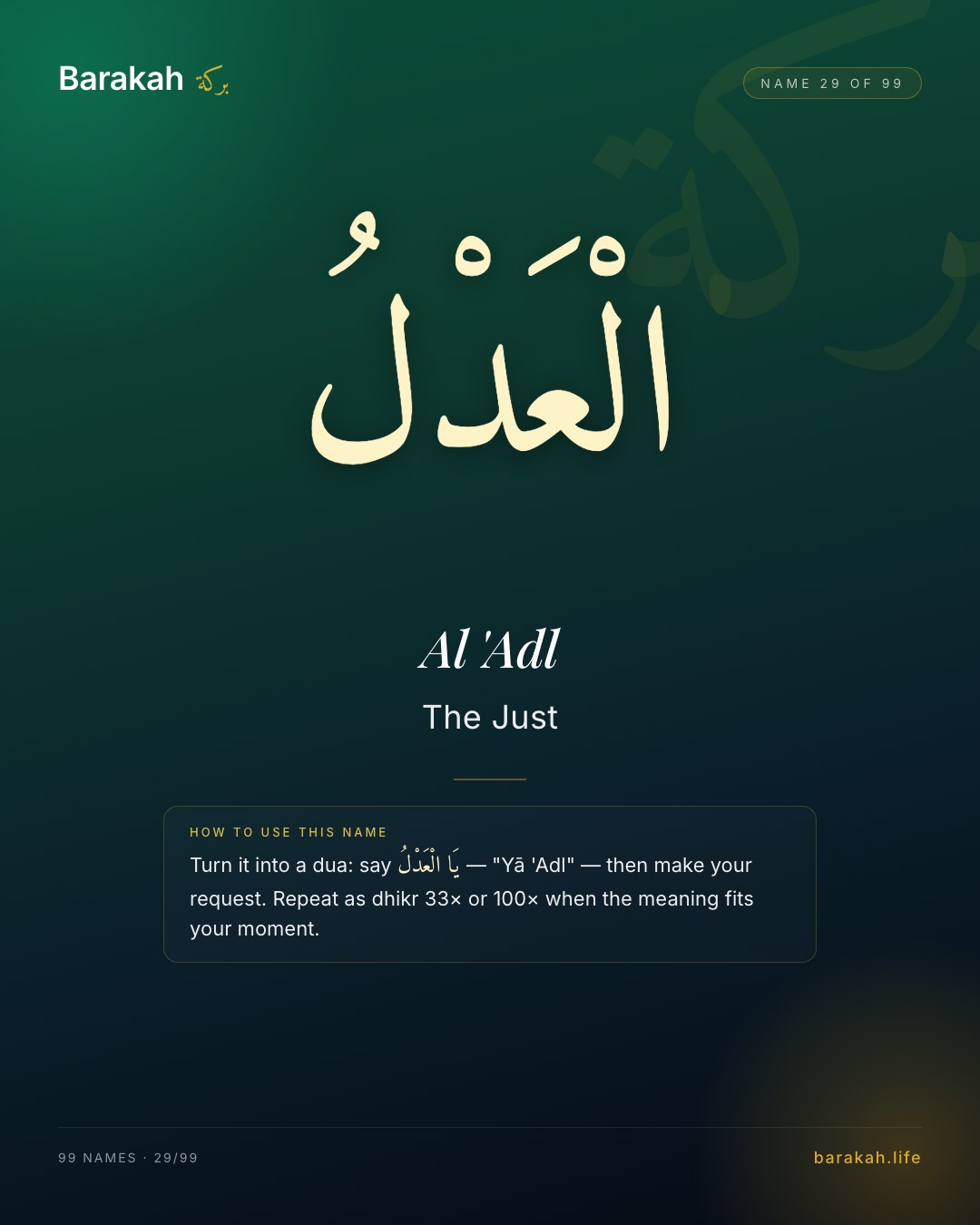
Al 'Adl
The Embodiment of Justice
The Just, the One who is entitled to do what He does.
Allah is Al-Adl, the One who rectifies and sets matters straight in a just and equitable manner. He always delivers absolute justice through His wisdom, without failure. He gives each what he deserves and puts everything in its proper order. Al-Adl is among the names not universally listed by the scholars, but the attribute saturates the Quran and the Sunnah: 'Indeed, Allah does not do injustice, even as much as an atom's weight' (Quran 4:40).
Mentions of Al 'Adl
From the Quran & Hadith
From the root ʿayn-dal-lam (ع د ل), which carries the classical Arabic connotations of acting justly, fairly, and equitably; adjusting properly, making even; straightening, rectifying, and establishing justice or balance; making equal and uniform; turning away from something rightly; and making comfortable with what is right. Al-Adl is not merely one who acts justly: He is justice as an essence.
He forbade injustice for Himself
In the ḥadīth qudsī, Allah declares: 'O My servants, I have forbidden dhulm (oppression) for Myself, and I have made it forbidden amongst you, so do not oppress one another' (Sahih Muslim 2577). Ponder that structure: He can do anything He pleases, yet He forbids injustice for Himself, then commands us to uphold the same standard, to call out and prevent any injustice we may see. Allah does not need the prohibition; we need to know that He took it upon Himself.
Why is there suffering?
The topic of suffering can plant doubt in a believer's heart, and the uneasiness comes from being unable to comprehend the whole of Allah's justice from inside a temporary residence. Everything happening is within His ownership and control, and He is the All-Wise and All-Knowing. Seeing Allah only through the lens of His sovereignty misses His essence; it is more comprehensive to see all His attributes working together: the All-Knower, the All-Wise, the Merciful, and the Embodiment of Justice at once. Allah tells mankind: 'Surely We will test you with a bit of fear and hunger, and loss in wealth and lives and fruits, and give good tidings to the patient' (Quran 2:155). And the Prophet ﷺ said: 'No fatigue, nor disease, nor sorrow, nor sadness, nor hurt, nor distress befalls a Muslim, even if it were the prick he receives from a thorn, but that Allah expiates some of his sins for that' (Sahih al-Bukhari 5641). This life is temporary, every hardship carries ease, and the ledger closes fair: 'Allah does not task any self beyond its capacity' (Quran 2:286).
On the suffering of a child
For every child that passes away, eternal bliss in Paradise is granted. Abu Hurairah (may Allah be pleased with him) affirmed to a bereaved father that small children are the fowls of Paradise: one of them meets his parent, takes hold of his garment, and does not let go until Allah causes parent and child to enter Paradise together (Sahih Muslim 2635). No grief on earth is dismissed in that picture; it is answered.
Inna-llāha lā yadhlimu mithqāla dharrah. Wa in taku ḥasanatan yuḍāʿifhā wa yu'ti min ladunhu ajran ʿadhīmā.
“Indeed, Allah does not do injustice, even as much as an atom's weight; while if there is a good deed, He multiplies it and gives from Himself a great reward.”
Inna-llāha ya'muru bi-l-ʿadli wa-l-iḥsāni wa ītā'i dhi-l-qurbā wa yanhā ʿani-l-faḥshā'i wa-l-munkari wa-l-baghy. Yaʿidhukum laʿallakum tadhakkarūn.
“Indeed, Allah orders justice and good conduct and giving to relatives and forbids immorality and bad conduct and oppression. He admonishes you that perhaps you will be reminded.”
Wa tammat kalimatu rabbika ṣidqan wa ʿadlā. Lā mubaddila li-kalimātih. Wa huwa-s-Samīʿu-l-ʿAlīm.
“And the word of your Lord has been fulfilled in truth and in justice. None can alter His words, and He is the Hearing, the Knowing.”
Yā ayyuha-lladhīna āmanū kūnū qawwāmīna bi-l-qisṭi shuhadā'a lillāhi wa law ʿalā anfusikum awi-l-wālidayni wa-l-aqrabīn. In yakun ghaniyyan aw faqīran fa-llāhu awlā bihimā. Falā tattabiʿu-l-hawā an taʿdilū. Wa in talwū aw tuʿriḍū fa-inna-llāha kāna bimā taʿmalūna khabīrā.
“O you who have believed, be persistently standing firm in justice, witnesses for Allah, even if it be against yourselves or parents and relatives. Whether one is rich or poor, Allah is more worthy of both. So follow not personal inclination, lest you not be just. And if you distort your testimony or refuse to give it, then indeed Allah is ever, with what you do, Acquainted.”
In the ḥadīth qudsī: 'O My servants, I have forbidden oppression for Myself, and I have made it forbidden amongst you, so do not oppress one another.'
Abdullah ibn Amr (may Allah be pleased with him) reported that the Messenger of Allah ﷺ said: 'Verily, those who were just will be, in the presence of Allah, upon pulpits of light, near the right hand of the Merciful. They are those who practiced justice in their judgments and with their families and in all that they did.'
In recognizing Allah as just, how can we bring this virtue into our own life? Instead of seeking confirmation, looking to prove our side as being correct, we can instead seek the truth. That necessitates leaving emotions and ego at the door, embracing our weaknesses, and accepting the possibility of being wrong. Justice as Al-Adl teaches it stands firm even against ourselves, our parents, and our relatives (Quran 4:135). And expand the scope beyond interpersonal dynamics: look within. Are we just to our own souls, treating ourselves with respect, or are we oppressive to ourselves? The standard He forbade for Himself and forbade among us includes the version we practice against the person in the mirror.
Allāhumma-jʿalnā mina-l-muqsiṭīna fī ḥukminā wa ahlinā
O Allah, make us among the just in our judgments and with our families.
- Sahih Muslim 2577
- Sahih al-Bukhari 5641
- Sahih Muslim 1827
Count "Al 'Adl", The Just
Saved as a custom preset in your tasbih. Tap-to-count, hit 33 or 100, and the lifetime total stays with your account.