Fasting and prayer on your period: a guide across the schools
Hayd, istihada and nifas explained gently and in full: why fasts are made up and prayers are not, what to do when your period starts or ends on a fasting day, ghusl, the Quran and du'a, and every point where the four schools differ.
Every month, a Muslim woman steps back from salah and, in Ramadan, from the fast. That part is known. The questions come at the edges: the period that ends ten minutes after Fajr, the brown spotting on day eleven, the bleeding that will not stop, the Quran she was memorising, the fasts that pile up until Sha'ban. This guide answers them in order and shows plainly where the four schools agree and where they differ.
In short
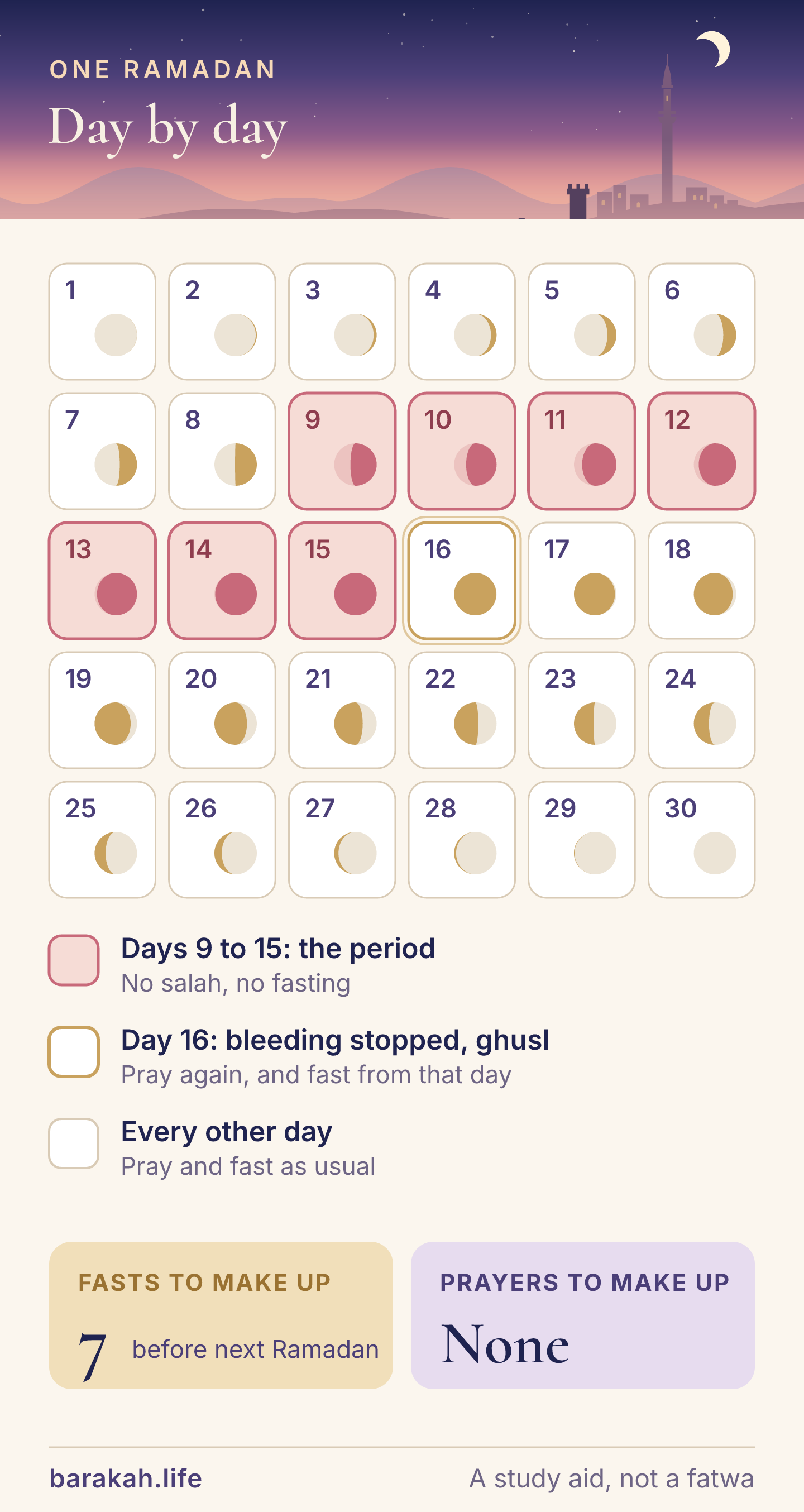
You do not pray or fast during your period (hayd) or the bleeding after childbirth (nifas). Every school agrees.
Missed Ramadan fasts are made up before the next Ramadan; the prayers of those days are never made up.
If the bleeding stops before Fajr, you fast that day, even if your ghusl comes after Fajr. If it starts at any moment before Maghrib, that day is made up.
Bleeding outside the period (istihada) does not stop prayer or fasting; you make wudu for each prayer time or prayer, as your school teaches.
Du'a, dhikr and listening to the Quran stay open throughout. Reciting from memory, and the limits of a period, are where the schools differ, set out side by side below.
This is something Allah has decreed for the daughters of Adam.
Ṣaḥīḥ al-Bukhārī 294, said to ʿĀʾisha when her period began on the way to Hajj and she was crying
He ﷺ did not tell her she had lost her Hajj. He told her to do everything the pilgrims do except the tawaf until she was pure (Ṣaḥīḥ al-Bukhārī 305). That is the shape of everything below: a few acts set aside for a few days, and almost everything else open.
That would happen to us, and we were commanded to make up the fast, and we were not commanded to make up the prayer.
Ṣaḥīḥ Muslim 335c
Al-Nawawī explains the difference by hardship: a week of fasts comes once a year, but a week of prayers is thirty-five, every month. Leaving salah in these days is not a lapse or a sin. It is obeying the same command that, the rest of the month, tells her to pray.
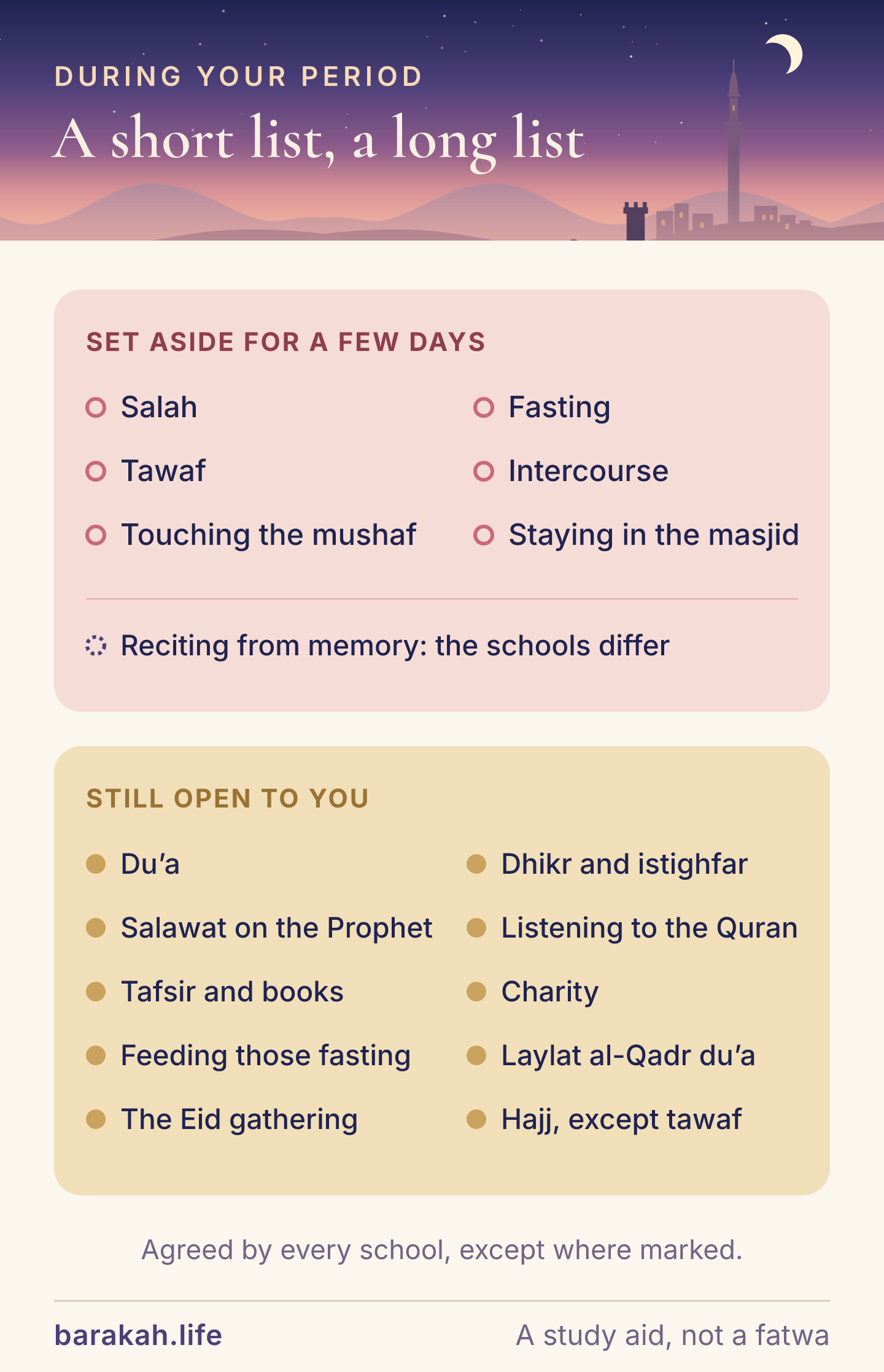
A few other acts wait until she is pure, in every school: tawaf, intercourse (Qur'ān 2:222), touching a mushaf directly, and staying in a masjid. Nothing else changes. She cooks, eats with her family and sleeps beside her husband (Ṣaḥīḥ Muslim 302: “do everything except intercourse”).
Wa yas'alūnaka ʿani l-maḥīḍ, qul huwa adhan fa-ʿtazilu n-nisā'a fi l-maḥīḍ, wa lā taqrabūhunna ḥattā yaṭhurn, fa-idhā taṭahharna fa'tūhunna min ḥaythu amarakumu llāh, inna llāha yuḥibbu t-tawwābīna wa yuḥibbu l-mutaṭahhirīn.
They ask you about menstruation. Say: it is a discomfort, so keep away from intimacy with women during it, and do not approach them until they are pure. When they have cleansed themselves, come to them as Allah has directed you. Allah loves those who turn back to Him, and loves those who keep themselves pure.
Qur'ān 2:222One month, one pattern: the fasts of the period days are owed; the prayers are not.
Three kinds of bleeding: hayd, istihada and nifas
The fiqh separates three things that can look the same on a pad:
Hayd is the monthly period. It is what sets aside salah and fasting.
Istihada is bleeding outside the period: past the maximum, too soon after the last period, or never stopping. For worship it is like a nosebleed: she prays and fasts.
Nifas is the bleeding after childbirth. It has the rulings of hayd, with its own maximum.
Which of the three it is depends on how long the bleeding lasts, how long you were clean before it, and your usual pattern: exactly the numbers on which the schools differ.
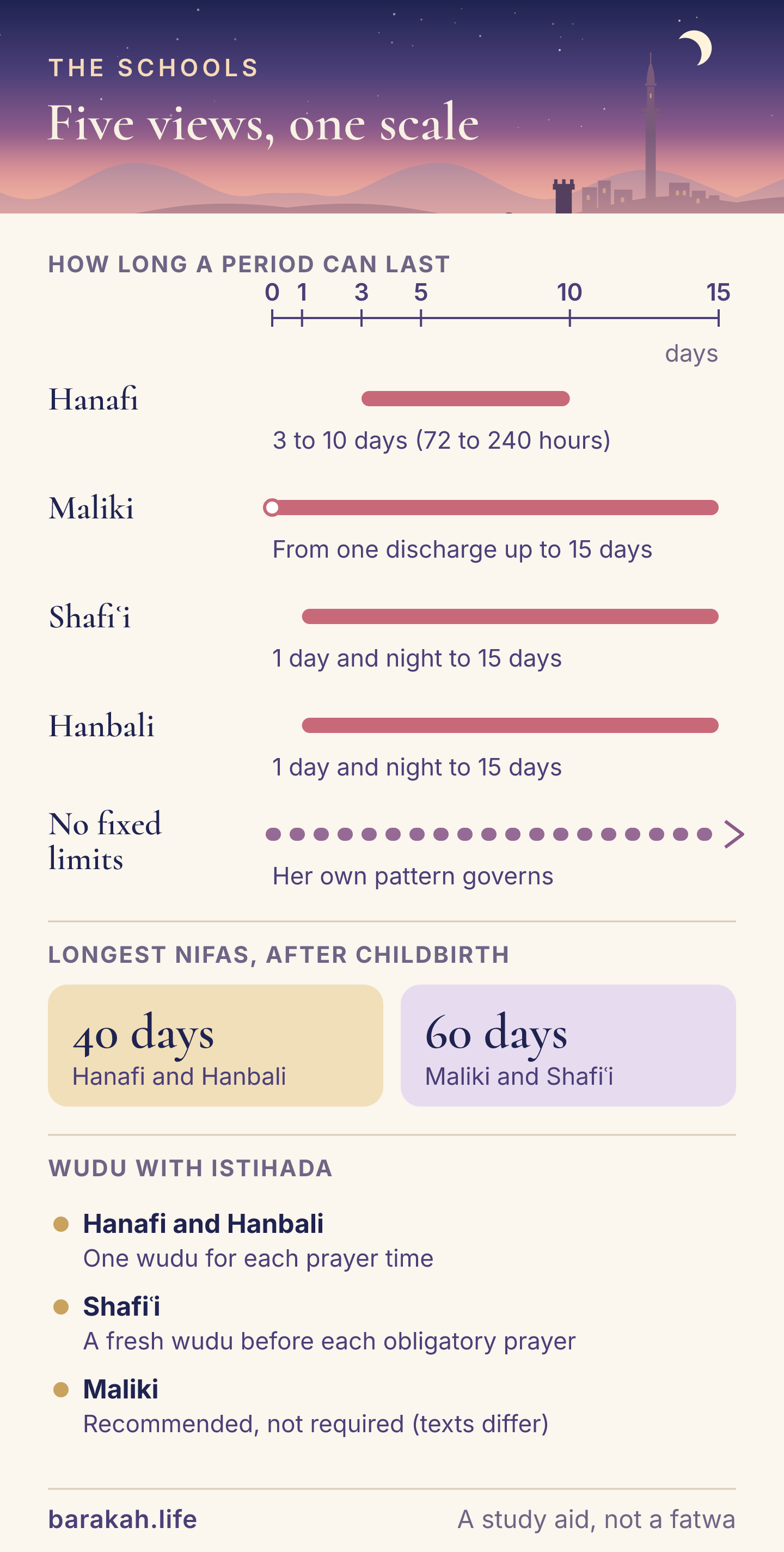
How long can a period last? Each school's limits
The Quran and the authentic Sunnah set no number of days for hayd. The schools derived limits from reports of the Companions and from what women reported of their cycles, and reached different figures. A fifth view, held by Ibn Taymiyya and Ibn ʿUthaymīn, sets no fixed limits and lets a woman's own pattern govern. It is listed separately because it is not the Hanbali school's position, as Ibn ʿUthaymīn himself noted.
View
Shortest
Longest
Clean gap
Hanafi
3 days
10 days
15 days
Maliki
One discharge
15 days
15 days
Shafiʿi
24 hours
15 days
15 days
Hanbali
24 hours
15 days
13 days
No fixed limits
None
None
None
The Hanafi three days are counted as 72 clock hours, and the ten as 240. For worship, the Maliki school counts even a single discharge of blood as a period. The clean gap is the shortest purity that must separate two periods; bleeding that comes sooner is istihada.
The same body, read by five views. Follow the one you were taught; where you were taught none, ask a scholar which to follow.
Your habit (ʿāda)
Your usual length is your habit. One period sets it in the Hanafi, Maliki and Shafiʿi schools; the Hanbali school needs three. When bleeding runs past the maximum:
Hanafi: she goes back to her habit. Days beyond it are istihada, and their prayers are made up.
Maliki: past her longest habit she waits three more days (istiẓhār), never beyond fifteen, then she is pure and prays.
Shafiʿi: the look of the blood first (strong, dark blood against weaker), then her habit.
Hanbali: habit first; the look of the blood only if she has forgotten her habit.
A first period, with no habit yet, has its own rules in each school. If yours is irregular or long, ask a scholar, ideally a woman, with your dates written down.
Clean days in the middle, and brown or yellow discharge
If bleeding stops for a day and returns within the limits, the Hanafi and Shafiʿi schools count the clean day as part of the period, while the Maliki and Hanbali schools treat it as purity: she does ghusl and prays that day. Brown and yellow discharge is part of the period when it comes within the period's days (in the Hanbali school, within her habit days). After the period has clearly ended, it is not, on the words of Umm ʿAṭiyya:
Kunnā lā naʿuddu l-kudrata wa ṣ-ṣufrata baʿda ṭ-ṭuhri shay'ā.
We did not count brown and yellow discharge after purity as anything.
Sunan Abī Dāwūd 307, graded ṣaḥīḥ by al-Albānī (and Ṣaḥīḥ al-Bukhārī 326 without the words “after purity”)
Istihada: bleeding that is not a period
Fāṭima bint Abī Ḥubaysh bled almost constantly and asked the Prophet ﷺ whether she should stop praying. His answer is the foundation of the whole subject:
Dhāliki ʿirqun wa laysat bil-ḥayḍah, fa-idhā aqbalati l-ḥayḍatu fa-daʿi ṣ-ṣalāh, wa idhā adbarat fa-ghtasilī wa ṣallī.
That is a vein, not the period. When the period comes, leave the prayer, and when it goes, bathe and pray.
Ṣaḥīḥ al-Bukhārī 320
So she keeps her period days by her habit or the look of the blood, and outside them she prays, fasts and reads the Quran like any other day. In another narration he told her to leave the prayer “for the days you used to menstruate” (Ṣaḥīḥ al-Bukhārī 325). To Ḥamna bint Jaḥsh, whose heavy bleeding left her no clear pattern, he said to count six or seven days as her period, as women around her did (Jāmiʿ al-Tirmidhī 128, which al-Tirmidhī called ḥasan ṣaḥīḥ and al-Albānī ḥasan).
What changes is wudu, because the bleeding is constant:
View
Wudu with istihada
Hanafi
One wudu for each prayer time, valid until the time ends
Maliki
Recommended before each prayer, not required when the bleeding is present most of the time (some Maliki texts require it)
Shafiʿi
Wash, use a pad, make wudu after the time enters and pray at once; one wudu per obligatory prayer
Hanbali
One wudu for each prayer time
No fixed limits
Per prayer time (Ibn Taymiyya); recommended only, in Ibn ʿUthaymīn's later view
Intimacy during istihada is permitted in the Hanafi, Maliki and Shafiʿi schools; the Hanbali school allows it when there is a need. Bleeding that never really stops is also worth showing a doctor.
Nifas: the bleeding after childbirth
Nifas has no minimum: if the bleeding stops a week after the birth, she does ghusl and prays. Its maximum is 40 days in the Hanafi and Hanbali schools and 60 in the Maliki and Shafiʿi schools; the no-fixed-limits view sets none, but cuts off bleeding that runs on without stopping at forty days. Umm Salama reported that in the Prophet's time women in nifas would sit for forty days (Sunan Abī Dāwūd 311 and Jāmiʿ al-Tirmidhī 139, graded ḥasan). Bleeding past the maximum is istihada.
After a miscarriage, the schools agree the bleeding is nifas once the pregnancy had taken human form; earlier losses are where they differ most, and where a scholar should gently look at your case. Bleeding during pregnancy is istihada in the Hanafi and Hanbali schools; the Maliki and Shafiʿi schools allow it to be a period.
When your period starts or ends on a fasting day
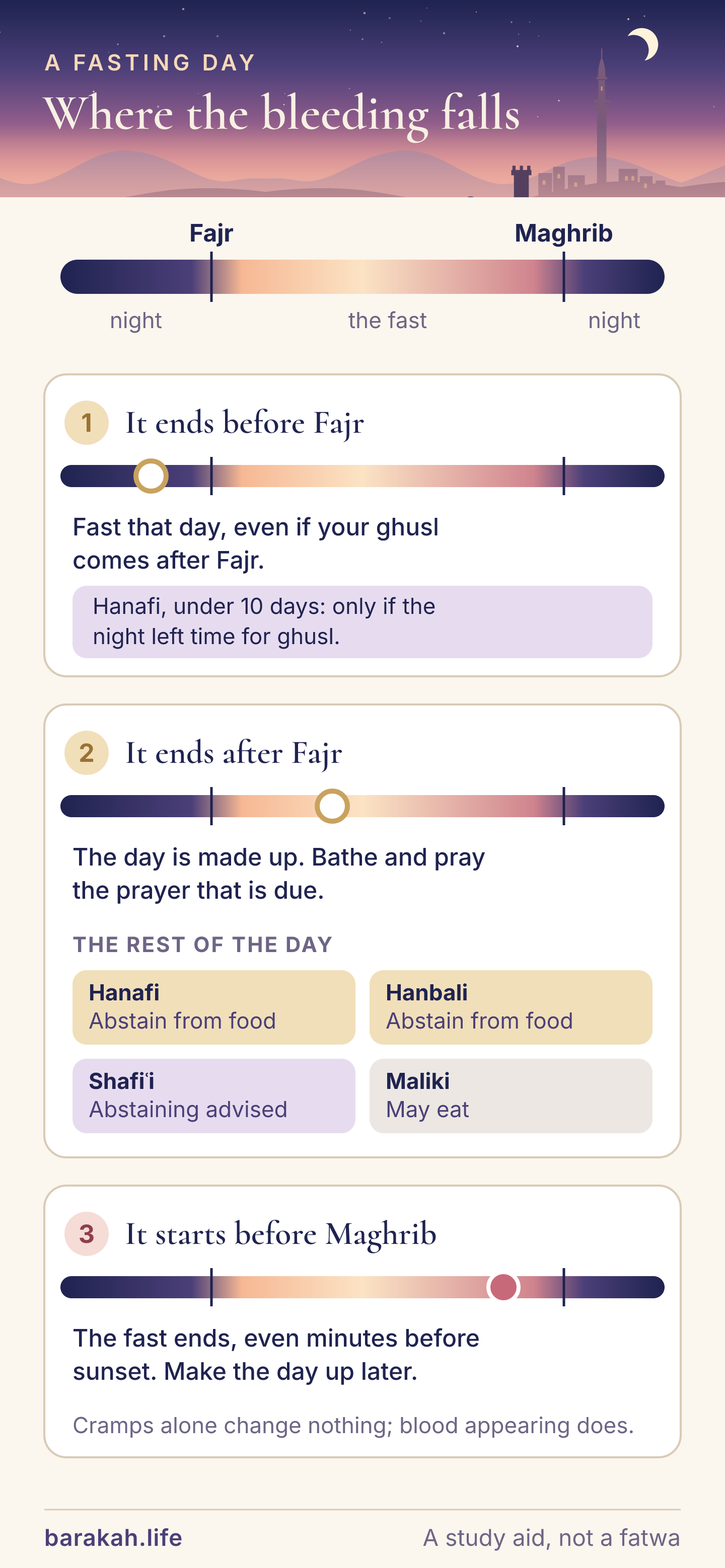
This causes most worry in Ramadan, and most guides skip it. A fast runs from true dawn (Fajr) to sunset (Maghrib); what matters is where the bleeding falls against those two moments.
Where the bleeding falls against Fajr and Maghrib decides the day.
It starts during the day
If bleeding appears at any moment between Fajr and Maghrib, even a minute before sunset, that day's fast ends and is made up later. What counts is blood actually appearing, not cramps or the feeling that it is coming: if it only shows after Maghrib, the fast was complete.
It ends before Fajr
She makes the intention and fasts that day, even if she could not do ghusl until after Fajr. The Maliki, Shafiʿi and Hanbali schools say so plainly: the ghusl is for the prayer, not for the fast (Dar al-Iftaʾ al-Miṣriyya, fatwa 18376). The Hanafi school adds a condition. If the period ended at its full ten days, she fasts regardless. If it ended earlier, the fast is valid only if enough of the night remained for ghusl (Birgivī and Ibn ʿĀbidīn add time to begin the prayer with “Allāhu akbar”). If it did not, she abstains that day and makes it up.
It ends after Fajr
The day does not count as a fast and is made up. She does ghusl and prays the prayer that is due. What she does with the rest of the day is where the schools differ:
View
Rest of the day
Hanafi
She abstains from food and drink until Maghrib, out of respect for the month (al-Hidāya)
Hanbali
She abstains (the established position of the school); a narration from Imam Aḥmad, preferred by Ibn ʿUthaymīn, does not require it
Shafiʿi
Abstaining is recommended, not required (al-Nawawī)
Maliki
She may eat for the rest of the day (al-Risāla)
Whichever view she follows, she does not owe a penalty for that day beyond making it up,.
Ghusl at the end of your period, and the prayer then due
A period ends with one of two signs: a white discharge, or complete dryness when a piece of cotton is checked. Women in Madinah used to send ʿĀʾisha cotton with yellow traces to ask whether they could pray, and she would tell them:
Muwaṭṭaʾ Mālik, Book 2, Hadith 97, a report from ʿĀʾisha (graded ṣaḥīḥ); al-Bukhārī cites it in the heading of a chapter
Once you see the sign, ghusl is due, and with it the prayer of the time you are in. Do not leave it for a more convenient shower and lose a prayer.
How to do the ghusl
The Prophet ﷺ taught Asmāʾ of the Anṣār the bath after a period, and ʿĀʾisha praised the Anṣār women whose shyness did not stop them learning their religion:
Pour water over your head three times, working it into the roots of the hair.
Wash the whole body, right side first, leaving no dry spot: the navel, behind the ears, under the arms.
Freshen the area with cotton touched with fragrance (Ṣaḥīḥ al-Bukhārī 314), a sunnah, not a condition.
What makes the ghusl valid is water reaching the whole body and the roots of the hair. The Hanafi school also requires rinsing the mouth and nose, and the Maliki school requires rubbing the body (dalk); the intention is required in every school except the Hanafi, which makes it a sunnah. Braids need not be undone if the water reaches the roots (Ṣaḥīḥ Muslim 330, from Umm Salama); the Hanbali school recommends undoing them for this ghusl in particular.
Which prayers do I owe?
Two moments matter: a period that ends before a prayer's time runs out, and one that begins after a prayer's time has started but before you prayed it.
View
Ends before the time runs out
Begins after the time started
Hanafi
Pray it if time remained for ghusl and to begin it (at the ten-day maximum, to begin it alone). No joined prayer
Not owed
Maliki
Pray it if time remained, after ghusl, for one rak'ah. With time for five rak'ahs before sunset, Dhuhr too; four before Fajr, Maghrib too
Not owed, as long as its time had not run out
Shafiʿi
Pray it if time remained to begin it, and Dhuhr with Asr, Maghrib with Isha
Owed if enough time had passed to pray it
Hanbali
As the Shafiʿi school: that prayer and the one joined before it
Owed if time to begin it had passed
No fixed limits
Time for one rak'ah; Ibn Taymiyya adds the joined prayer, Ibn ʿUthaymīn does not
Ibn ʿUthaymīn: owed after a rak'ah's time; Ibn Taymiyya: not owed
An example: the bleeding stops twenty minutes before Maghrib. Every school has her bathe and pray Asr. The Shafiʿi and Hanbali schools add Dhuhr, because the two can be joined; the Maliki school too if the ghusl leaves time for five rak'ahs; the Hanafi school does not. Any such prayer she missed goes on her make-up list.
Quran, du'a and dhikr on your period
A short list is set aside. The long list is still yours.
Du'a, dhikr, istighfar, salawat on the Prophet ﷺ, and listening to the Quran are open by agreement. So is closeness to the Quran itself:
Kāna yattaki'u fī ḥijrī wa ana ḥā'iḍ, thumma yaqra'u l-Qur'ān.
He would lean in my lap while I was menstruating, and recite the Quran.
Ṣaḥīḥ al-Bukhārī 297, from ʿĀʾisha
Reciting it herself is where the schools part ways:
View
Reciting the Quran during a period
Hanafi
Not recited, even less than a verse, with the intention of recitation. Quranic du'as and dhikr said as du'a are fine
Maliki
May recite from memory while the bleeding continues; once it stops, not until ghusl
Shafiʿi
Not recited, even part of a verse; Quranic words said as dhikr are fine
Hanbali
Not a full verse or more; part of a verse and dhikr phrases are fine
No fixed limits
Ibn Taymiyya permits it, noting the report that forbids it is weak (Jāmiʿ al-Tirmidhī 131). Ibn ʿUthaymīn advises abstaining except for a need such as teaching or revision
So in every school you can say “Rabbanā ātinā fi d-dunyā ḥasanah” as your own du'a, and Bismillah before you eat; for Quranic adhkar such as Āyat al-Kursī, follow your school's rule above. A hafidha who is revising should ask her teacher; the Maliki school and the no-fixed-limits view give the most room.
Touching a printed mushaf directly is avoided in the four schools (the Maliki school excepts a woman teaching or learning). Many contemporary scholars do not treat a phone as a mushaf, so touching the screen is not touching a mushaf, but that does not change the ruling on reciting.
Ramadan on your period: a plan
Most women miss five to ten days of Ramadan. Those days can still be among the best of the month.
Keep the nights. Wake for the last third, make du'a, sit with the adhkar. A period on the odd nights of the last ten does not shut you out of Laylat al-Qadr. The du'a the Prophet ﷺ taught ʿĀʾisha for that night needs no prayer and no purity:
O Allah, You are the One who pardons, and You love to pardon, so pardon me.
Sunan Ibn Mājah 3850, graded ṣaḥīḥ by al-Albānī (also Jāmiʿ al-Tirmidhī 3513)
Stay with the Quran. Listen to the juz you would have recited, read a translation or tafsir, and in the Maliki school or the no-fixed-limits view recite from memory.
Feed the people who are fasting. “Whoever gives a fasting person food to break the fast has the same reward, without anything lessened from theirs” (Jāmiʿ al-Tirmidhī 807, graded ṣaḥīḥ). The kitchen at iftar is worship.
Go to the Eid gathering. The Prophet ﷺ told women on their periods to come out for Eid, join in the good and the du'a of the Muslims, and keep back from the prayer place (Ṣaḥīḥ al-Bukhārī 324).
Plan ahead. Logged dates show which nights of the last ten may fall in your period, and the count of fasts to repay is ready when Ramadan ends.
What about pills to delay my period?
Ibn Qudāma reports that Imam Aḥmad saw no harm in a woman taking a known medicine that stops her period (al-Mughnī, vol. 1, p. 266), and Dar al-Iftaʾ al-Miṣriyya permits it where a doctor confirms no harm. Ibn ʿUthaymīn discouraged it, citing doctors who warned of side effects. If you consider it, decide with your doctor. Spotting while on such pills is judged by the colour rules above.
Making up your missed fasts before the next Ramadan
Fa-ʿiddatun min ayyāmin ukhar, yurīdu llāhu bikumu l-yusra wa lā yurīdu bikumu l-ʿusra wa li-tukmilu l-ʿiddah.
Then an equal number of other days. Allah wants ease for you, not hardship, and wants you to complete the count.
Qur'ān 2:185 (part)
The verse names the sick and the traveller; ʿĀʾisha's answer to Muʿādha gives the same rule to the menstruating woman. You have the whole year, and ʿĀʾisha herself repaid hers late in it:
Kāna yakūnu ʿalayya ṣ-ṣawmu min Ramaḍān, fa-mā astaṭīʿu an aqḍiya illā fī Shaʿbān.
I would owe fasts from Ramadan, and I could not make them up except in Sha'ban.
Ṣaḥīḥ al-Bukhārī 1950
Any day except the two Eids will do, and the days need not be in a row. Sooner is better: nobody is promised Sha'ban.
If the next Ramadan arrives first without an excuse such as illness, pregnancy or nursing, the Maliki, Shafiʿi and Hanbali schools add a fidya: feeding one poor person for each day, on top of the make-up. The Hanafi school asks only for the make-up.
The six days of Shawwal reward those who “fast Ramadan and then follow it with six” (Ṣaḥīḥ Muslim 1164). Ibn ʿUthaymīn held that the make-up should come first for that promise; scholars of other schools allow the six first. If you can, repay first and the question disappears.
Prayers are different. None of your period's prayers are owed. Only a prayer that was due at the edges, as in the table above, or days of istihada mistaken for a period, need making up.
How the For sisters tracker applies your school's rules
All of this is a lot to hold in your head while tired and cramping. So we built the For sisters space in the Barakah Life app on this same rulebook.
You choose your view: Hanafi, Maliki, Shafiʿi, Hanbali or no fixed limits. Choose “I'm not sure” and it shows every school side by side.
It reads each day in your school as period, istihada or nifas, with the source for every reading.
It tells you when ghusl became due and which prayers are then owed, using your own prayer times.
It keeps one count of the fasts you owe, and the salah tracker does not break your streak on days your school excuses.
Reminders are discreet, worded so they never say what is being tracked.
It is free and private. Your log is never shown to anyone, never used for ads, never sent to AI and kept out of analytics. If you sign in, the dates are kept in your own account so they survive a new phone; finer details like flow stay on your phone.
Try it in Barakah Life. Open For sisters in the Barakah Life app, choose your school, and log your dates. It is a tool to help you, not a fatwa: for your own situation, ask a knowledgeable scholar, ideally a woman. New to all of this? Start with the shorter beginner's guide on the New Muslim Path.
Questions people ask
Can you fast on your period in Islam?
No. A fast kept during a period or the bleeding after childbirth is not valid, in every school. You eat and drink normally on those days and make up each missed Ramadan fast before the next Ramadan.
Do I have to make up the prayers I missed on my period?
No. By agreement, the prayers of the period days are lifted, not deferred. ʿĀʾisha said women were commanded to make up the fast and not the prayer (Ṣaḥīḥ Muslim 335).
My period ended before Fajr but I did ghusl after Fajr. Is my fast valid?
Yes, in the Maliki, Shafiʿi and Hanbali schools: the ghusl is for prayer, not for the fast. In the Hanafi school it is valid if the period ended at ten days, or if enough of the night was left for ghusl.
My period ended after Fajr in Ramadan. Can I fast that day?
The day does not count and is made up. Do ghusl and pray. For the rest of the day the Hanafi and Hanbali schools ask you to abstain from food, the Shafiʿi school recommends it, and the Maliki school allows eating.
Can I read the Quran on my period?
You can always listen to it, read its translation and say its du'as as du'a. Reciting it from memory is not allowed in the Hanafi, Shafiʿi and Hanbali schools, is allowed in the Maliki school while the bleeding continues, and was permitted by Ibn Taymiyya.
Can I make du'a on my period?
Yes, in every school. Du'a, dhikr, istighfar and salawat on the Prophet ﷺ stay open throughout, including on Laylat al-Qadr.
What is the difference between a period and istihada?
A period (hayd) falls within your school's limits and sets aside prayer and fasting. Istihada is bleeding outside those limits: you pray and fast, with wudu for each prayer time or prayer as your school teaches.
Is brown discharge part of my period?
Within your period's days, yes (in the Hanbali school, within your usual days). After you are clearly pure, brown or yellow discharge is not a period (Sunan Abī Dāwūd 307).
A closing word
When the Companions asked about menstruation, Allah answered in His Book, and the Prophet ﷺ answered with patience, even through his shyness. Asking about these rulings is part of that tradition. Keep the nights, keep your tongue busy with remembrance, repay the days before Sha'ban runs out, and know that a woman who leaves her prayer because Allah told her to has not left Allah.
Sunan Abī Dāwūd 307, 311; Jāmiʿ al-Tirmidhī 128, 131, 139, 807, 3513; Sunan Ibn Mājah 3850; Muwaṭṭaʾ Mālik, Book 2, Hadith 97. Gradings as recorded by al-Tirmidhī, al-Albānī and others on sunnah.com.
Hanafi: al-Marghīnānī, al-Hidāya, vol. 1, pp. 32 to 35; Ibn ʿĀbidīn, Radd al-Muḥtār, vol. 1, pp. 282 to 307, and Manhal al-Wāridīn; Birgivī, Dhakhr al-Mutaʾahhilīn; al-Shurunbulālī, Marāqī al-Falāḥ.
Maliki: Khalīl, al-Mukhtaṣar; al-Dardīr, al-Sharḥ al-Kabīr, with al-Dasūqī's Ḥāshiya, vol. 1, pp. 115 to 186; Ibn Abī Zayd, al-Risāla; Ibn Rushd, Bidāyat al-Mujtahid.
Shafiʿi: al-Nawawī, Minhāj al-Ṭālibīn and Rawḍat al-Ṭālibīn; Ibn al-Naqīb, ʿUmdat al-Sālik (Reliance of the Traveller, e10 to e13); Bāʿishn, Bushrā al-Karīm.
Hanbali: al-Ḥajjāwī, Zād al-Mustaqniʿ; al-Buhūtī, al-Rawḍ al-Murbiʿ and Kashshāf al-Qināʿ, vol. 1, pp. 478 to 518; Ibn Qudāma, al-Mughnī, vol. 1, pp. 224 to 266.
Ibn Taymiyya, Majmūʿ al-Fatāwā 19/237 to 240 and 26/191; Ibn ʿUthaymīn, Risāla fi l-Dimāʾ al-Ṭabīʿiyya (English translation) and al-Sharḥ al-Mumtiʿ, vols. 1 and 2.
Consensus: al-Nawawī, Sharḥ Ṣaḥīḥ Muslim 4/26; Ibn al-Mundhir, al-Ijmāʿ, nos. 28 to 31.
Dar al-Iftaʾ al-Miṣriyya fatwas 18376 (purity before Fajr), 20194 (abstaining after purity in the day) and 1250 (medicine to delay a period); Islamweb fatwa 6674.
This guide summarises the positions of the schools as recorded in the sources above. It is a study aid, not a fatwa. Your own cycle can raise questions no article can settle; where it does, ask a knowledgeable scholar you trust, ideally a woman.
Tagswomenmenstruationhaydfastingramadanfiqh
Pass it on
Know someone who needs this today? Send it to them.
“Whoever guides someone to good has a reward like the one who does it.” Sahih Muslim 1893