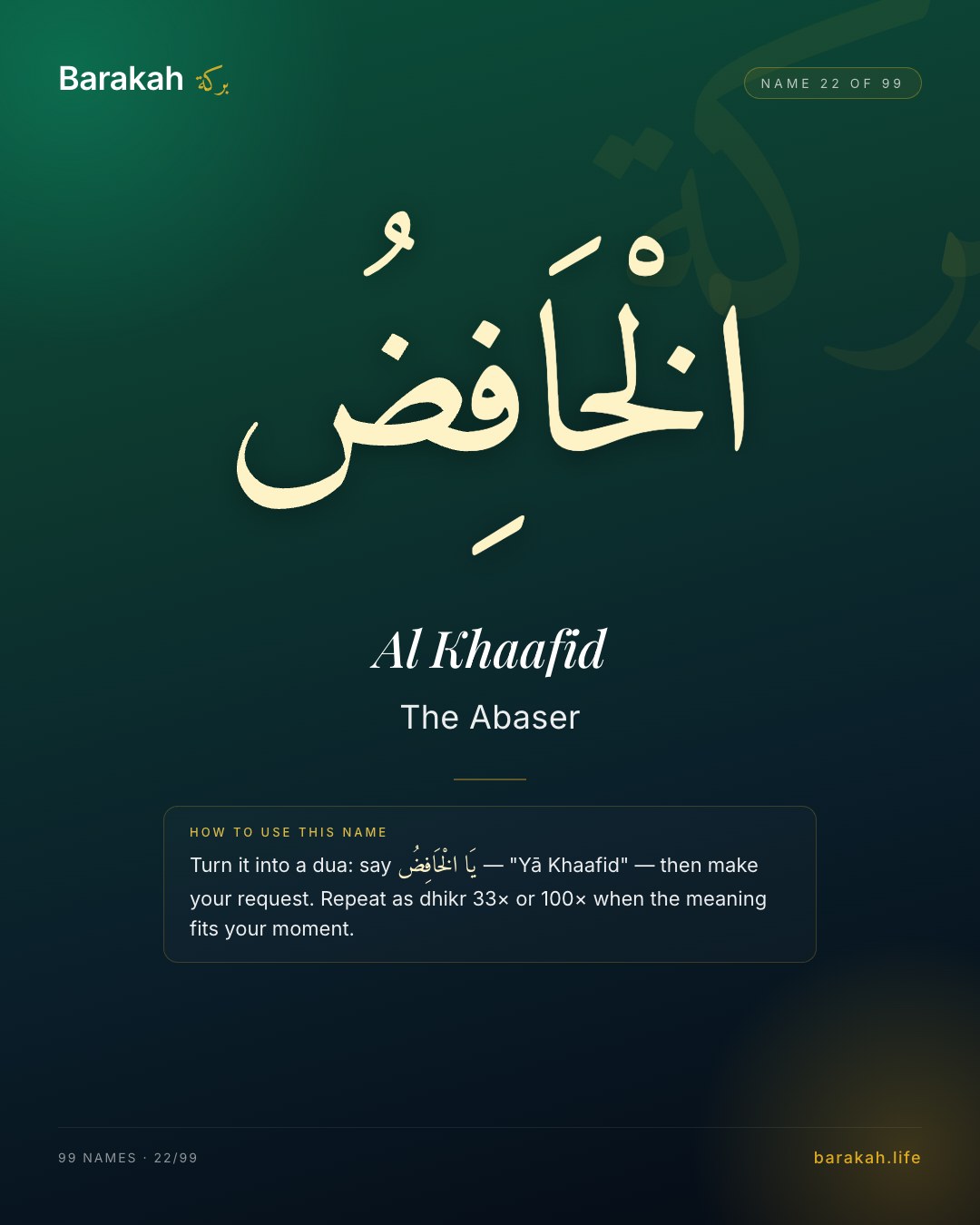
Al Khaafid
The Reducer
The Lowerer, the Reducer, the Abaser.
Al-Khaafid is the One who lowers whoever He wills. This attribute describes how Allah abases the proud, the oppressors, and the rebels. He chooses the ones to be humbled, softened, or made gentle, and He decides to raise or weaken people, to give them honor, or to take it away.
Mentions of Al Khaafid
From the Quran & Hadith
From the root kha-fa-dad (خ ف ض), which carries the classical Arabic connotations of lowering, weakening, and depressing; making humble and abasing; relaxing, diminishing, and subduing; and making gentle, tranquil, easy to deal with, softening, and facilitating. The same root that abases the proud also softens and gentles: what Allah lowers, He lowers with wisdom.
Among the discussed names
Scholars have differed on what qualifies as a Name of Allah: of the 99, most are explicitly mentioned in the Quran, and there is no single agreed-upon list for the remainder. Al-Khaafid is among those excluded by some scholars, including Ibn Uthaymeen, Ibn Hazm, and Ibn Hajar, though it is commonly recognized in most books of Asmaul Husna. Its meaning, in any case, is described by the Quran itself: khaafiḍatun raafiʿah, 'it will bring down some and raise up others' (Quran 56:3), said of the Final Hour.
The downfall of Firaun
The best-known example of Allah debasing someone is Firaun, the tyrant of the story of Musa (peace be upon him). Despite immense power and being the Pharaoh of Egypt, he sought after Musa to kill or imprison him, and Allah protected Musa by parting the sea: 'Then We inspired to Musa, Strike with your staff the sea, and it parted, and each portion was like a great towering mountain' (Quran 26:63). Firaun pursued, and the Quran says simply: 'Then We drowned the others' (26:66). Of his end Allah says: 'So today We will save you in body that you may be to those who succeed you a sign. And indeed, many among the people, of Our signs, are heedless' (Quran 10:92).
Lowered in wealth, lowered in poverty
The Quran warns against reading fortune as favour: 'And as for man, when his Lord tries him and is generous to him and favors him, he says, My Lord has honored me. But when He tries him and restricts his provision, he says, My Lord has humiliated me' (Quran 89:15-16). Both readings are wrong. In wealth, the test is whether the person forgets his Lord, becomes arrogant and ungrateful, or abuses power. In poverty, the test may be of patience, of contentment in scarcity, of whether faith holds. Having wealth is not a sign of Allah's approval, and lacking it is not a sign of His displeasure: both are tests for the believer.
Khāfiḍatun rāfiʿah.
“It will bring down some and raise up others.”
Laqad khalaqna-l-insāna fī aḥsani taqwīm. Thumma radadnāhu asfala sāfilīn. Illa-lladhīna āmanū wa ʿamilu-ṣ-ṣāliḥāti fa-lahum ajrun ghayru mamnūn.
“We have certainly created man in the best of stature; then We return him to the lowest of the low, except for those who believe and do righteous deeds, for they will have a reward uninterrupted.”
Fa-amma-l-insānu idhā ma-btalāhu rabbuhu fa-akramahu wa naʿʿamahu fa-yaqūlu rabbī akraman. Wa ammā idhā ma-btalāhu fa-qadara ʿalayhi rizqahu fa-yaqūlu rabbī ahānan.
“And as for man, when his Lord tries him and is generous to him and favors him, he says, My Lord has honored me. But when He tries him and restricts his provision, he says, My Lord has humiliated me.”
Salamah bin Ubaidullah bin Mihsan al-Ansari narrated from his father that the Messenger of Allah ﷺ said: 'Whoever among you wakes up physically healthy, feeling safe and secure within himself, with food for the day, it is as if he acquired the whole world.'
In the tafsir of Surah al-Fajr, Maududi observes something subtle: the believer's reaction when his financial situation worsens, 'my Lord has humiliated me,' can reveal a hidden message or wrongful thinking the person may have been blinded to. The ego was preoccupied with attaining worldly success and identified with it too deeply, forgetting that having wealth is not a sign of Allah's approval and that a lack is not a sign of His displeasure. We need to remind ourselves that sometimes this is enough: to wake up healthy, safe, and fed for the day is, by the Prophet's ﷺ measure, to have acquired the whole world. Anything Allah gives beyond it is a gift. And before the proud in us objects, remember whose Names these are: the One who lowered Firaun mid-triumph can soften any height we imagine we built ourselves.
Allāhumma-khfiḍ ʿannī kibrī wa-rfaʿnī bi-ṭāʿatik
O Allah, lower my pride and raise me through obedience to You.
- Sunan Ibn Majah 4141
- Quran 10:92
Count "Al Khaafid", The Abaser
Saved as a custom preset in your tasbih. Tap-to-count, hit 33 or 100, and the lifetime total stays with your account.